
下一代免疫疗法:控制肺癌
The next generation of immunotherapy: keeping lung cancer in check.
作者信息
Somasundaram Ashwin, Burns Timothy F
机构信息
University of Pittsburgh Medical Center, Pittsburgh, PA, USA.
Division of Hematology-Oncology, Department of Medicine, University of Pittsburgh, Hillman Cancer Center Research Pavilion, 5117 Centre Avenue, Pittsburgh, PA, 15213-1863, USA.
出版信息
J Hematol Oncol. 2017 Apr 24;10(1):87. doi: 10.1186/s13045-017-0456-5.
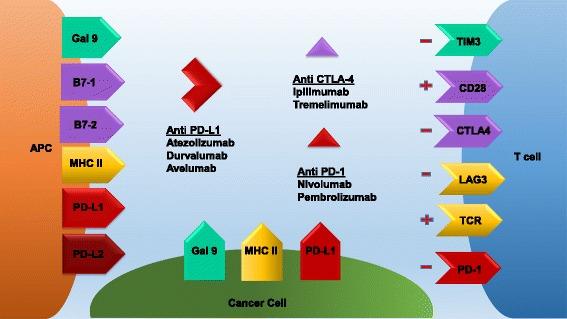
Lung cancer is the deadliest malignancy with more cancer deaths per year than the next three cancers combined. Despite remarkable advances in targeted therapy, advanced lung cancer patients have not experienced a significant improvement in mortality. Lung cancer has been shown to be immunogenic and responsive to checkpoint blockade therapy. Checkpoint signals such as CTLA-4 and PD-1/PD-L1 dampen T cell activation and allow tumors to escape the adaptive immune response. Response rates in patients with pretreated, advanced NSCLC were much higher and more durable with PD-1 blockade therapy compared to standard-of-care, cytotoxic chemotherapy. Therefore, PD-1 inhibitors such as nivolumab and pembrolizumab were rapidly approved for both squamous and nonsquamous lung cancer in the pretreated population. The advent of these new therapies have revolutionized the treatment of lung cancer; however, the majority of NSCLC patients still do not respond to PD-1/PD-L1 inhibition leaving an unmet need for a large and growing population.Immunotherapy combinations with chemotherapy, radiation therapy, or novel immunomodulatory agents are currently being examined with the hope of achieving higher response rates and improving overall survival rate. Chemotherapy and radiation therapy has been theorized to increase the release of tumor antigen leading to increased responses with immunotherapy. However, cytotoxic chemotherapy and radiation therapy may also destroy actively proliferating T cells. The correct combination and order of therapy is under investigation. The majority of patients who do respond to immunotherapy have a durable response attributed to the effect of adaptive immune system's memory. Unfortunately, some patients' tumors do progress afterward and investigation of checkpoint blockade resistance is still nascent.This review will summarize the latest efficacy and safety data for early and advanced NSCLC in both the treatment-naïve and pretreated settings. The emerging role of immunotherapy for the treatment of small cell lung cancer and malignant mesothelioma will also be discussed.
肺癌是最致命的恶性肿瘤,每年因癌症死亡的人数比接下来三种癌症的死亡人数总和还多。尽管靶向治疗取得了显著进展,但晚期肺癌患者的死亡率并未得到显著改善。肺癌已被证明具有免疫原性,并且对检查点阻断疗法有反应。诸如CTLA-4和PD-1/PD-L1等检查点信号会抑制T细胞活化,使肿瘤能够逃避适应性免疫反应。与标准的细胞毒性化疗相比,经预处理的晚期非小细胞肺癌患者接受PD-1阻断疗法后的缓解率更高且更持久。因此,纳武单抗和派姆单抗等PD-1抑制剂在经预处理的人群中迅速被批准用于治疗鳞状和非鳞状肺癌。这些新疗法的出现彻底改变了肺癌的治疗方式;然而,大多数非小细胞肺癌患者对PD-1/PD-L1抑制仍无反应,这使得大量且不断增加的人群的需求未得到满足。目前正在研究免疫疗法与化疗、放疗或新型免疫调节剂的联合使用,以期获得更高的缓解率并提高总生存率。从理论上讲,化疗和放疗可增加肿瘤抗原的释放,从而增强免疫疗法的反应。然而,细胞毒性化疗和放疗也可能破坏活跃增殖的T细胞。目前正在研究正确的治疗组合和顺序。大多数对免疫疗法有反应的患者会有持久的反应,这归因于适应性免疫系统记忆的作用。不幸的是,一些患者的肿瘤随后仍会进展,对检查点阻断耐药性的研究仍处于初期阶段。本综述将总结初治和经预处理情况下早期和晚期非小细胞肺癌的最新疗效和安全性数据。还将讨论免疫疗法在治疗小细胞肺癌和恶性间皮瘤方面的新兴作用。
 Zotero 插件