
在有心血管疾病风险的日本受试者中,端粒长度较短与肾功能损害有关。
Short telomere length is associated with renal impairment in Japanese subjects with cardiovascular risk.
作者信息
Eguchi Kazuo, Honig Lawrence S, Lee Joseph H, Hoshide Satoshi, Kario Kazuomi
机构信息
Division of Cardiovascular Medicine, Department of Medicine, Jichi Medical University, Tochigi, Japan.
Department of Neurology, Columbia University College of Physicians & Surgeons, New York, NY, United States of America.
出版信息
PLoS One. 2017 Apr 25;12(4):e0176138. doi: 10.1371/journal.pone.0176138. eCollection 2017.
INTRODUCTION
Short telomere length has been suggested to be associated with atherosclerotic changes in Western populations. We examined the relationships between leukocyte telomere length and cardiovascular and renal function in a Japanese cohort.
PARTICIPANTS AND METHODS
We enrolled 770 subjects who each had at least one cardiovascular risk factor. The mean age was 59.5 ± 12.2 years; mean BMI was 25.1 ± 4.6 kg/m2. We measured leukocyte telomere length (LTL) by quantitative PCR (T/S ratio), and measured other biomarkers from blood and urine samples. In addition, we assessed surrogate markers of arterial stiffness, cardiovascular organ damage and kidney function, including flow-mediated vasodilation (FMD), pulse wave velocity (PWV), carotid artery augmentation index (CAAI), and urinary albumin creatinine ratio (UACR) and eGFR.
RESULTS
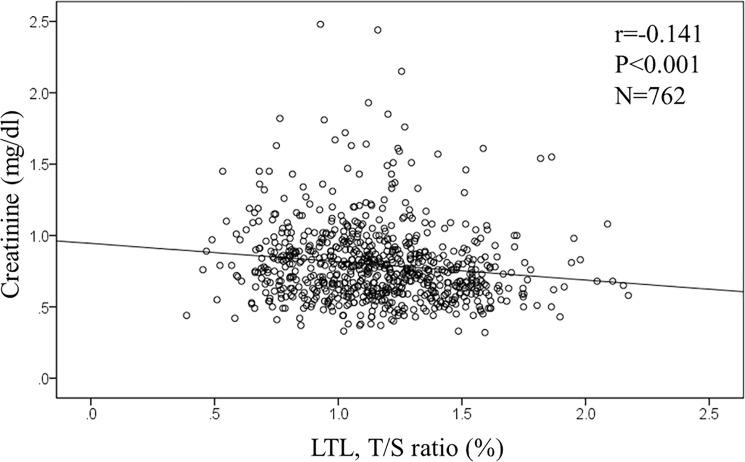
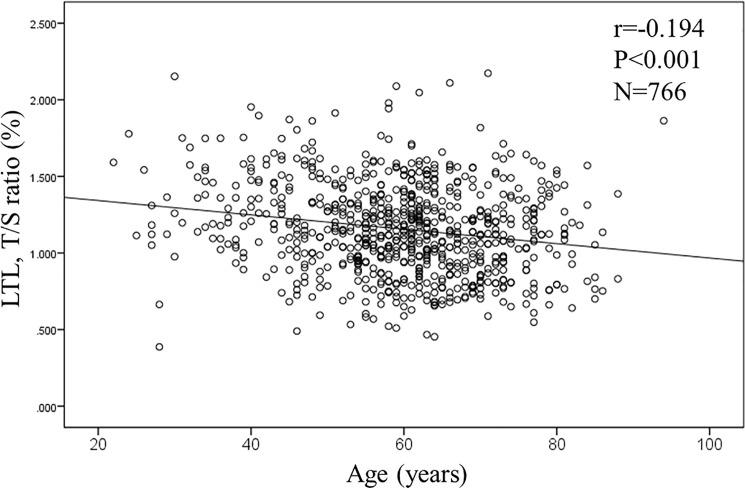
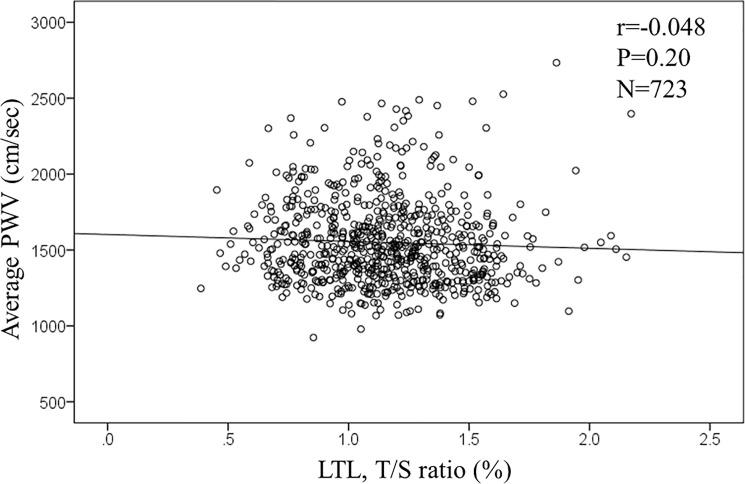
Leukocyte telomere length (T/S ratio) was inversely associated with age (r = -0.194, P<0.001), and was lower in men (1.13 ± 0.29%) than in women (1.20 ± 0.31%, P = 0.002). T/S ratio was positively associated with BMI in women (r = 0.11, P = 0.047), but not in men. LTL did not show a significant relationship to cardiovascular surrogate markers, including arterial stiffness, FMD, and PWV, but did show some relationship to CAAI, which was inversely associated with T/S ratio only in men (r = -0.159, P = 0.015). LTL did show a significant positive association with renal function measured by eGFR (r = 0.16, P<0.001) both in men and women.
CONCLUSIONS
In this Japanese sample of persons with increased cardiovascular risk, telomere length showed a relationship of longer telomere length to better renal function, but did not overall show convincing association with cardiovascular measures of arterial stiffness and target organ damage.
引言
在西方人群中,短端粒长度被认为与动脉粥样硬化改变有关。我们在一个日本队列中研究了白细胞端粒长度与心血管和肾功能之间的关系。
参与者与方法
我们招募了770名至少有一项心血管危险因素的受试者。平均年龄为59.5±12.2岁;平均体重指数为25.1±4.6kg/m²。我们通过定量PCR(T/S比值)测量白细胞端粒长度(LTL),并从血液和尿液样本中测量其他生物标志物。此外,我们评估了动脉僵硬度、心血管器官损伤和肾功能的替代标志物,包括血流介导的血管舒张(FMD)、脉搏波速度(PWV)、颈动脉增强指数(CAAI)以及尿白蛋白肌酐比值(UACR)和估算肾小球滤过率(eGFR)。
结果
白细胞端粒长度(T/S比值)与年龄呈负相关(r = -0.194,P<0.001),男性(1.13±0.29%)低于女性(1.20±0.31%,P = 0.002)。T/S比值在女性中与体重指数呈正相关(r = 0.11,P = 0.047),但在男性中无此相关性。LTL与包括动脉僵硬度、FMD和PWV在内的心血管替代标志物无显著关系,但与CAAI有一定关系,CAAI仅在男性中与T/S比值呈负相关(r = -0.159,P = 0.015)。LTL在男性和女性中均与通过eGFR测量的肾功能呈显著正相关(r = 0.16,P<0.001)。
结论
在这个心血管风险增加的日本样本中,端粒长度显示出端粒长度越长肾功能越好的关系,但总体上与动脉僵硬度和靶器官损伤的心血管测量指标没有令人信服的关联。
 Zotero 插件