
通过对古代单倍型块进行全基因组扫描揭示与表型相关的功能差异。
Revealing phenotype-associated functional differences by genome-wide scan of ancient haplotype blocks.
作者信息
Onuki Ritsuko, Yamaguchi Rui, Shibuya Tetsuo, Kanehisa Minoru, Goto Susumu
机构信息
Bioinformatics Team, Advanced Analysis Center, National Agriculture and Food Research Organization (NARO), 2-1-2 Kannondai, Tsukuba, Ibaraki, Japan.
Human Genome Center, Institute of Medical Science, University of Tokyo, 4-6-1 Shirokanedai, Minato-ku, Tokyo, Japan.
出版信息
PLoS One. 2017 Apr 26;12(4):e0176530. doi: 10.1371/journal.pone.0176530. eCollection 2017.
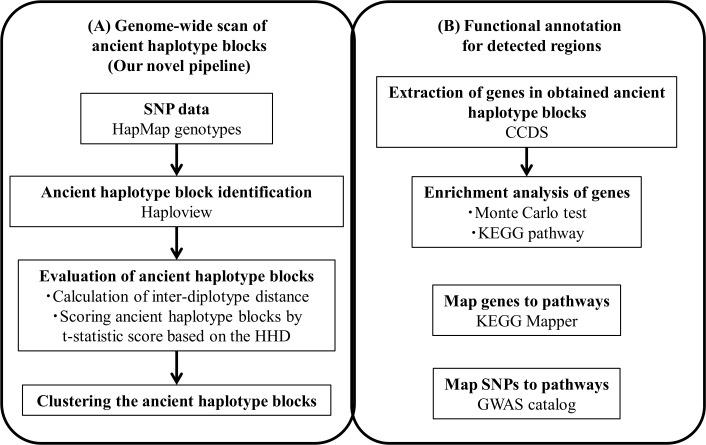
Genome-wide scans for positive selection have become important for genomic medicine, and many studies aim to find genomic regions affected by positive selection that are associated with risk allele variations among populations. Most such studies are designed to detect recent positive selection. However, we hypothesize that ancient positive selection is also important for adaptation to pathogens, and has affected current immune-mediated common diseases. Based on this hypothesis, we developed a novel linkage disequilibrium-based pipeline, which aims to detect regions associated with ancient positive selection across populations from single nucleotide polymorphism (SNP) data. By applying this pipeline to the genotypes in the International HapMap project database, we show that genes in the detected regions are enriched in pathways related to the immune system and infectious diseases. The detected regions also contain SNPs reported to be associated with cancers and metabolic diseases, obesity-related traits, type 2 diabetes, and allergic sensitization. These SNPs were further mapped to biological pathways to determine the associations between phenotypes and molecular functions. Assessments of candidate regions to identify functions associated with variations in incidence rates of these diseases are needed in the future.
全基因组正选择扫描对于基因组医学已变得至关重要,许多研究旨在寻找受正选择影响且与人群中风险等位基因变异相关的基因组区域。大多数此类研究旨在检测近期的正选择。然而,我们推测古代正选择对于适应病原体也很重要,并且已经影响了当前免疫介导的常见疾病。基于这一假设,我们开发了一种基于连锁不平衡的新流程,旨在从单核苷酸多态性(SNP)数据中检测不同人群中与古代正选择相关的区域。通过将此流程应用于国际人类基因组单体型图计划(International HapMap project)数据库中的基因型,我们发现检测区域中的基因在与免疫系统和传染病相关的通路中富集。检测区域还包含据报道与癌症、代谢疾病、肥胖相关性状、2型糖尿病和过敏致敏相关的SNP。这些SNP被进一步映射到生物通路,以确定表型与分子功能之间的关联。未来需要对候选区域进行评估,以确定与这些疾病发病率变异相关的功能。

 Zotero 插件