
通过配体取代调控铁配位络合物中的电荷转移激发态弛豫和自旋交叉
Manipulating charge transfer excited state relaxation and spin crossover in iron coordination complexes with ligand substitution.
作者信息
Zhang Wenkai, Kjær Kasper S, Alonso-Mori Roberto, Bergmann Uwe, Chollet Matthieu, Fredin Lisa A, Hadt Ryan G, Hartsock Robert W, Harlang Tobias, Kroll Thomas, Kubiček Katharina, Lemke Henrik T, Liang Huiyang W, Liu Yizhu, Nielsen Martin M, Persson Petter, Robinson Joseph S, Solomon Edward I, Sun Zheng, Sokaras Dimosthenis, van Driel Tim B, Weng Tsu-Chien, Zhu Diling, Wärnmark Kenneth, Sundström Villy, Gaffney Kelly J
机构信息
PULSE Institute , SLAC National Accelerator Laboratory , Stanford University , Menlo Park , California 94025 , USA . Email:
Department of Chemical Physics , Lund University , P.O. Box 12 4 , 22100 Lund , Sweden.
出版信息
Chem Sci. 2017 Jan 1;8(1):515-523. doi: 10.1039/c6sc03070j. Epub 2016 Aug 25.
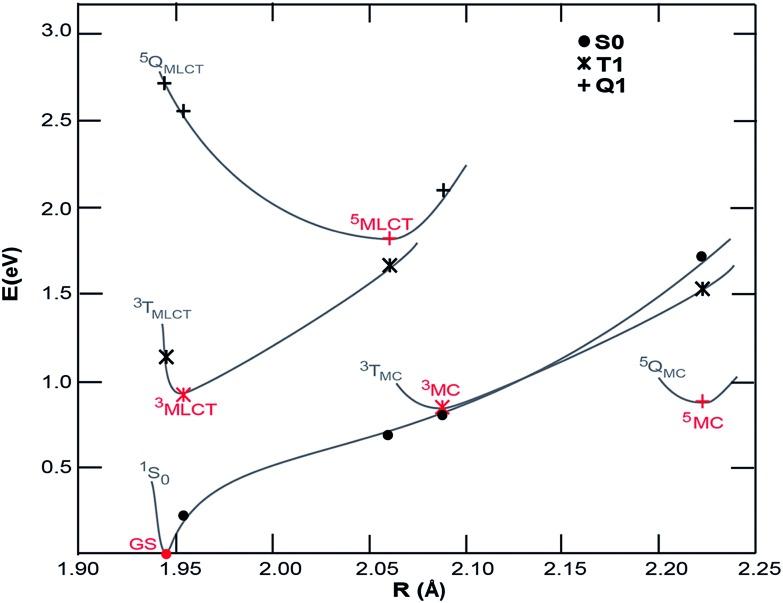
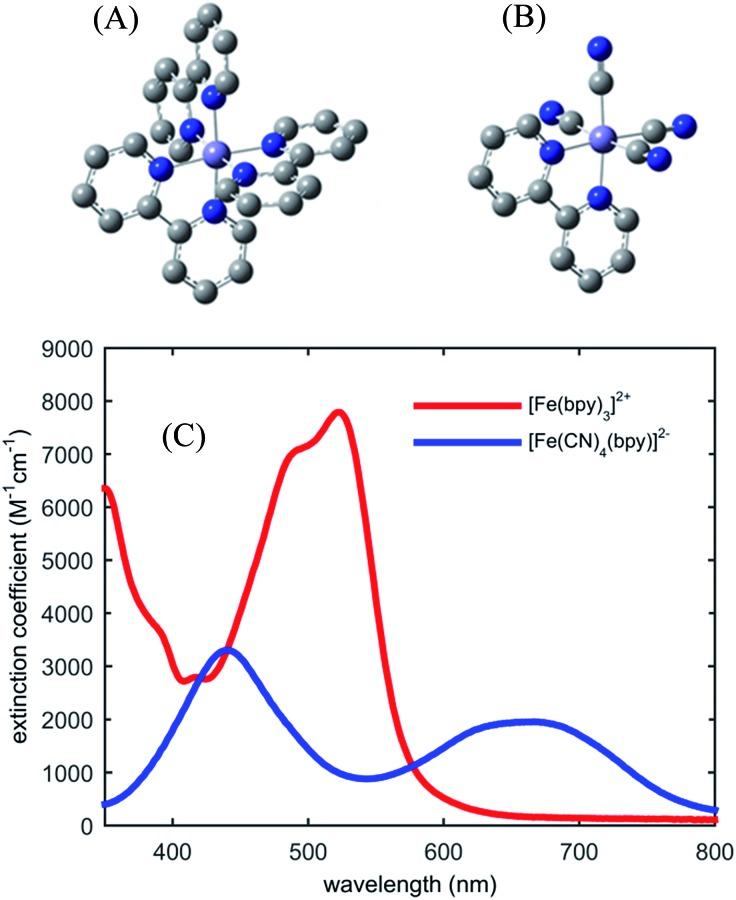
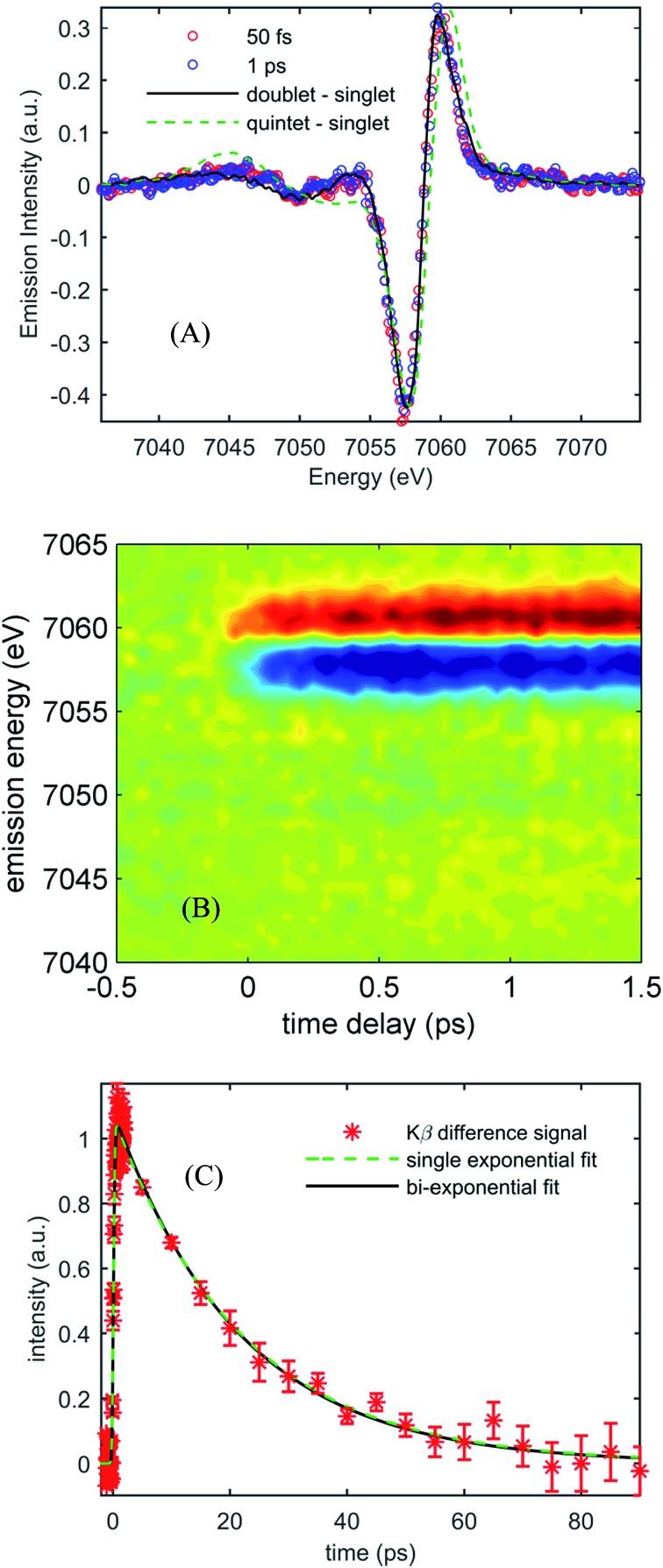
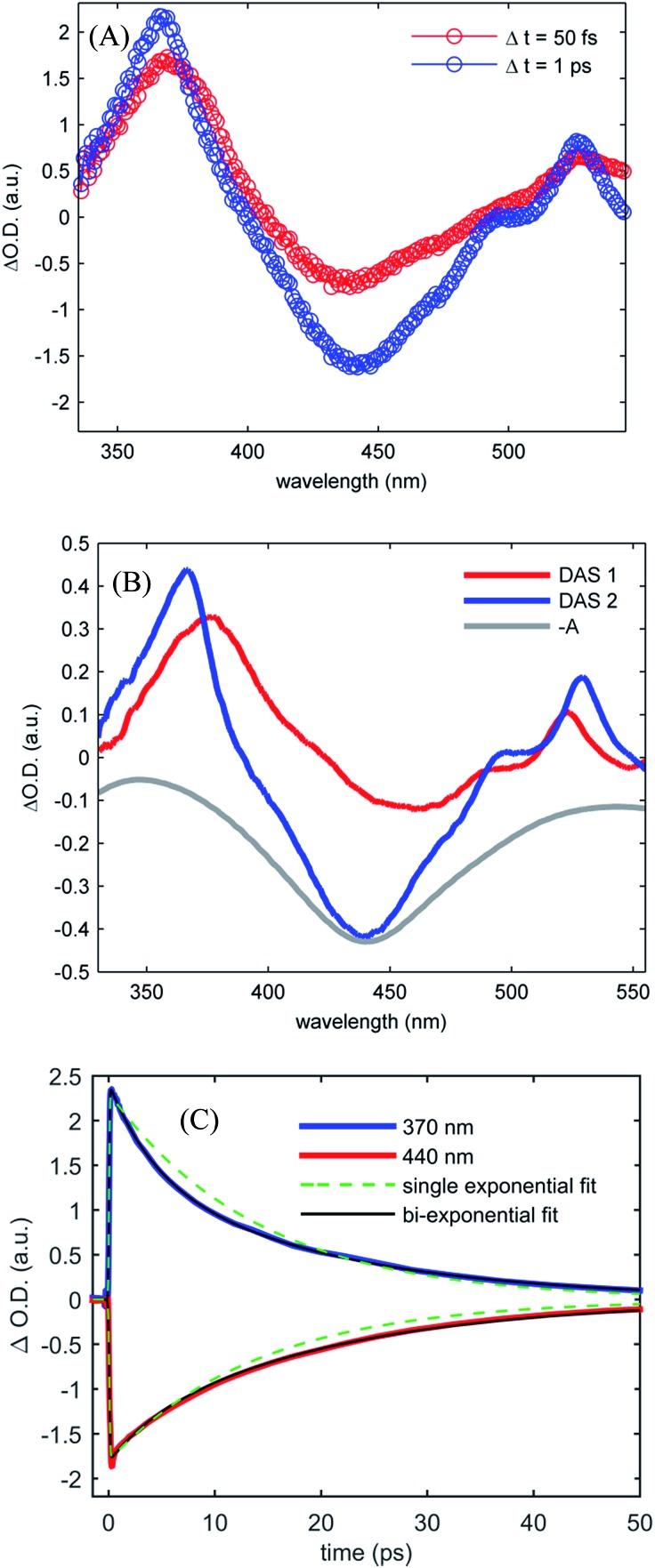
Developing light-harvesting and photocatalytic molecules made with iron could provide a cost effective, scalable, and environmentally benign path for solar energy conversion. To date these developments have been limited by the sub-picosecond metal-to-ligand charge transfer (MLCT) electronic excited state lifetime of iron based complexes due to spin crossover - the extremely fast intersystem crossing and internal conversion to high spin metal-centered excited states. We revitalize a 30 year old synthetic strategy for extending the MLCT excited state lifetimes of iron complexes by making mixed ligand iron complexes with four cyanide (CN) ligands and one 2,2'-bipyridine (bpy) ligand. This enables MLCT excited state and metal-centered excited state energies to be manipulated with partial independence and provides a path to suppressing spin crossover. We have combined X-ray Free-Electron Laser (XFEL) Kβ hard X-ray fluorescence spectroscopy with femtosecond time-resolved UV-visible absorption spectroscopy to characterize the electronic excited state dynamics initiated by MLCT excitation of [Fe(CN)(bpy)]. The two experimental techniques are highly complementary; the time-resolved UV-visible measurement probes allowed electronic transitions between valence states making it sensitive to ligand-centered electronic states such as MLCT states, whereas the Kβ fluorescence spectroscopy provides a sensitive measure of changes in the Fe spin state characteristic of metal-centered excited states. We conclude that the MLCT excited state of [Fe(CN)(bpy)] decays with roughly a 20 ps lifetime without undergoing spin crossover, exceeding the MLCT excited state lifetime of [Fe(2,2'-bipyridine)] by more than two orders of magnitude.
开发含铁的光捕获和光催化分子可为太阳能转换提供一种经济高效、可扩展且环境友好的途径。迄今为止,由于自旋交叉——极快的系间窜越和内转换至高自旋金属中心激发态,这些进展受到铁基配合物亚皮秒级金属到配体电荷转移(MLCT)电子激发态寿命的限制。我们重振了一种有30年历史的合成策略,通过制备含有四个氰基(CN)配体和一个2,2'-联吡啶(bpy)配体的混合配体铁配合物来延长铁配合物的MLCT激发态寿命。这使得MLCT激发态和金属中心激发态能量能够部分独立地进行调控,并提供了一条抑制自旋交叉的途径。我们将X射线自由电子激光(XFEL)Kβ硬X射线荧光光谱与飞秒时间分辨紫外可见吸收光谱相结合,以表征由[Fe(CN)₄(bpy)]的MLCT激发引发的电子激发态动力学。这两种实验技术具有高度互补性;时间分辨紫外可见测量探测价态之间的允许电子跃迁,使其对诸如MLCT态等配体中心电子态敏感,而Kβ荧光光谱则提供了对金属中心激发态特征的铁自旋态变化的灵敏测量。我们得出结论,[Fe(CN)₄(bpy)]的MLCT激发态以大约20 ps的寿命衰减,且不发生自旋交叉,比[Fe(2,2'-联吡啶)₃]的MLCT激发态寿命长两个多数量级。

 Zotero 插件