
包裹唑来膦酸的自组装纳米颗粒可抑制间充质基质细胞的分化、迁移和促血管生成因子的分泌及其与前列腺癌细胞的相互作用。
Self-assembling nanoparticles encapsulating zoledronic acid inhibit mesenchymal stromal cells differentiation, migration and secretion of proangiogenic factors and their interactions with prostate cancer cells.
作者信息
Borghese Cinzia, Casagrande Naike, Pivetta Eliana, Colombatti Alfonso, Boccellino Mariarosaria, Amler Evzen, Normanno Nicola, Caraglia Michele, De Rosa Giuseppe, Aldinucci Donatella
机构信息
Molecular Oncology Unit, Centro di Riferimento Oncologico, IRCCS-National Cancer Institute, Aviano, PN, Italy.
Department of Biochemistry, Biophysics and General Pathology, Second University of Naples, Naples, Italy.
出版信息
Oncotarget. 2017 Jun 27;8(26):42926-42938. doi: 10.18632/oncotarget.17216.
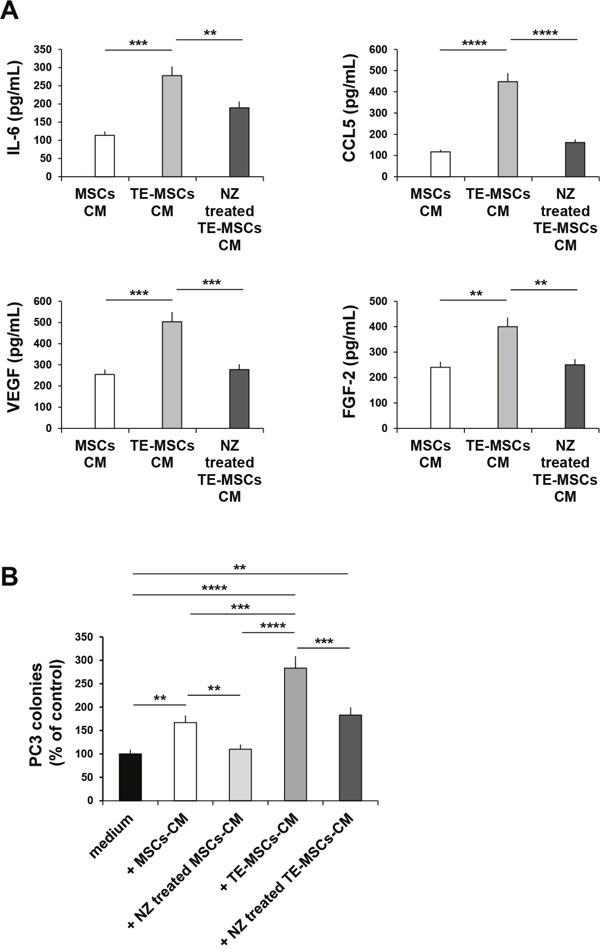
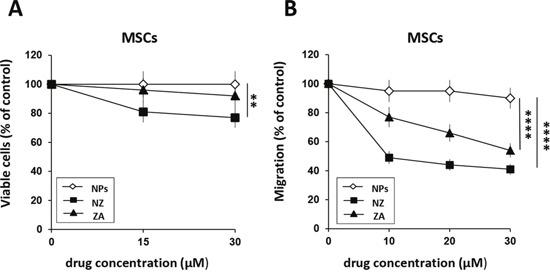
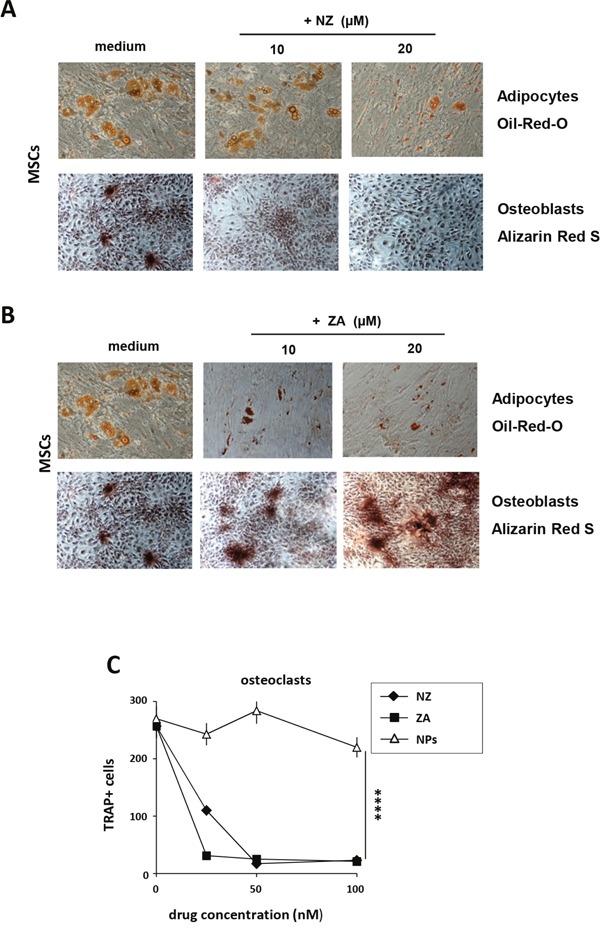
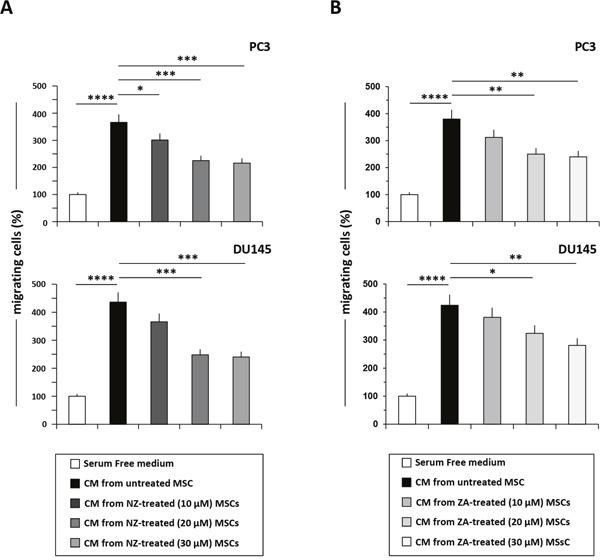
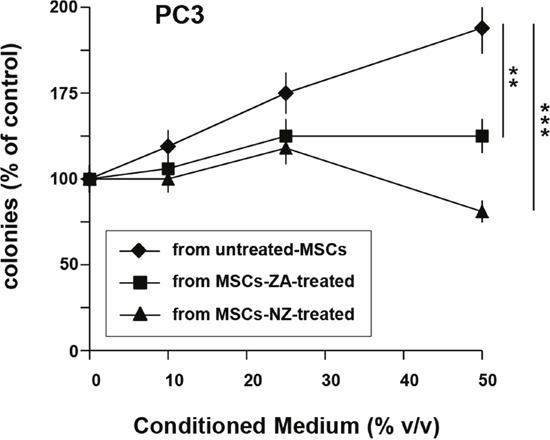
Zoledronic Acid (ZA) rapidly concentrates into the bone and reduces skeletal-related events and pain in bone metastatic prostate cancer (PCa), but exerts only a limited or absent impact as anti-cancer activity. Recently, we developed self-assembling nanoparticles (NPS) encapsulating zoledronic acid (NZ) that allowed a higher intratumor delivery of the drug compared with free zoledronic acid (ZA) in in vivo cancer models of PCa. Increasing evidence suggests that Bone Marrow (BM) Mesenchymal stromal cells (BM-MSCs) are recruited into the stroma of developing tumors where they contribute to progression by enhancing tumor growth and metastasis.We demonstrated that treatment with NZ decreased migration and differentiation into adipocytes and osteoblasts of MSCs and inhibited osteoclastogenesis. Treatment with NZ reduced the capability of MSCs to promote the migration and the clonogenic growth of the prostate cancer cell lines PC3 and DU145. The levels of Interleukin-6 and of the pro-angiogenic factors VEGF and FGF-2 were significantly reduced in MSC-CM derived from MSCs treated with NZ, and CCL5 secretion was almost totally abolished. Moreover, treatment of MSCs with supernatants from PC3 cells, leading to tumor-educated MSCs (TE-MSCs), increased the secretion of IL-6, CCL5, VEGF and FGF-2 by MSCs and increased their capability to increase PC3 cells clonogenic growth. Treatment with NZ decreased cytokine secretion and the pro-tumorigenic effects also of TE-MSCS. In conclusion, demonstrating that NZ is capable to inhibit the cross talk between MSCs and PCa, this study provides a novel insight to explain the powerful anticancer activity of NZ on PCa.
唑来膦酸(ZA)可迅速在骨骼中聚集,并减少骨转移性前列腺癌(PCa)的骨相关事件和疼痛,但作为抗癌活性的作用有限或不存在。最近,我们开发了包裹唑来膦酸的自组装纳米颗粒(NPS)(NZ),在PCa的体内癌症模型中,与游离唑来膦酸(ZA)相比,该纳米颗粒能使药物在肿瘤内的递送量更高。越来越多的证据表明,骨髓(BM)间充质基质细胞(BM-MSCs)被募集到正在发展的肿瘤基质中,通过促进肿瘤生长和转移来促进肿瘤进展。我们证明,用NZ处理可减少MSC向脂肪细胞和成骨细胞的迁移和分化,并抑制破骨细胞生成。用NZ处理可降低MSC促进前列腺癌细胞系PC3和DU145迁移和克隆生长的能力。在用NZ处理的MSC衍生的MSC-CM中,白细胞介素-6以及促血管生成因子VEGF和FGF-2的水平显著降低,CCL5分泌几乎完全被消除。此外,用PC3细胞的上清液处理MSC,导致肿瘤驯化的MSC(TE-MSCs),增加了MSC分泌IL-6、CCL5、VEGF和FGF-2,并增加了它们促进PC3细胞克隆生长的能力。用NZ处理可减少细胞因子分泌以及TE-MSCS的促肿瘤作用。总之,本研究表明NZ能够抑制MSC与PCa之间的相互作用,为解释NZ对PCa强大的抗癌活性提供了新的见解。

 Zotero 插件