
全膝关节置换术后局部浸润镇痛与坐骨神经阻滞辅助股神经阻滞用于疼痛控制的比较:一项系统评价与荟萃分析。
Comparison of local infiltration analgesia and sciatic nerve block as an adjunct to femoral nerve block for pain control after total knee arthroplasty: A systematic review and meta-analysis.
作者信息
Zhang Zhi, Yang Qing, Xin Wenqi, Zhang Yixuan
机构信息
Department of Anesthesiology, Huaihe Hospital, Henan University, Kaifeng, China.
出版信息
Medicine (Baltimore). 2017 May;96(19):e6829. doi: 10.1097/MD.0000000000006829.
BACKGROUND
To perform a meta-analysis to assess the efficiency and safety between local infiltration analgesia (LIA) and sciatic nerve block (SNB) when combined with femoral nerve block (FNB) for pain control following total knee arthroplasty (TKA).
METHODS
We systemically searched the following electronic databases for potentially relevant articles: Embase (1980-2017.01), Medline (1966-2017.01), PubMed (1966-2017.01), ScienceDirect (1985-2017.01), web of science (1950-2017.01) and the Cochrane Library. Only studies published in English that were accessible online were considered. Furthermore, we only considered studies that were published from 1966 to 2017. Only studies that met the following inclusion criteria were considered: (a) patients were adult human subjects who were set to undergo TKA; (b) the intervention was either SNB combined with FNB or LIA combined with FNB; (c) the outcomes of the studies, such as visual analog scale (VAS) scores, morphine consumption, length of stay and postoperative adverse effects, including the risk of nausea, vomiting and falls, were reported; (d) studies were either RCTs or non-RCT. Meta-analysis was performed using Stata 11.0 software. Modified Jadad score (7-points scale) which was based on Cochrane Handbook for Systematic Reviews of Interventions is used for assessment of RCTs. The Methodological Index for Nonrandomized Studies (MINORS) scale was used to assess non-RCTs with scores ranging 0 to 24. The synthesis of the outcomes for all studies was calculated as the weighted average rate by using a fixed or random effect model which depends on statistical heterogeneity. Systematic review registration number is CRD42017110661.
RESULTS
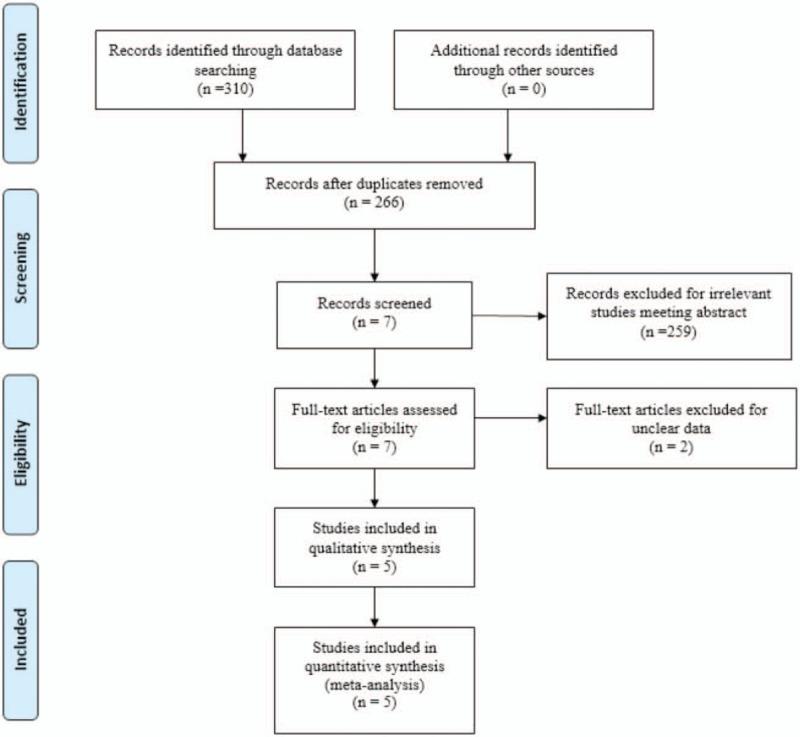
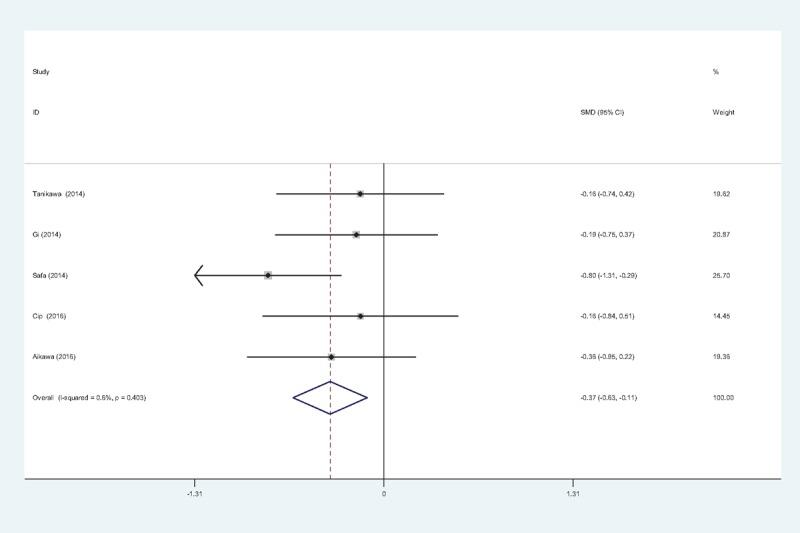
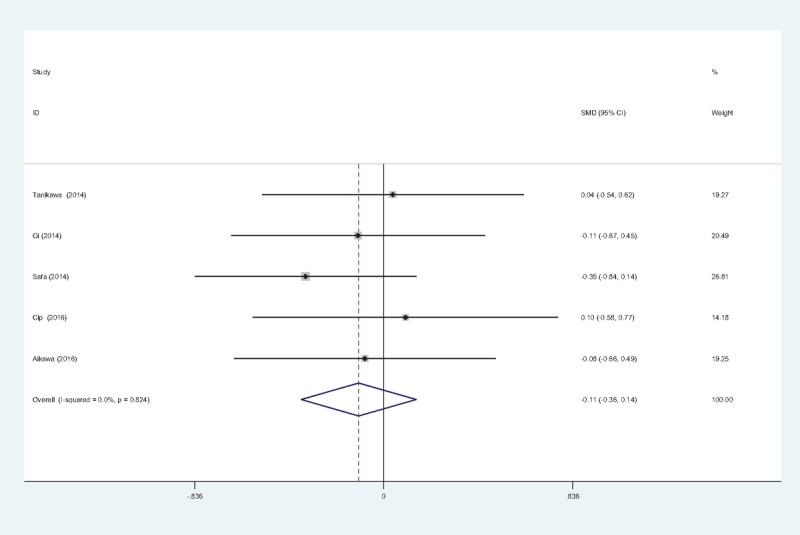
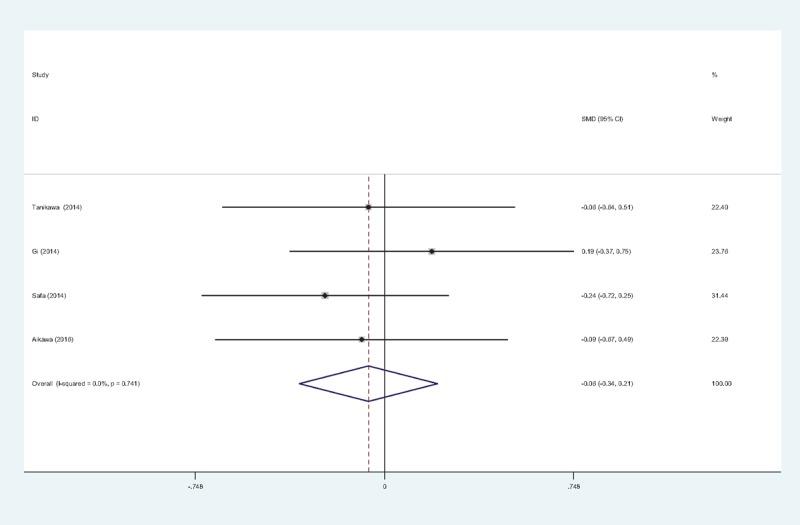
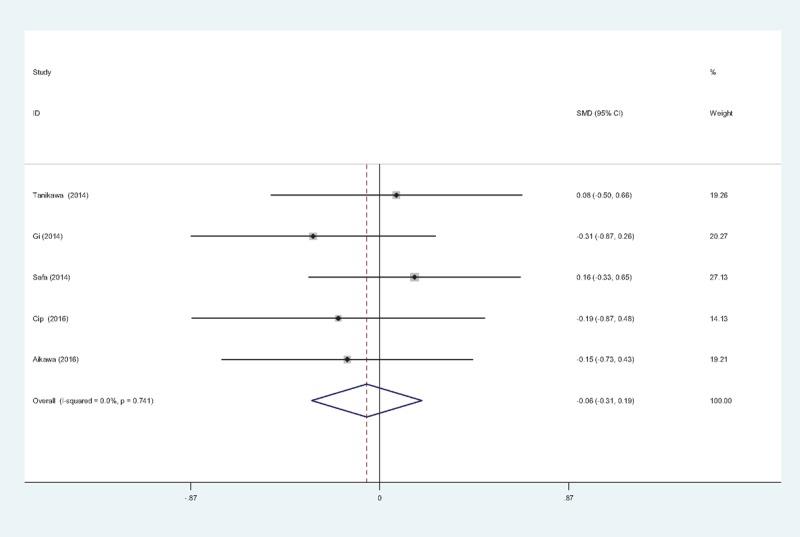
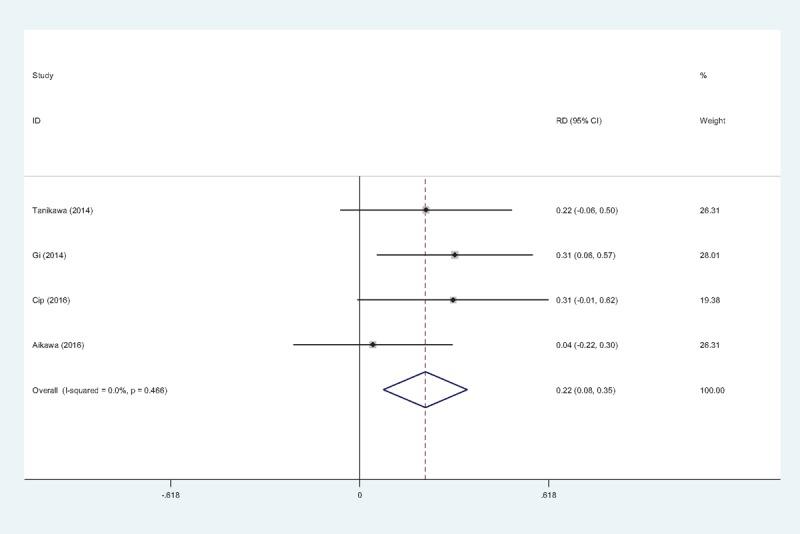
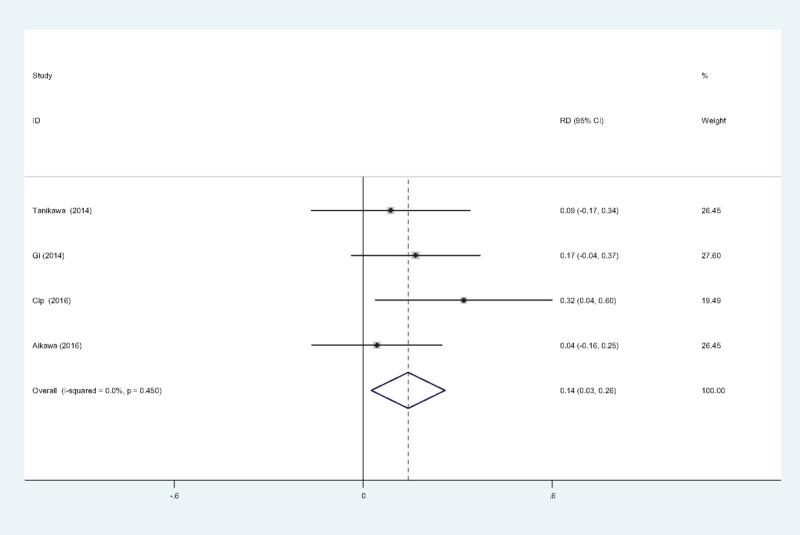
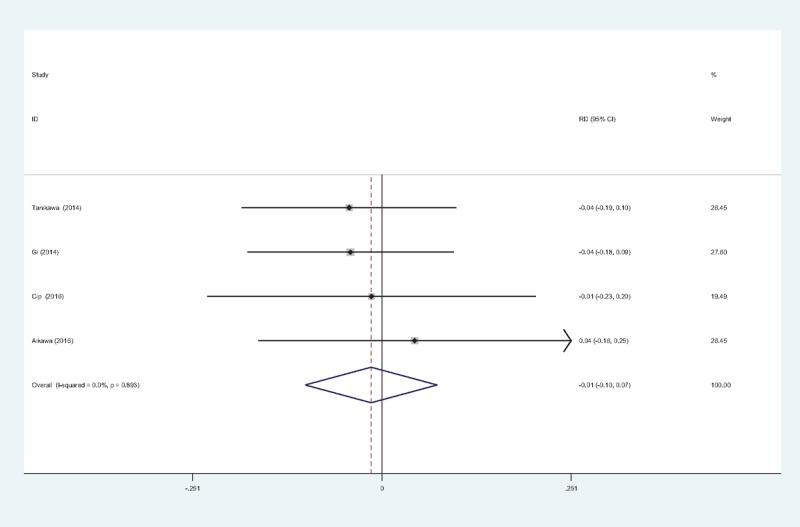
Three randomized controlled trials (RCTs) and 2 nonrandomized controlled trials (Non-RCTs), including 240 patients met the inclusion criteria. The present meta-analysis indicated that there were significant differences between groups in terms of visual analog scale (VAS) score at 12 hours (SMD = -0.337, 95% CI: -0.593 to -0.081, P =.010), VAS score at 24 hours (SMD = -0.337, 95% CI: -0.612 to -0.061, P =.017), morphine equivalent consumption at 24 hours (SMD = -0.371, 95% CI: -0.627 to -0.114, P = .005) and incidence of nausea (RD = 0.215, 95% CI: 0.078 to 0.353, P = .002) and vomiting (RD = 0.143, 95% CI: 0.026 to 0.260, P = .017).
CONCLUSION
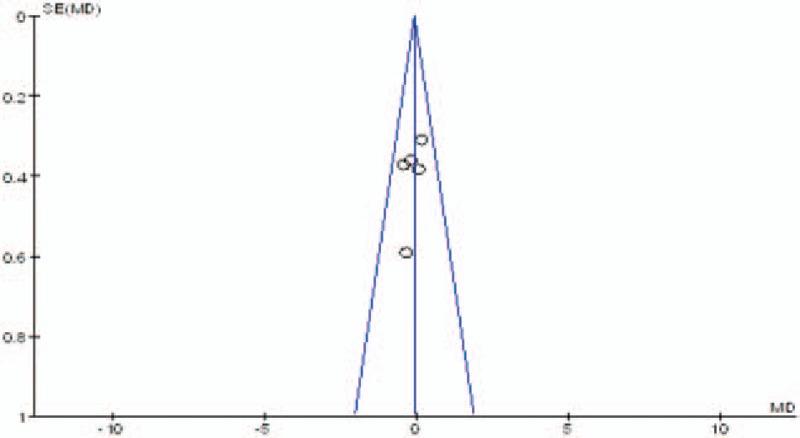
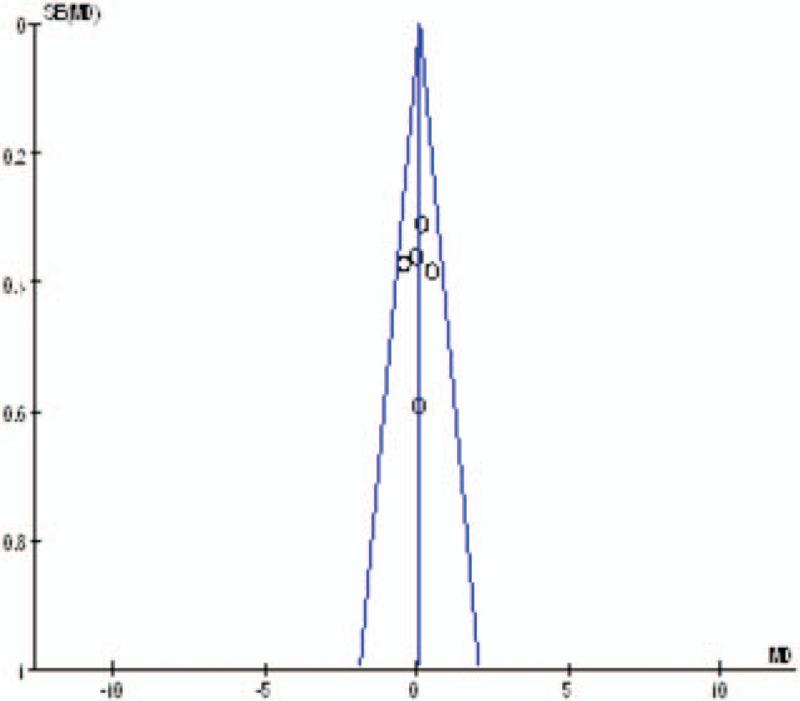
FNB combined with SNB provided decreased VAS scores and less morphine consumption at 12 and 24 hours compared with FNB combined with LIA in total knee arthroplasty. In addition, it was associated with lower risks of nausea and vomiting. We assessed the quality of the evidence as low to very low; therefore, our confidence in the effect estimate is limited, and the true effect may be substantially different from our estimates. Further studies should focus on surgeries that are known to be associated with significant postoperative pain, particularly surgeries where improved pain control may deliver significant clinical benefits through reduced morbidity, or cost-effectiveness benefits through faster rehabilitation and discharge. The present meta-analysis has the following limitations: (1) only 5 studies were included in the meta-analysis. Although all of them are recently published studies, the sample sizes are relatively small; (2) Functional outcome is an important parameter; however, owing to the insufficiency of relevant data, we failed to perform a meta-analysis on functional outcome; (3) The doses of anesthetics and the concomitant pain management regimes varied between the studies, which may have influenced the results; (4) The duration of follow-up was relatively short, which might have led to an underestimating of complications; and (5) publication bias present in the meta-analysis may have influenced the results.
背景
进行一项荟萃分析,以评估全膝关节置换术(TKA)后局部浸润镇痛(LIA)与坐骨神经阻滞(SNB)联合股神经阻滞(FNB)用于疼痛控制时的有效性和安全性。
方法
我们系统检索了以下电子数据库以查找潜在相关文章:Embase(1980 - 2017.01)、Medline(1966 - 2017.01)、PubMed(1966 - 2017.01)、ScienceDirect(1985 - 2017.01)、科学网(1950 - 2017.01)和Cochrane图书馆。仅考虑在线可获取的英文发表研究。此外,我们仅考虑1966年至2017年发表的研究。仅纳入符合以下纳入标准的研究:(a)患者为拟行TKA的成年人类受试者;(b)干预措施为SNB联合FNB或LIA联合FNB;(c)报告研究结果,如视觉模拟评分(VAS)、吗啡用量、住院时间和术后不良反应,包括恶心、呕吐和跌倒风险;(d)研究为随机对照试验(RCT)或非随机对照试验。使用Stata 11.0软件进行荟萃分析。基于《Cochrane系统评价干预措施手册》的改良Jadad评分(7分制)用于评估RCT。非随机研究方法学指数(MINORS)量表用于评估非RCT,评分范围为0至24。所有研究结果的综合计算采用固定或随机效应模型的加权平均率,具体取决于统计异质性。系统评价注册号为CRD42017110661。
结果
三项随机对照试验(RCT)和两项非随机对照试验(非RCT),共240例患者符合纳入标准。本荟萃分析表明,两组在12小时时的视觉模拟评分(VAS)(标准化均数差[SMD] = -0.337,95%可信区间[CI]:-0.593至-0.081,P =.010)、24小时时的VAS评分(SMD = -0.337,95% CI:-0.612至-0.061,P =.017)、24小时时的吗啡等效用量(SMD = -0.371,95% CI:-0.627至-0.114,P =.005)以及恶心发生率(风险差[RD] = 0.215,95% CI:0.078至0.353,P =.002)和呕吐发生率(RD = 0.143,95% CI:0.026至0.260,P =.017)方面存在显著差异。
结论
在全膝关节置换术中,与FNB联合LIA相比,FNB联合SNB在12小时和24小时时VAS评分降低,吗啡用量减少。此外,其恶心和呕吐风险较低。我们将证据质量评估为低至极低;因此,我们对效应估计的信心有限,真实效应可能与我们的估计有很大差异。进一步的研究应聚焦于已知与显著术后疼痛相关的手术,特别是那些通过改善疼痛控制可能通过降低发病率带来显著临床益处,或通过更快康复和出院带来成本效益益处的手术。本荟萃分析存在以下局限性:(1)荟萃分析仅纳入5项研究。尽管它们都是近期发表的研究,但样本量相对较小;(2)功能结局是一个重要参数;然而,由于相关数据不足,我们未能对功能结局进行荟萃分析;(3)各研究之间麻醉剂剂量和伴随的疼痛管理方案不同,这可能影响结果;(4)随访时间相对较短,这可能导致并发症被低估;(5)荟萃分析中存在的发表偏倚可能影响结果。



 Zotero 插件