
慢性鼻-鼻窦炎患者的鼻窦微生物群在组成和功能上存在差异,具有免疫学和临床差异的后果。
Compositionally and functionally distinct sinus microbiota in chronic rhinosinusitis patients have immunological and clinically divergent consequences.
机构信息
Department of Otolaryngology, University of California, San Francisco, CA, 94143, USA.
Present Address: Pathogen and Microbiome Institute, Northern Arizona University, Flagstaff, AZ, 86011, USA.
出版信息
Microbiome. 2017 May 12;5(1):53. doi: 10.1186/s40168-017-0266-6.
BACKGROUND
Chronic rhinosinusitis (CRS) is a heterogeneous disease characterized by persistent sinonasal inflammation and sinus microbiome dysbiosis. The basis of this heterogeneity is poorly understood. We sought to address the hypothesis that a limited number of compositionally distinct pathogenic bacterial microbiota exist in CRS patients and invoke discrete immune responses and clinical phenotypes in CRS patients.
RESULTS
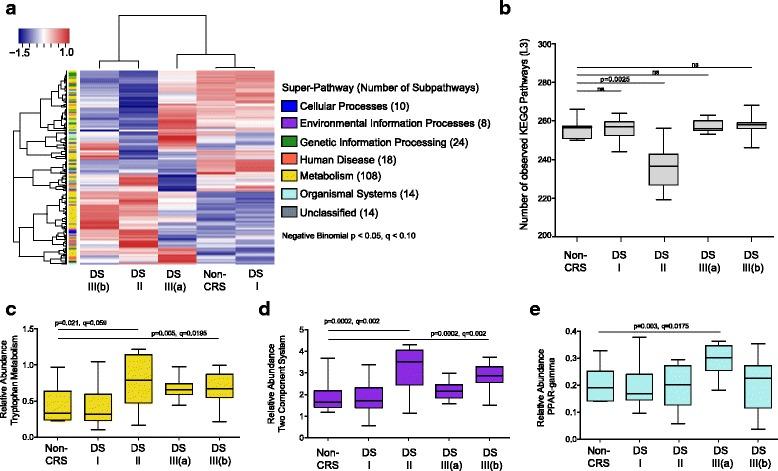
Sinus brushings from patients with CRS (n = 59) and healthy individuals (n = 10) collected during endoscopic sinus surgery were analyzed using 16S rRNA gene sequencing, predicted metagenomics, and RNA profiling of the mucosal immune response. We show that CRS patients cluster into distinct sub-groups (DSI-III), each defined by specific pattern of bacterial co-colonization (permutational multivariate analysis of variance (PERMANOVA); p = 0.001, r = 0.318). Each sub-group was typically dominated by a pathogenic family: Streptococcaceae (DSI), Pseudomonadaceae (DSII), Corynebacteriaceae [DSIII(a)], or Staphylococcaceae [DSIII(b)]. Each pathogenic microbiota was predicted to be functionally distinct (PERMANOVA; p = 0.005, r = 0.217) and encode uniquely enriched gene pathways including ansamycin biosynthesis (DSI), tryptophan metabolism (DSII), two-component response [DSIII(b)], and the PPAR-γ signaling pathway [DSIII(a)]. Each is also associated with significantly distinct host immune responses; DSI, II, and III(b) invoked a variety of pro-inflammatory, T1 responses, while DSIII(a), which exhibited significantly increased incidence of nasal polyps (Fisher's exact; p = 0.034, relative risk = 2.16), primarily induced IL-5 expression (Kruskal Wallis; q = 0.045).
CONCLUSIONS
A large proportion of CRS patient heterogeneity may be explained by the composition of their sinus bacterial microbiota and related host immune response-features which may inform strategies for tailored therapy in this patient population.
背景
慢性鼻鼻窦炎(CRS)是一种异质性疾病,其特征为持续性的鼻窦炎症和鼻窦微生物组失调。这种异质性的基础尚未被充分理解。我们试图验证以下假说,即在 CRS 患者中存在数量有限的组成上有明显差异的致病性细菌微生物组,并在 CRS 患者中引发不同的免疫反应和临床表型。
结果
在鼻窦内镜手术中收集了 59 例 CRS 患者和 10 例健康个体的鼻窦刷检样本,通过 16S rRNA 基因测序、预测宏基因组学和黏膜免疫反应的 RNA 谱分析进行了分析。我们表明,CRS 患者可以聚类为不同的亚群(DSI-III),每个亚群都由特定的细菌共定植模式定义(置换多元方差分析(PERMANOVA);p=0.001,r=0.318)。每个亚群通常由一种致病性家族主导:链球菌科(DSI)、假单胞菌科(DSII)、棒状杆菌科[DSIII(a)]或葡萄球菌科[DSIII(b)]。每个致病性微生物组被预测为具有不同的功能(PERMANOVA;p=0.005,r=0.217),并编码独特丰富的基因途径,包括安沙霉素生物合成(DSI)、色氨酸代谢(DSII)、双组分反应[DSIII(b)]和 PPAR-γ 信号通路[DSIII(a)]。每个亚群还与显著不同的宿主免疫反应相关;DSI、II 和 III(b)引发了各种促炎、T1 反应,而 DSIII(a),其鼻息肉的发生率显著增加(Fisher 精确检验;p=0.034,相对风险=2.16),主要诱导了 IL-5 的表达(Kruskal-Wallis;q=0.045)。
结论
很大一部分 CRS 患者的异质性可以用鼻窦细菌微生物组的组成及其相关的宿主免疫反应特征来解释,这可能为该患者群体的靶向治疗策略提供信息。


 Zotero 插件