
唾液外泌体PSMA7:一种有前景的炎症性肠病生物标志物。
Salivary exosomal PSMA7: a promising biomarker of inflammatory bowel disease.
作者信息
Zheng Xiaowen, Chen Feng, Zhang Qian, Liu Yulan, You Peng, Sun Shan, Lin Jiuxiang, Chen Ning
机构信息
The Department of Orthodontics, Peking University School and Hospital of Stomatology, Beijing, 100081, China.
Central Laboratory, Peking University School and Hospital of Stomatology, Beijing, 100081, China.
出版信息
Protein Cell. 2017 Sep;8(9):686-695. doi: 10.1007/s13238-017-0413-7. Epub 2017 May 18.
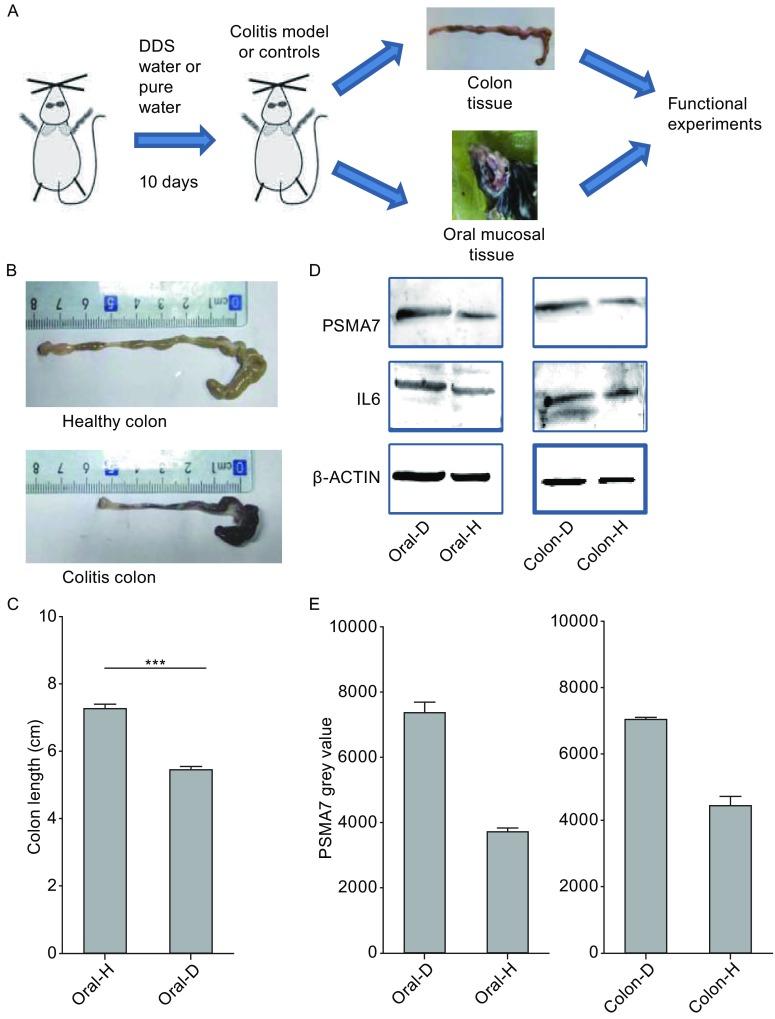
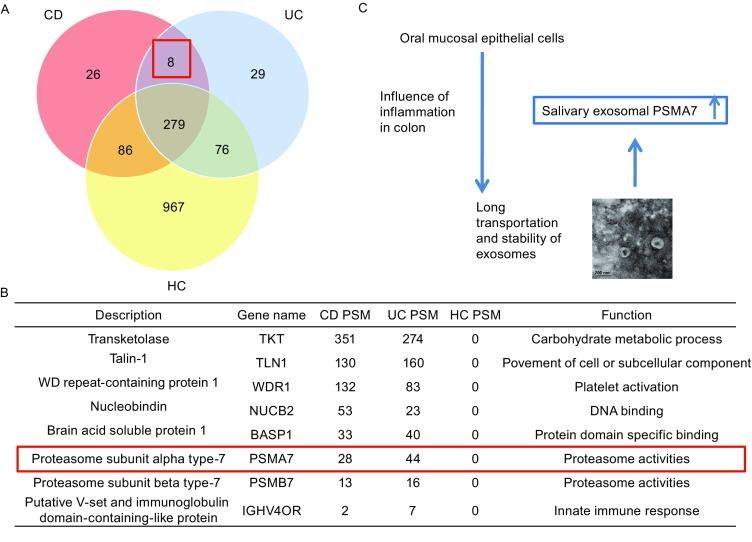
Inflammatory bowel disease (IBD) is an intestinal immune-dysfunctional disease worldwide whose prevalence increasing in Asia including China. It is a chronic disease of the gastrointestinal tract with unknown cause. Exosomes are small vesicles in various body fluids. They have diameters of 40-120 nm, and one of their functions is long-distance transfer of various substances. In this study, we investigated the contents of salivary exosomes in patients with IBD and in healthy controls to explore a new biomarker in patients with IBD. In this study, whole saliva was obtained from patients with IBD (ulcerative colitis (UC), n = 37; Crohn's disease (CD), n = 11) and apparently healthy individuals (HC, n = 10). Salivary exosomes were extracted from samples, and the proteins within the exosomes were identified by liquid chromatograph-mass spectrometer (LC-MS/MS). The results showed that more than 2000 proteins were detected in salivary exosomes from patients with IBD. Through gene ontology analysis, we found that proteasome subunit alpha type 7 (PSMA7) showed especially marked differences between patients with IBD and the healthy controls, in that its expression level was much higher in the CD and UC groups. This exosomal protein is related to proteasome activity and inflammatory responses. So we conclude that in this research, salivary exosomal PSMA7 was present at high levels in salivary exosomes from subjects with IBD. It can be a very promising biomarker to release the patients from the pain of colonoscopy.
炎症性肠病(IBD)是一种全球性的肠道免疫功能失调疾病,在包括中国在内的亚洲地区其患病率正在上升。它是一种病因不明的胃肠道慢性疾病。外泌体是存在于各种体液中的小囊泡。它们的直径为40 - 120纳米,其功能之一是各种物质的长距离转运。在本研究中,我们调查了IBD患者和健康对照者唾液外泌体的成分,以探索IBD患者的一种新生物标志物。在本研究中,从IBD患者(溃疡性结肠炎(UC),n = 37;克罗恩病(CD),n = 11)和明显健康的个体(HC,n = 10)中获取全唾液。从样本中提取唾液外泌体,并通过液相色谱 - 质谱联用仪(LC-MS/MS)鉴定外泌体内的蛋白质。结果显示,在IBD患者的唾液外泌体中检测到2000多种蛋白质。通过基因本体分析,我们发现蛋白酶体亚基α7型(PSMA7)在IBD患者和健康对照者之间表现出特别明显的差异,即其在CD组和UC组中的表达水平要高得多。这种外泌体蛋白与蛋白酶体活性和炎症反应有关。所以我们得出结论,在本研究中,唾液外泌体PSMA7在IBD受试者的唾液外泌体中含量很高。它可能是一种非常有前景的生物标志物,可使患者免受结肠镜检查之苦。



 Zotero 插件