
胃旁路手术可持久降低心血管疾病风险因素,并降低充血性心力衰竭的长期风险。
Gastric Bypass Surgery Produces a Durable Reduction in Cardiovascular Disease Risk Factors and Reduces the Long-Term Risks of Congestive Heart Failure.
作者信息
Benotti Peter N, Wood G Craig, Carey David J, Mehra Vishal C, Mirshahi Tooraj, Lent Michelle R, Petrick Anthony T, Still Christopher, Gerhard Glenn S, Hirsch Annemarie G
机构信息
Geisinger Obesity Institute, Geisinger Medical Center, Danville, PA
Geisinger Obesity Institute, Geisinger Medical Center, Danville, PA.
出版信息
J Am Heart Assoc. 2017 May 23;6(5):e005126. doi: 10.1161/JAHA.116.005126.
BACKGROUND
Obesity and its association with reduced life expectancy are well established, with cardiovascular disease as one of the major causes of fatality. Metabolic surgery is a powerful intervention for severe obesity, resulting in improvement in comorbid diseases and in cardiovascular risk factors. This study investigates the relationship between metabolic surgery and long-term cardiovascular events.
METHODS AND RESULTS
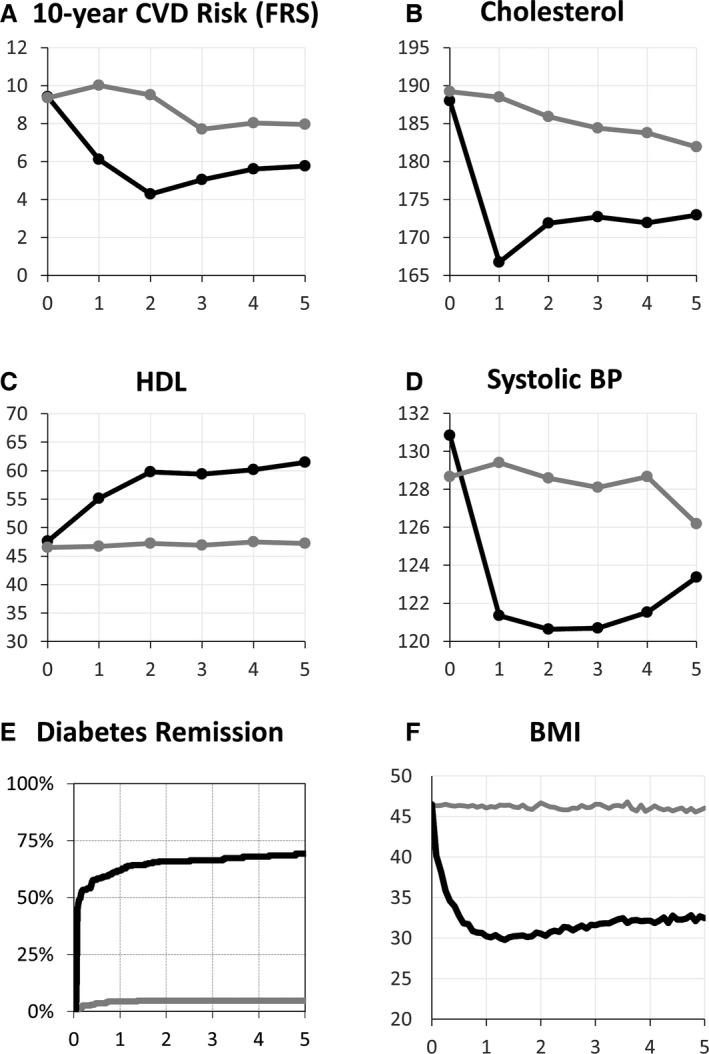
A cohort of Roux-en-Y gastric bypass surgery (RYGB) patients was tightly matched by age, body mass index, sex, Framingham Risk Score, smoking history, use of antihypertension medication, diabetes mellitus status, and calendar year with a concurrent cohort of nonoperated control patients. The primary study end points of major cardiovascular events (myocardial infarction, stroke, and congestive heart failure) were evaluated using Cox regression. Secondary end points of longitudinal cardiovascular risk factors were evaluated using repeated-measures regression. The RYGB and matched controls (N=1724 in each cohort) were followed for up to 12 years after surgery (overall median of 6.3 years). Kaplan-Meier analysis revealed a statistically significant reduction in incident major composite cardiovascular events (=0.017) and congestive heart failure (0.0077) for the RYGB cohort. Adjusted Cox regression models confirmed the reductions in severe composite cardiovascular events in the RYGB cohort (hazard ratio=0.58, 95% CI=0.42-0.82). Improvements of cardiovascular risk factors (eg, 10-year cardiovascular risk score, total cholesterol, high-density lipoprotein, systolic blood pressure, and diabetes mellitus) were observed within the RYGB cohort after surgery.
CONCLUSIONS
Gastric bypass is associated with a reduced risk of major cardiovascular events and the development of congestive heart failure.
背景
肥胖及其与预期寿命缩短的关联已得到充分证实,心血管疾病是主要致死原因之一。代谢手术是治疗重度肥胖的有效干预手段,可改善合并症及心血管危险因素。本研究旨在探讨代谢手术与长期心血管事件之间的关系。
方法与结果
一组接受 Roux-en-Y 胃旁路手术(RYGB)的患者在年龄、体重指数、性别、弗雷明汉风险评分、吸烟史、抗高血压药物使用情况、糖尿病状态及历年情况等方面与一组同期未手术的对照患者进行了严格匹配。使用 Cox 回归评估主要心血管事件(心肌梗死、中风和充血性心力衰竭)的主要研究终点。使用重复测量回归评估纵向心血管危险因素的次要终点。对 RYGB 组和匹配的对照组(每组 N = 1724)术后长达 12 年(总体中位数为 6.3 年)进行随访。Kaplan-Meier 分析显示,RYGB 队列中主要复合心血管事件(P = 0.017)和充血性心力衰竭(P = 0.0077)的发生率有统计学意义的降低。调整后的 Cox 回归模型证实了 RYGB 队列中严重复合心血管事件的减少(风险比 = 0.58,95% CI = 0.42 - 0.82)。术后在 RYGB 队列中观察到心血管危险因素(如 10 年心血管风险评分、总胆固醇、高密度脂蛋白、收缩压和糖尿病)有所改善。
结论
胃旁路手术与主要心血管事件风险降低及充血性心力衰竭的发生有关。


 Zotero 插件