
信号素3A促进心肌梗死后心脏炎症的消退。
Sema3A promotes the resolution of cardiac inflammation after myocardial infarction.
作者信息
Rienks Marieke, Carai Paolo, Bitsch Nicole, Schellings Mark, Vanhaverbeke Maarten, Verjans Johan, Cuijpers Ilona, Heymans Stephane, Papageorgiou Anna
机构信息
Cardiovascular Research Institute Maastricht, Universiteitssingel 50, 6229 ER, Maastricht, The Netherlands.
Department of Cardiovascular Sciences, KU Leuven, Leuven, Belgium.
出版信息
Basic Res Cardiol. 2017 Jul;112(4):42. doi: 10.1007/s00395-017-0630-5. Epub 2017 May 24.
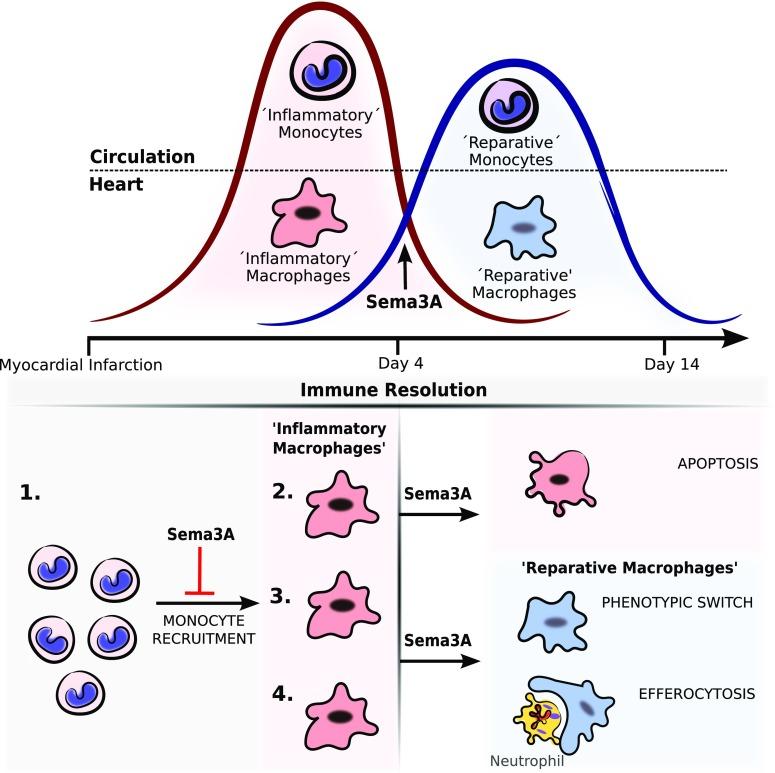
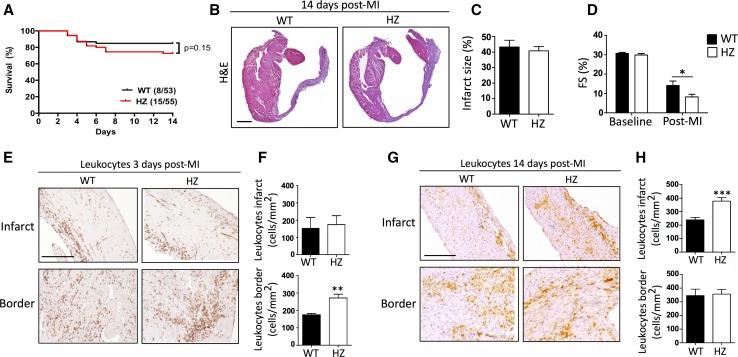
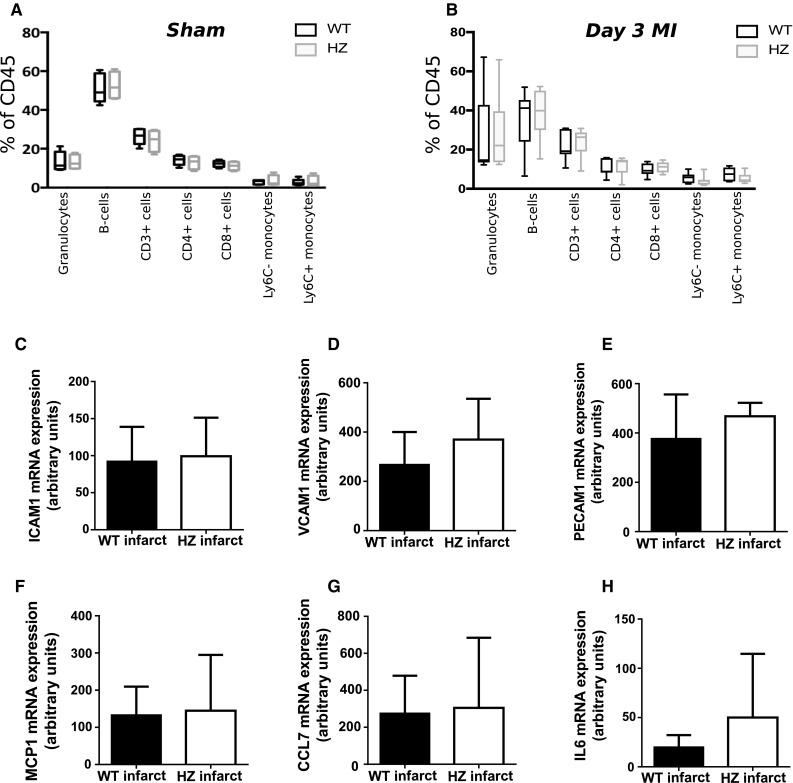
Optimal healing after myocardial infarction requires not only the induction of inflammation, but also its timely resolution. In patients, 30 days post myocardial infarction, circulating monocytes have increased expression of Semaphorin3A (Sema3A) as compared to directly after admission. This increased expression coincides with increased expression of Cx3CR1-a marker of non-classical monocytes that are important for immune resolution hence proper wound healing. In mice, the expression of Sema3A also increases in response to myocardial ischemia being expressed by infiltrating leukocytes. Comparing Sema3A heterozygote (HZ) and wild type (WT) mice post myocardial infarction, revealed increased presence of leukocytes in the cardiac tissues of HZ mice as compared to WT, with no differences in capillary density, collagen deposition, cardiomyocyte surface area, chemokine-or adhesion molecules expression. Whilst infarct sizes were similar 14 days after myocardial infarction in both genotypes, Sema3A HZ mice had thinner infarcts and reduced cardiac function as compared to their WT littermates. In vitro experiments were conducted to study the role of Sema3A in inflammation and resolution of inflammation as a potential explanation for the differences in leukocyte recruitment and cardiac function observed in our in vivo experiments. Here, recombinant Sema3A protein was able to affect the pro-inflammatory state of cultured bone marrow derived macrophages. First, the pro-inflammatory state was altered by the induced apoptosis of classical macrophages in the presence of Sema3A. Second, Sema3A promoted the polarization of classical macrophages to resolution-phase macrophages and enhanced their efferocytotic ability, findings that were reflected in the infarcted cardiac tissue of the Sema3A HZ mice. Finally, we demonstrated that besides promoting resolution of inflammation, Sema3A was also able to retard the migration of monocytes to the myocardium. Collectively our data demonstrate that Sema3A reduces cardiac inflammation and improves cardiac function after myocardial infarction by promoting the resolution of inflammation.
心肌梗死后的最佳愈合不仅需要引发炎症,还需要炎症的及时消退。在患者中,心肌梗死后30天,循环单核细胞中信号素3A(Sema3A)的表达比入院后即刻有所增加。这种表达增加与Cx3CR1表达增加相一致,Cx3CR1是非经典单核细胞的标志物,对免疫消退进而对伤口的正常愈合很重要。在小鼠中,Sema3A的表达也会因心肌缺血而增加,由浸润的白细胞表达。比较心肌梗死后的信号素3A杂合子(HZ)小鼠和野生型(WT)小鼠,发现与WT小鼠相比,HZ小鼠心脏组织中的白细胞数量增加,而毛细血管密度、胶原沉积、心肌细胞表面积、趋化因子或黏附分子表达没有差异。虽然两种基因型的小鼠在心肌梗死后14天梗死面积相似,但与同窝野生型小鼠相比,Sema3A HZ小鼠的梗死灶更薄且心脏功能降低。进行了体外实验以研究Sema3A在炎症和炎症消退中的作用,作为对我们体内实验中观察到的白细胞募集和心脏功能差异的潜在解释。在此,重组Sema3A蛋白能够影响培养的骨髓来源巨噬细胞的促炎状态。首先,在Sema3A存在的情况下,经典巨噬细胞的诱导凋亡改变了促炎状态。其次,Sema3A促进经典巨噬细胞向消退期巨噬细胞极化并增强其噬菌能力,这些发现反映在Sema3A HZ小鼠的梗死心脏组织中。最后,我们证明,除了促进炎症消退外,Sema3A还能够延缓单核细胞向心肌的迁移。我们的数据共同表明,Sema3A通过促进炎症消退来减轻心肌梗死后的心脏炎症并改善心脏功能。



 Zotero 插件