
模拟细胞复杂力学环境的杂化聚合物网络的非线性力学。
Nonlinear mechanics of hybrid polymer networks that mimic the complex mechanical environment of cells.
机构信息
Department of Molecular Materials, Radboud University Nijmegen, Institute for Molecules and Materials, Heyendaalseweg 135, 6525 AJ Nijmegen, The Netherlands.
The University of Queensland, Australian Institute for Bioengineering and Nanotechnology, Brisbane, Queensland 4072, Australia.
出版信息
Nat Commun. 2017 May 25;8:15478. doi: 10.1038/ncomms15478.
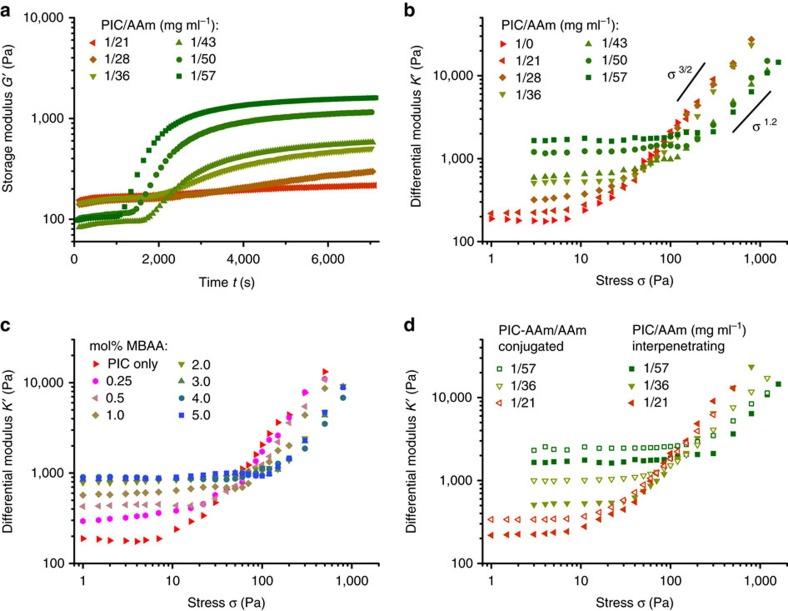
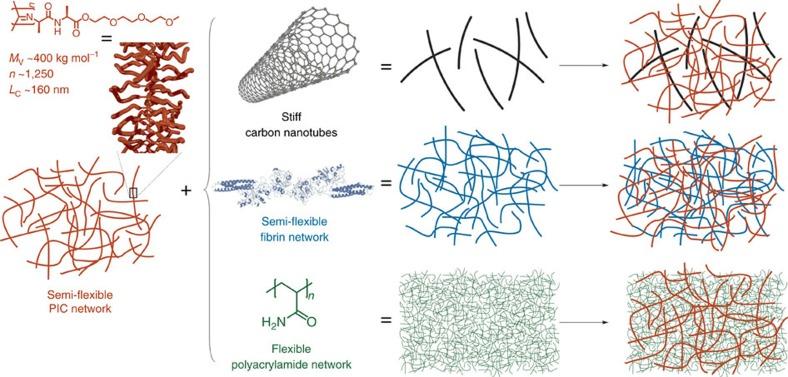
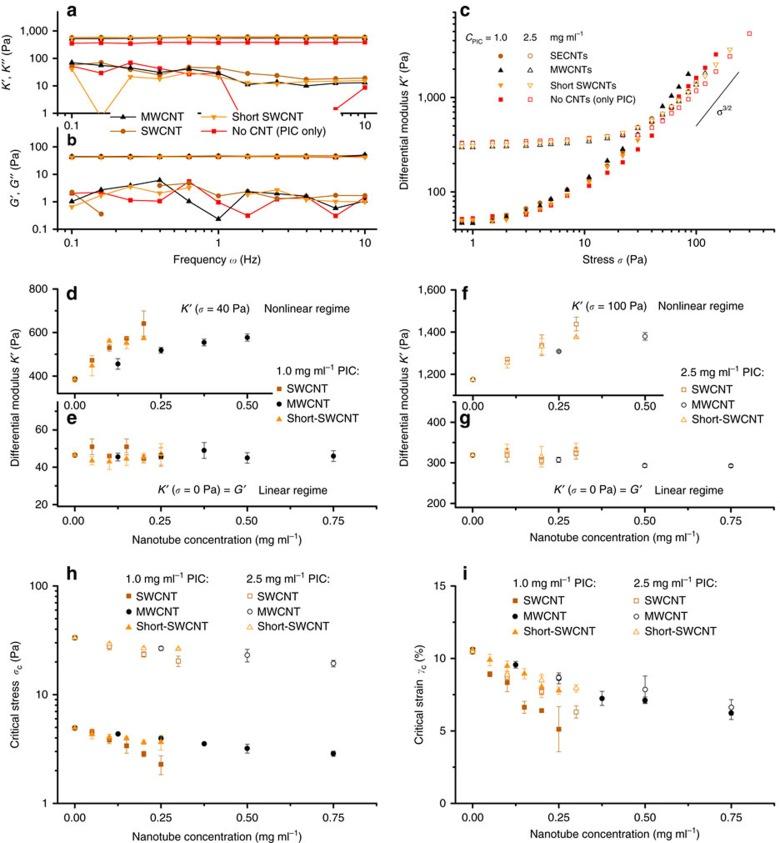
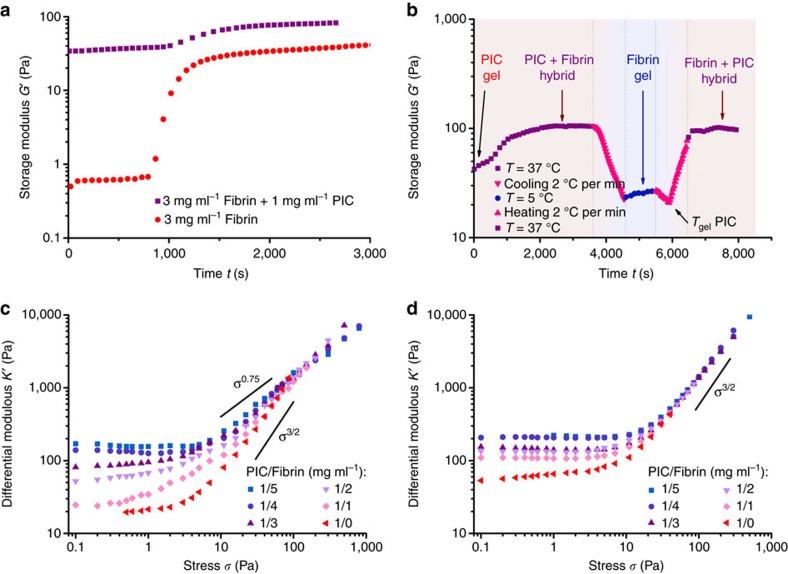
The mechanical properties of cells and the extracellular environment they reside in are governed by a complex interplay of biopolymers. These biopolymers, which possess a wide range of stiffnesses, self-assemble into fibrous composite networks such as the cytoskeleton and extracellular matrix. They interact with each other both physically and chemically to create a highly responsive and adaptive mechanical environment that stiffens when stressed or strained. Here we show that hybrid networks of a synthetic mimic of biological networks and either stiff, flexible and semi-flexible components, even very low concentrations of these added components, strongly affect the network stiffness and/or its strain-responsive character. The stiffness (persistence length) of the second network, its concentration and the interaction between the components are all parameters that can be used to tune the mechanics of the hybrids. The equivalence of these hybrids with biological composites is striking.
细胞的力学特性及其所处的细胞外环境是由生物聚合物的复杂相互作用所决定的。这些生物聚合物具有广泛的刚度范围,它们自组装成纤维状复合网络,如细胞骨架和细胞外基质。它们通过物理和化学相互作用来创建一个高度响应和自适应的机械环境,在受到压力或拉伸时会变硬。在这里,我们表明,生物网络的合成模拟物与刚性、柔性和半柔性成分的混合网络,即使这些添加成分的浓度非常低,也会强烈影响网络的刚度和/或其应变响应特性。第二个网络的刚度(持久长度)、其浓度以及组件之间的相互作用都是可以用来调整混合体力学性能的参数。这些混合体与生物复合材料的等效性是惊人的。
 Zotero 插件