
利什曼原虫LABCG1和LABCG2转运蛋白与毒力和氧化应激有关:与自噬的功能联系
Leishmania LABCG1 and LABCG2 transporters are involved in virulence and oxidative stress: functional linkage with autophagy.
作者信息
Manzano José Ignacio, Perea Ana, León-Guerrero David, Campos-Salinas Jenny, Piacenza Lucia, Castanys Santiago, Gamarro Francisco
机构信息
Instituto de Parasitología y Biomedicina "López-Neyra", IPBLN-CSIC, Parque Tecnológico de Ciencias de la Salud, Avda. del Conocimiento s/n, 18016, Granada, Spain.
Departamento de Bioquímica, Facultad de Medicina, Universidad de la República, Montevideo, Uruguay.
出版信息
Parasit Vectors. 2017 May 30;10(1):267. doi: 10.1186/s13071-017-2198-1.
BACKGROUND
The G subfamily of ABC (ATP-binding cassette) transporters of Leishmania include 6 genes (ABCG1-G6), some with relevant biological functions associated with drug resistance and phospholipid transport. Several studies have shown that Leishmania LABCG2 transporter plays a role in the exposure of phosphatidylserine (PS), in virulence and in resistance to antimonials. However, the involvement of this transporter in other key biological processes has not been studied.
METHODS
To better understand the biological function of LABCG2 and its nearly identical tandem-repeated transporter LABCG1, we have generated Leishmania major null mutant parasites for both genes (ΔLABCG1-2). NBD-PS uptake, infectivity, metacyclogenesis, autophagy and thiols were measured.
RESULTS
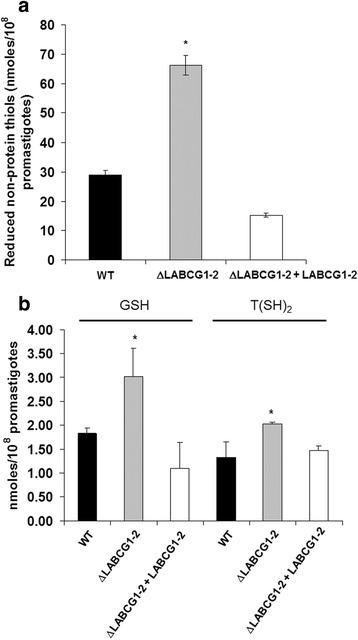
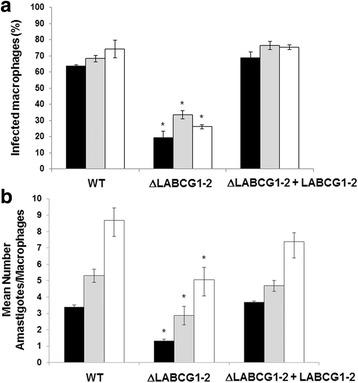
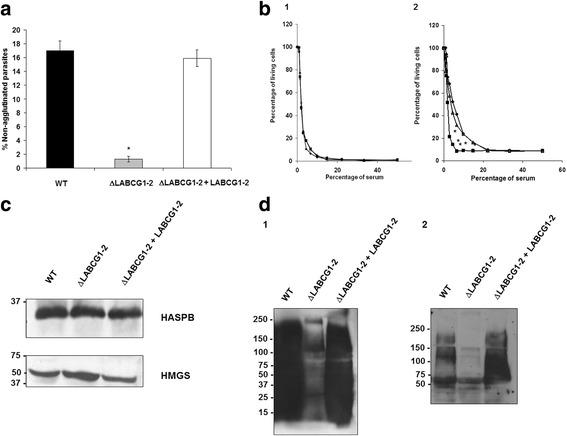
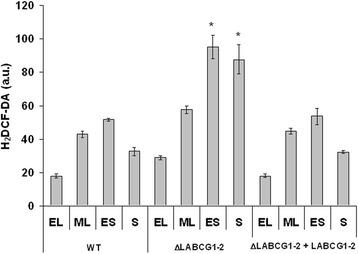
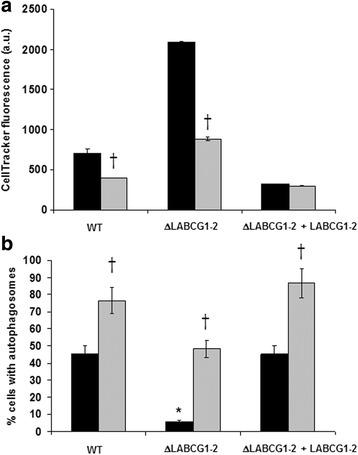
Leishmania major ΔLABCG1-2 parasites present a reduction in NBD-PS uptake, infectivity and virulence. In addition, we have shown that ΔLABCG1-2 parasites in stationary phase growth underwent less metacyclogenesis and presented differences in the plasma membrane's lipophosphoglycan composition. Considering that autophagy is an important process in terms of parasite virulence and cell differentiation, we have shown an autophagy defect in ΔLABCG1-2 parasites, detected by monitoring expression of the autophagosome marker RFP-ATG8. This defect correlates with increased levels of reactive oxygen species and higher non-protein thiol content in ΔLABCG1-2 parasites. HPLC analysis revealed that trypanothione and glutathione were the main molecules accumulated in these ΔLABCG1-2 parasites. The decrease in non-protein thiol levels due to preincubation with buthionine sulphoximide (a γ-glutamylcysteine synthetase inhibitor) restored the autophagy process in ΔLABCG1-2 parasites, indicating a relationship between autophagy and thiol content.
CONCLUSIONS
LABCG1-2 transporters from Leishmania could be considered as phosphatidylserine and non-protein thiol transporters. They probably accomplish transportation in conjunction with other molecules that are involved in oxidative stress, autophagy, metacyclogenesis and infectivity processes. The overall conclusion is that LABCG1-2 transporters could play a key role in Leishmania cell survival and infectivity.
背景
利什曼原虫ABC(ATP结合盒)转运蛋白的G亚家族包含6个基因(ABCG1 - G6),其中一些基因具有与耐药性和磷脂转运相关的重要生物学功能。多项研究表明,利什曼原虫LABCG2转运蛋白在磷脂酰丝氨酸(PS)的暴露、毒力及对锑剂的耐药性方面发挥作用。然而,该转运蛋白在其他关键生物学过程中的作用尚未得到研究。
方法
为了更好地理解LABCG2及其近乎相同的串联重复转运蛋白LABCG1的生物学功能,我们构建了这两个基因的利什曼原虫主要无效突变寄生虫(ΔLABCG1 - 2)。测定了NBD - PS摄取、感染性、前鞭毛体形成、自噬和硫醇含量。
结果
利什曼原虫主要ΔLABCG1 - 2寄生虫的NBD - PS摄取、感染性和毒力降低。此外,我们发现处于稳定期生长的ΔLABCG1 - 2寄生虫前鞭毛体形成减少,且质膜脂磷壁酸组成存在差异。鉴于自噬在寄生虫毒力和细胞分化方面是一个重要过程,我们通过监测自噬体标记物RFP - ATG8的表达,发现ΔLABCG1 - 2寄生虫存在自噬缺陷。这种缺陷与ΔLABCG1 - 2寄生虫中活性氧水平升高和非蛋白硫醇含量增加相关。HPLC分析显示,锥虫硫醇和谷胱甘肽是这些ΔLABCG1 - 2寄生虫中积累的主要分子。用丁硫氨酸亚砜胺(一种γ - 谷氨酰半胱氨酸合成酶抑制剂)预孵育导致非蛋白硫醇水平降低,恢复了ΔLABCG1 - 2寄生虫的自噬过程,表明自噬与硫醇含量之间存在关联。
结论
利什曼原虫的LABCG1 - 2转运蛋白可被视为磷脂酰丝氨酸和非蛋白硫醇转运蛋白。它们可能与参与氧化应激、自噬、前鞭毛体形成和感染性过程的其他分子共同完成转运。总体结论是,LABCG1 - 2转运蛋白可能在利什曼原虫细胞存活和感染性中起关键作用。



 Zotero 插件