
在随机对照的英国TACT2试验(CRUK/05/19)中,比较加速与标准表柔比星序贯环磷酰胺、甲氨蝶呤和氟尿嘧啶或卡培他滨作为乳腺癌辅助治疗的效果:一项多中心、3期、开放标签、随机对照试验。
Accelerated versus standard epirubicin followed by cyclophosphamide, methotrexate, and fluorouracil or capecitabine as adjuvant therapy for breast cancer in the randomised UK TACT2 trial (CRUK/05/19): a multicentre, phase 3, open-label, randomised, controlled trial.
作者信息
Cameron David, Morden James P, Canney Peter, Velikova Galina, Coleman Robert, Bartlett John, Agrawal Rajiv, Banerji Jane, Bertelli Gianfilippo, Bloomfield David, Brunt A Murray, Earl Helena, Ellis Paul, Gaunt Claire, Gillman Alexa, Hearfield Nicholas, Laing Robert, Murray Nicholas, Couper Niki, Stein Robert C, Verrill Mark, Wardley Andrew, Barrett-Lee Peter, Bliss Judith M
机构信息
Cancer Research UK Edinburgh Centre, MRC Institute of Genetics and Molecular Medicine, University of Edinburgh, Edinburgh, UK.
ICR-CTSU, Division of Clinical Studies, Institute of Cancer Research, London, UK.
出版信息
Lancet Oncol. 2017 Jul;18(7):929-945. doi: 10.1016/S1470-2045(17)30404-7. Epub 2017 Jun 7.
BACKGROUND
Adjuvant chemotherapy for early breast cancer has improved outcomes but causes toxicity. The UK TACT2 trial used a 2×2 factorial design to test two hypotheses: whether use of accelerated epirubicin would improve time to tumour recurrence (TTR); and whether use of oral capecitabine instead of cyclophosphamide would be non-inferior in terms of patients' outcomes and would improve toxicity, quality of life, or both.
METHODS
In this multicentre, phase 3, randomised, controlled trial, we enrolled patients aged 18 years or older from 129 UK centres who had histologically confirmed node-positive or high-risk node-negative operable breast cancer, had undergone complete excision, and were due to receive adjuvant chemotherapy. Patients were randomly assigned to receive four cycles of 100 mg/m epirubicin either every 3 weeks (standard epirubicin) or every 2 weeks with 6 mg pegfilgrastim on day 2 of each cycle (accelerated epirubicin), followed by four 4-week cycles of either classic cyclophosphamide, methotrexate, and fluorouracil (CMF; 600 mg/m cyclophosphamide intravenously on days 1 and 8 or 100 mg/m orally on days 1-14; 40 mg/m methotrexate intravenously on days 1 and 8; and 600 mg/m fluorouracil intravenously on days 1 and 8 of each cycle) or four 3-week cycles of 2500 mg/m capecitabine (1250 mg/m given twice daily on days 1-14 of each cycle). The randomisation schedule was computer generated in random permuted blocks, stratified by centre, number of nodes involved (none vs one to three vs four or more), age (≤50 years vs >50 years), and planned endocrine treatment (yes vs no). The primary endpoint was TTR, defined as time from randomisation to first invasive relapse or breast cancer death, with intention-to-treat analysis of standard versus accelerated epirubicin and per-protocol analysis of CMF versus capecitabine. This trial is registered with ISRCTN, number 68068041, and with ClinicalTrials.gov, number NCT00301925.
FINDINGS
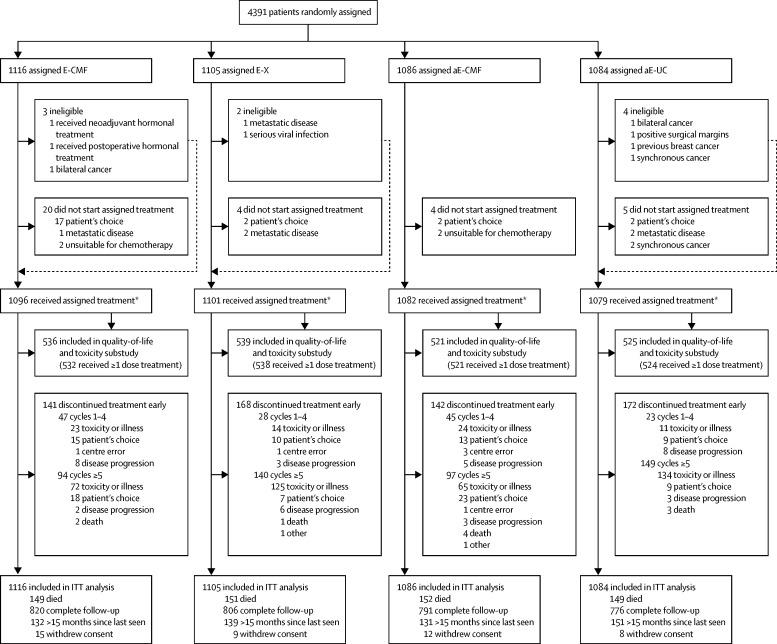
From Dec 16, 2005, to Dec 5, 2008, 4391 patients (4371 women and 20 men) were recruited. At a median follow-up of 85·6 months (IQR 80·6-95·9) no significant difference was seen in the proportions of patients free from TTR events between the accelerated and standard epirubicin groups (overall hazard ratio [HR] 0·94, 95% CI 0·81-1·09; stratified p=0·42). At 5 years, 85·9% (95% CI 84·3-87·3) of patients receiving standard epirubicin and 87·1% (85·6-88·4) of those receiving accelerated epirubicin were free from TTR events. 4358 patients were included in the per-protocol analysis, and no difference was seen in the proportions of patients free from TTR events between the CMF and capecitabine groups (HR 0·98, 95% CI 0·85-1.14; stratified p=0·00092 for non-inferiority). Compared with baseline, significantly more patients taking CMF than those taking capecitabine had clinically relevant worsening of quality of life at end of treatment (255 [58%] of 441 vs 235 [50%] of 475; p=0·011) and at 12 months (114 [34%] of 334 vs 89 [22%] of 401; p<0·001 at 12 months) and had worse quality of life over time (p<0·0001). Detailed toxicity and quality-of-life data were collected from 2115 (48%) of treated patients. The most common grade 3 or higher adverse events in cycles 1-4 were neutropenia (175 [16%]) and fatigue (56 [5%]) of the 1070 patients treated with standard epirubicin, and fatigue (63 [6%]) and infection (34 [3%]) of the 1045 patients treated with accelerated epirubicin. In cycles 5-8, the most common grade 3 or higher adverse events were neutropenia (321 [31%]) and fatigue (109 [11%]) in the patients treated with CMF, and hand-foot syndrome (129 [12%]) and diarrhoea (67 [6%]) in the 1044 patients treated with capcitabine.
INTERPRETATION
We found no benefit from increasing the dose density of the anthracycline component of chemotherapy. However, capecitabine could be used in place of CMF without significant loss of efficacy and with improved quality of life.
FUNDING
Cancer Research UK, Amgen, Pfizer, and Roche.
背景
早期乳腺癌的辅助化疗改善了治疗效果,但会产生毒性。英国TACT2试验采用2×2析因设计来检验两个假设:使用加速给药的表柔比星是否会改善肿瘤复发时间(TTR);使用口服卡培他滨替代环磷酰胺在患者治疗效果方面是否不劣于环磷酰胺,以及是否能改善毒性、生活质量或两者兼具。
方法
在这项多中心、3期、随机对照试验中,我们从英国129个中心招募了18岁及以上的患者,这些患者经组织学确诊为淋巴结阳性或高危淋巴结阴性的可手术乳腺癌,已接受完整切除,且即将接受辅助化疗。患者被随机分配接受4个周期的表柔比星,剂量为100mg/m²,每3周给药一次(标准表柔比星)或每2周给药一次,并在每个周期的第2天给予6mg聚乙二醇化重组人粒细胞刺激因子(加速表柔比星),随后接受4个为期4周的周期治疗,治疗方案为经典的环磷酰胺、甲氨蝶呤和氟尿嘧啶(CMF;环磷酰胺600mg/m²,在第1天和第8天静脉注射或在第1 - 14天口服100mg/m²;甲氨蝶呤40mg/m²,在第1天和第8天静脉注射;氟尿嘧啶600mg/m²,在每个周期的第1天和第8天静脉注射)或4个为期3周的周期治疗,治疗方案为卡培他滨2500mg/m²(每个周期的第1 - 14天,每日两次,每次1250mg/m²)。随机分组方案由计算机生成随机排列的区组,按中心、受累淋巴结数量(无淋巴结转移vs 1 - 3个淋巴结转移vs 4个或更多淋巴结转移)、年龄(≤50岁vs >50岁)和计划的内分泌治疗(是vs否)进行分层。主要终点是TTR,定义为从随机分组到首次侵袭性复发或乳腺癌死亡的时间,对标准表柔比星与加速表柔比星进行意向性分析,对CMF与卡培他滨进行符合方案分析。本试验已在国际标准随机对照试验编号注册库(ISRCTN)注册,编号为68068041,在ClinicalTrials.gov注册,编号为NCT00301925。
结果
从2005年12月16日至2008年12月5日,共招募了4391例患者(4371例女性和20例男性)。在中位随访85.6个月(四分位间距80.6 - 95.9个月)时,加速表柔比星组和标准表柔比星组无TTR事件的患者比例无显著差异(总体风险比[HR] 0.94,95%置信区间0.81 - 1.09;分层p = 0.42)。5年时,接受标准表柔比星治疗的患者中有85.9%(95%置信区间84.3 - 87.3)无TTR事件,接受加速表柔比星治疗的患者中有87.1%(85.6 - 88.4)无TTR事件。4358例患者纳入符合方案分析,CMF组和卡培他滨组无TTR事件的患者比例无差异(HR 0.98,95%置信区间0.85 - 1.14;非劣效性分层p = 0.00092)。与基线相比,治疗结束时服用CMF的患者中,生活质量出现临床相关恶化的患者显著多于服用卡培他滨的患者(441例中的255例[58%] vs 475例中的235例[50%];p = 0.011),在12个月时也是如此(334例中的114例[34%] vs 401例中的89例[22%];12个月时p < 0.001),且随着时间推移生活质量更差(p < 0.0001)。从2115例(48%)接受治疗的患者中收集了详细的毒性和生活质量数据。在第1 - 4周期中,接受标准表柔比星治疗的1070例患者中,最常见的3级或更高等级不良事件是中性粒细胞减少(175例[16%])和疲劳(56例[5%]),接受加速表柔比星治疗的1045例患者中,最常见的是疲劳(63例[6%])和感染(34例[3%])。在第5 - 8周期中,接受CMF治疗的患者中,最常见的3级或更高等级不良事件是中性粒细胞减少(321例[31%])和疲劳(109例[11%]),接受卡培他滨治疗的1044例患者中,最常见的是手足综合征(129例[12%])和腹泻(67例[6%])。
解读
我们发现增加化疗中蒽环类药物成分的剂量密度并无益处。然而,卡培他滨可替代CMF使用,且疗效无显著损失,生活质量有所改善。
资助
英国癌症研究中心、安进公司、辉瑞公司和罗氏公司。



 Zotero 插件