
颗粒蛋白-上皮素前体在肝细胞癌中与78 kDa葡萄糖调节蛋白相互作用。
Granulin-epithelin precursor interacts with 78-kDa glucose-regulated protein in hepatocellular carcinoma.
作者信息
Yip Chi Wai, Lam Ching Yan, Poon Terence C W, Cheung Tan To, Cheung Phyllis F Y, Fung Sze Wai, Wang Xiao Qi, Leung Idy C Y, Ng Linda W C, Lo Chung Mau, Tsao George S W, Cheung Siu Tim
机构信息
Department of Surgery, The Chinese University of Hong Kong, Hong Kong, China.
Department of Surgery, The University of Hong Kong, Hong Kong, China.
出版信息
BMC Cancer. 2017 Jun 10;17(1):409. doi: 10.1186/s12885-017-3399-x.
BACKGROUND
Granulin-epithelin precursor (GEP) is a secretory growth factor, which has been demonstrated to control cancer growth, invasion, drug resistance and immune escape. Our previous studies and others also demonstrated its potential in targeted therapy. Comprehensive characterization of GEP partner on cancer cells are warranted. We have previously shown that GEP interacted with heparan sulfate on the surface of liver cancer cells and the interaction is crucial for GEP-mediated signaling transduction. This study aims to characterize GEP protein partner at the cell membrane with the co-immunoprecipitation and mass spectrometry approach.
METHODS
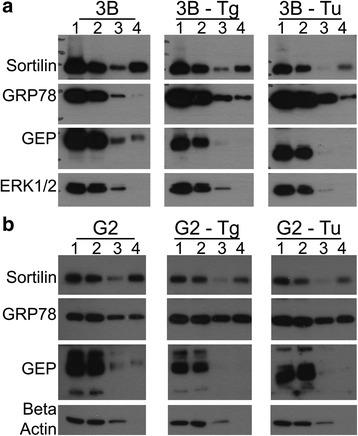
The membrane fraction from liver cancer model Hep3B was used for capturing binding partner with the specific monoclonal antibody against GEP. The precipitated proteins were analyzed by mass spectrometry. After identifying the GEP binding partner, this specific interaction was validated in additional liver cancer cell line HepG2 by co-immunoprecipitation using GRP78 and GEP antibodies, respectively, as the bait. GRP78 transcript levels in hepatocellular carcinoma (HCC) clinical samples (n = 77 pairs) were examined by real-time quantitative RT-PCR. GEP and GRP78 protein expressions were investigated by immunohistochemistry on paraffin sections.
RESULTS
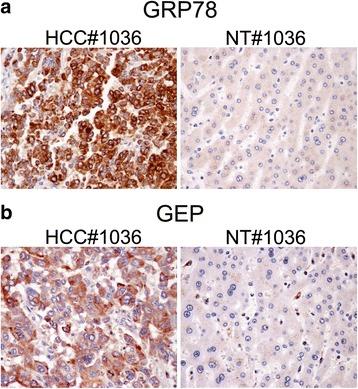
We identified the GEP-binding protein as 78-kDa glucose-regulated protein (GRP78, also named heat shock 70-kDa protein 5, HSPA5). This interaction was validated in independent HCC cell lines. Increased GRP78 mRNA levels were demonstrated in liver cancer tissues compared with the paralleled liver tissues (t-test, P = 0.002). GRP78 and GEP transcript levels were significantly correlated (Spearman's correlation, P = 0.001), and the proteins were also detectable in the cytoplasm of liver cancer cells by immunohistochemical staining.
CONCLUSIONS
GRP78 and GEP are interacting protein partners in liver cancer cells and may play a role in GEP-mediated cancer progression in HCC.
背景
颗粒蛋白-上皮素前体(GEP)是一种分泌性生长因子,已被证明可控制癌症的生长、侵袭、耐药性和免疫逃逸。我们之前的研究以及其他研究也证明了其在靶向治疗中的潜力。对癌细胞上GEP相互作用蛋白进行全面表征很有必要。我们之前已经表明,GEP与肝癌细胞表面的硫酸乙酰肝素相互作用,且这种相互作用对于GEP介导的信号转导至关重要。本研究旨在通过免疫共沉淀和质谱方法表征细胞膜上的GEP蛋白相互作用蛋白。
方法
使用肝癌模型Hep3B的膜组分,用针对GEP的特异性单克隆抗体捕获结合蛋白。对沉淀的蛋白质进行质谱分析。在鉴定出GEP结合蛋白后,分别使用GRP78和GEP抗体作为诱饵,通过免疫共沉淀在另一肝癌细胞系HepG2中验证这种特异性相互作用。通过实时定量逆转录PCR检测肝细胞癌(HCC)临床样本(n = 77对)中的GRP78转录水平。通过石蜡切片免疫组织化学研究GEP和GRP78蛋白表达。
结果
我们鉴定出GEP结合蛋白为78 kDa葡萄糖调节蛋白(GRP78,也称为热休克70 kDa蛋白5,HSPA5)。这种相互作用在独立的肝癌细胞系中得到验证。与平行的肝组织相比,肝癌组织中GRP78 mRNA水平升高(t检验,P = 0.002)。GRP78和GEP转录水平显著相关(Spearman相关性,P = 0.001),并且通过免疫组织化学染色在肝癌细胞的细胞质中也可检测到这两种蛋白。
结论
GRP78和GEP是肝癌细胞中的相互作用蛋白伴侣,可能在GEP介导的HCC癌症进展中发挥作用。



 Zotero 插件