
厄瓜多尔各省孕产妇死亡率方面的社会不平等现象。
Social inequalities in maternal mortality among the provinces of Ecuador.
作者信息
Sanhueza Antonio, Roldán Jakeline Calle, Ríos-Quituizaca Paulina, Acuña Maria Cecilia, Espinosa Isabel
机构信息
Pan American Health Organization, Washington, D.C., United States of America.
Ministry of Public Health of Ecuador, Quito, Ecuador.
出版信息
Rev Panam Salud Publica. 2017 Jun 8;41:e97. doi: 10.26633/RPSP.2017.97.
OBJECTIVE
This study set out to describe the association between the maternal mortality ratio (MMR) estimates and a set of socioeconomic indicators and compute the MMR inequalities among the provinces of Ecuador.
METHODS
A cross-sectional ecological study was conducted, using data for 2014 from the country's 24 provinces. The MMR estimate was calculated for each province, as well as the association and its strength between MMR and specific socioeconomic indicators. For the indicators that were found to be significantly associated with MMR, inequality measurements were computed.
RESULTS
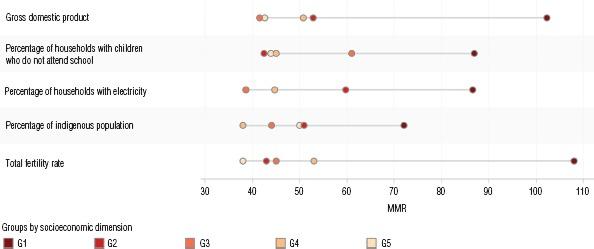
Despite a relatively low MMR for Ecuador overall, ratios differed substantially among the provinces. Five socioeconomic indicators proved to be statistically significantly associated with MMR: total fertility rate, the percentage of indigenous population, the percentage of households with children who do not attend school, gross domestic product, and the percentage of houses with electrical service. Of these five, only three had MMR inequalities that were significant: total fertility rate, gross domestic product, and the percentage of households with electricity.
CONCLUSIONS
This study supports research arguing that national averages can be misleading, as they often hide differences among subgroups at the local level. The findings also suggest that MMR is significantly associated with some socioeconomic indicators, including ones linked with significant health outcome inequalities. In order to reduce health inequities, it is crucial that countries look beyond national averages and identify the subgroups being left behind, explore the particular social determinants that generate these health inequalities, and examine the specific barriers and other factors affecting the subgroups most vulnerable to maternal health inequalities.
目的
本研究旨在描述孕产妇死亡率(MMR)估计值与一系列社会经济指标之间的关联,并计算厄瓜多尔各省之间的MMR不平等情况。
方法
开展了一项横断面生态研究,使用了该国24个省份2014年的数据。计算了每个省份的MMR估计值,以及MMR与特定社会经济指标之间的关联及其强度。对于发现与MMR显著相关的指标,计算了不平等度量。
结果
尽管厄瓜多尔总体的MMR相对较低,但各省之间的比率差异很大。五个社会经济指标被证明与MMR在统计学上显著相关:总生育率、土著人口百分比、有子女未上学家庭的百分比、国内生产总值以及有电力供应的房屋百分比。在这五个指标中,只有三个指标的MMR不平等情况显著:总生育率、国内生产总值以及有电力供应的家庭百分比。
结论
本研究支持了这样的研究观点,即全国平均水平可能具有误导性,因为它们常常掩盖了地方层面亚组之间的差异。研究结果还表明,MMR与一些社会经济指标显著相关,包括那些与显著的健康结果不平等相关的指标。为了减少健康不平等,各国至关重要的是超越全国平均水平,识别被落下的亚组,探索造成这些健康不平等的特定社会决定因素,并审视影响最易受孕产妇健康不平等影响的亚组的具体障碍和其他因素。

 Zotero 插件