
阿巴氯芬治疗脆性X综合征:3期试验结果
Arbaclofen in fragile X syndrome: results of phase 3 trials.
作者信息
Berry-Kravis Elizabeth, Hagerman Randi, Visootsak Jeannie, Budimirovic Dejan, Kaufmann Walter E, Cherubini Maryann, Zarevics Peter, Walton-Bowen Karen, Wang Paul, Bear Mark F, Carpenter Randall L
机构信息
Departments of Pediatrics, Neurological Sciences, Biochemistry, Rush University Medical Center, 1725 West Harrison, Suite 718, Chicago, IL 60612 USA.
MIND Institute and Department of Pediatrics, University of California Davis Medical Center, 2825 50th Street, Sacramento, CA 95817 USA.
出版信息
J Neurodev Disord. 2017 Jun 12;9:3. doi: 10.1186/s11689-016-9181-6. eCollection 2017.
BACKGROUND
Arbaclofen improved multiple abnormal phenotypes in animal models of fragile X syndrome (FXS) and showed promising results in a phase 2 clinical study. The objective of the study is to determine safety and efficacy of arbaclofen for social avoidance in FXS.
METHODS
Two phase 3 placebo-controlled trials were conducted, a flexible dose trial in subjects age 12-50 (209FX301, adolescent/adult study) and a fixed dose trial in subjects age 5-11 (209FX302, child study). The primary endpoint for both trials was the Social Avoidance subscale of the Aberrant Behavior Checklist-Community Edition, FXS-specific (ABC-C). Secondary outcomes included other ABC-C subscale scores, Clinical Global Impression-Improvement (CGI-I), Clinical Global Impression-Severity (CGI-S), and Vineland Adaptive Behavior Scales, Second Edition (Vineland-II) Socialization domain score.
RESULTS
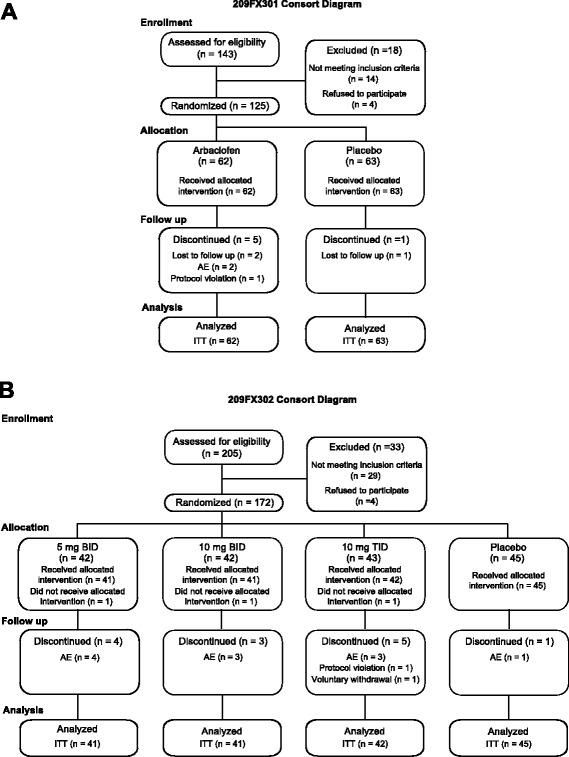
A total 119 of 125 randomized subjects completed the adolescent/adult study ( = 57 arbaclofen, 62 placebo) and 159/172 completed the child study (arbaclofen 5 BID = 38; 10 BID = 39; 10 TID = 38; placebo = 44). There were no serious adverse events (AEs); the most common AEs included somatic (headache, vomiting, nausea), neurobehavioral (irritability/agitation, anxiety, hyperactivity), decreased appetite, and infectious conditions, many of which were also common on placebo. In the combined studies, there were 13 discontinuations ( = 12 arbaclofen, 1 placebo) due to AEs (all neurobehavioral). The adolescent/adult study did not show benefit for arbaclofen over placebo for any measure. In the child study, the highest dose group showed benefit over placebo on the ABC-C Irritability subscale ( = 0.03) and Parenting Stress Index (PSI, = 0.03) and trends toward benefit on the ABC-C Social Avoidance and Hyperactivity subscales (both < 0.1) and CGI-I ( = 0.119). Effect size in the highest dose group was similar to effect sizes for FDA-approved serotonin reuptake inhibitors (SSRIs).
CONCLUSIONS
Arbaclofen did not meet the primary outcome of improved social avoidance in FXS in either study. Data from secondary measures in the child study suggests younger patients may derive benefit, but additional studies with a larger cohort on higher doses would be required to confirm this finding. The reported studies illustrate the challenges but represent a significant step forward in translating targeted treatments from preclinical models to clinical trials in humans with FXS.
背景
阿巴氯芬改善了脆性X综合征(FXS)动物模型中的多种异常表型,并在一项2期临床研究中显示出有前景的结果。本研究的目的是确定阿巴氯芬对FXS社交回避的安全性和有效性。
方法
进行了两项3期安慰剂对照试验,一项针对12 - 50岁受试者的灵活剂量试验(209FX301,青少年/成人研究)和一项针对5 - 11岁受试者的固定剂量试验(209FX302,儿童研究)。两项试验的主要终点均为特定于FXS的异常行为检查表社区版(ABC - C)中的社交回避分量表。次要结果包括其他ABC - C分量表得分、临床总体印象改善(CGI - I)、临床总体印象严重程度(CGI - S)以及文兰适应行为量表第二版(文兰-II)社交化领域得分。
结果
125名随机分组的受试者中,共有119名完成了青少年/成人研究(阿巴氯芬组 = 57名,安慰剂组 = 62名),159/172名完成了儿童研究(阿巴氯芬5毫克每日两次 = 38名;10毫克每日两次 = 39名;10毫克每日三次 = 38名;安慰剂组 = 44名)。无严重不良事件(AE);最常见的不良事件包括躯体症状(头痛、呕吐、恶心)、神经行为症状(易怒/激动、焦虑、多动)、食欲下降和感染性疾病,其中许多在安慰剂组中也很常见。在综合研究中,有13例因不良事件停药(阿巴氯芬组 = 12例,安慰剂组 = 1例)(均为神经行为方面)。青少年/成人研究中,在任何测量指标上,阿巴氯芬均未显示出优于安慰剂的效果。在儿童研究中,最高剂量组在ABC - C易怒分量表(P = 0.03)和养育压力指数(PSI,P = 0.03)上显示出优于安慰剂的效果,在ABC - C社交回避和多动分量表(均P < 0.1)以及CGI - I(P = 0.119)上有获益趋势。最高剂量组的效应大小与FDA批准的5 - 羟色胺再摄取抑制剂(SSRI)的效应大小相似。
结论
在两项研究中,阿巴氯芬均未达到改善FXS社交回避这一主要结局。儿童研究的次要测量数据表明,年轻患者可能会获益,但需要更多更大样本量、更高剂量的研究来证实这一发现。所报道的研究说明了其中的挑战,但代表了从临床前模型到FXS人类临床试验的靶向治疗转化过程中的重要一步。




 Zotero 插件