
南非 Xpert MTB/RIF 在结核病诊断中的成本效益:真实世界的成本分析和经济评估。
Cost-effectiveness of Xpert MTB/RIF for tuberculosis diagnosis in South Africa: a real-world cost analysis and economic evaluation.
机构信息
TB Centre, London School of Hygiene & Tropical Medicine, London, UK; Department of Global Health and Development, London School of Hygiene & Tropical Medicine, London, UK.
Department of Global Health and Development, London School of Hygiene & Tropical Medicine, London, UK.
出版信息
Lancet Glob Health. 2017 Jul;5(7):e710-e719. doi: 10.1016/S2214-109X(17)30205-X.
BACKGROUND
In 2010 a new diagnostic test for tuberculosis, Xpert MTB/RIF, received a conditional programmatic recommendation from WHO. Several model-based economic evaluations predicted that Xpert would be cost-effective across sub-Saharan Africa. We investigated the cost-effectiveness of Xpert in the real world during national roll-out in South Africa.
METHODS
For this real-world cost analysis and economic evaluation, we applied extensive primary cost and patient event data from the XTEND study, a pragmatic trial examining Xpert introduction for people investigated for tuberculosis in 40 primary health facilities (20 clusters) in South Africa enrolled between June 8, and Nov 16, 2012, to estimate the costs and cost per disability-adjusted life-year averted of introducing Xpert as the initial diagnostic test for tuberculosis, compared with sputum smear microscopy (the standard of care).
FINDINGS
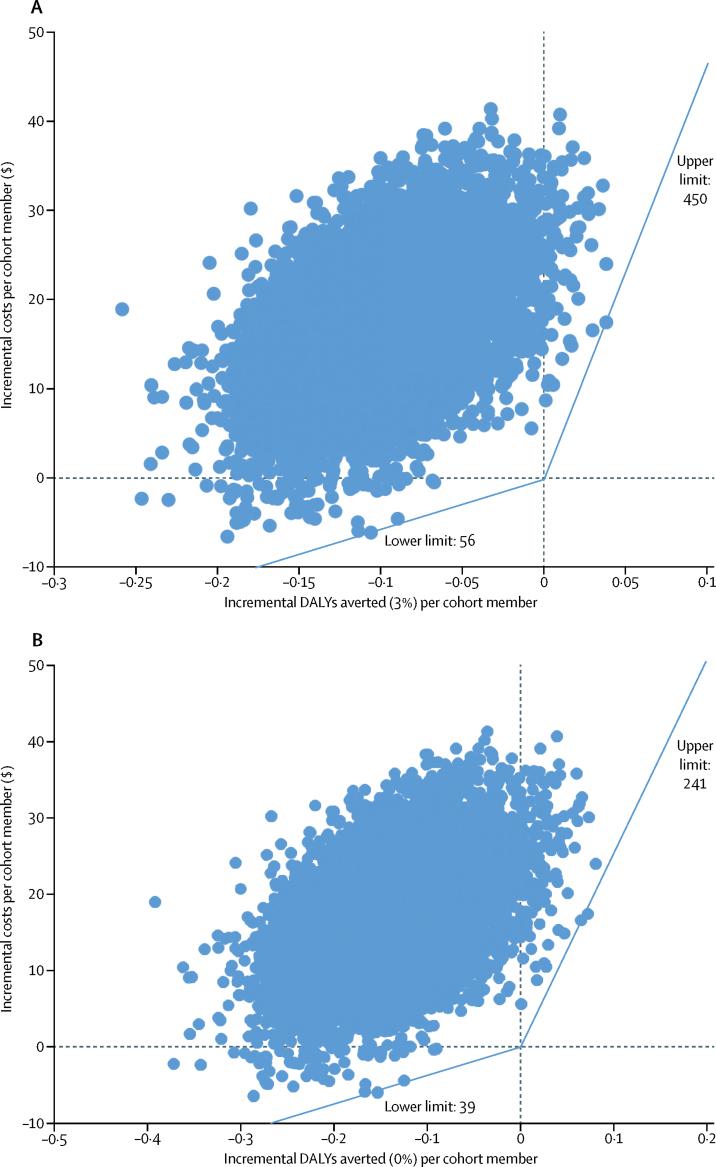
The mean total cost per study participant for tuberculosis investigation and treatment was US$312·58 (95% CI 252·46-372·70) in the Xpert group and $298·58 (246·35-350·82) in the microscopy group. The mean health service (provider) cost per study participant was $168·79 (149·16-188·42) for the Xpert group and $160·46 (143·24-177·68) for the microscopy group of the study. Considering uncertainty in both cost and effect using a wide range of willingness to pay thresholds, we found less than 3% probability that Xpert introduction improved the cost-effectiveness of tuberculosis diagnostics.
INTERPRETATION
After analysing extensive primary data collection during roll-out, we found that Xpert introduction in South Africa was cost-neutral, but found no evidence that Xpert improved the cost-effectiveness of tuberculosis diagnosis. Our study highlights the importance of considering implementation constraints, when predicting and evaluating the cost-effectiveness of new tuberculosis diagnostics in South Africa.
FUNDING
Bill & Melinda Gates Foundation.
背景
2010 年,世卫组织对一种新的结核病诊断检测方法——Xpert MTB/RIF 给予了有条件的规划推荐。几项基于模型的经济评估预测,Xpert 在撒哈拉以南非洲将具有成本效益。我们在南非国家推广期间调查了 Xpert 在现实世界中的成本效益。
方法
在这项真实世界的成本分析和经济评估中,我们应用了来自 XTEND 研究的广泛的初级成本和患者事件数据,该研究是一项在南非 40 个初级保健机构(20 个集群)中对疑似结核病患者进行 Xpert 检测的实用性试验,于 2012 年 6 月 8 日至 11 月 16 日期间入组,旨在评估引入 Xpert 作为结核病初始诊断检测的成本和每避免一个残疾调整生命年的成本,与痰涂片显微镜检查(标准护理)相比。
结果
在 Xpert 组,每位结核病研究参与者的平均总调查和治疗费用为 312.58 美元(95%CI 252.46-372.70),在显微镜组为 298.58 美元(246.35-350.82)。每位研究参与者的卫生服务(提供者)成本平均为 Xpert 组 168.79 美元(149.16-188.42),显微镜组为 160.46 美元(143.24-177.68)。考虑到成本和效果的不确定性,使用广泛的支付意愿阈值,我们发现 Xpert 的引入使结核病诊断的成本效益提高的可能性小于 3%。
解释
在推广期间进行了广泛的初级数据收集分析后,我们发现 Xpert 在南非的引入是成本中性的,但没有发现 Xpert 提高结核病诊断成本效益的证据。我们的研究强调了在预测和评估新的结核病诊断在南非的成本效益时,考虑实施限制的重要性。
资助
比尔和梅琳达·盖茨基金会。

 Zotero 插件