
NAC 转录因子 JUNGBRUNNEN1 增强番茄的耐旱性。
NAC transcription factor JUNGBRUNNEN1 enhances drought tolerance in tomato.
机构信息
Institute of Biochemistry and Biology, University of Potsdam, Potsdam-Golm, Germany.
Max Planck Institute of Molecular Plant Physiology, Potsdam-Golm, Germany.
出版信息
Plant Biotechnol J. 2018 Feb;16(2):354-366. doi: 10.1111/pbi.12776. Epub 2017 Aug 4.
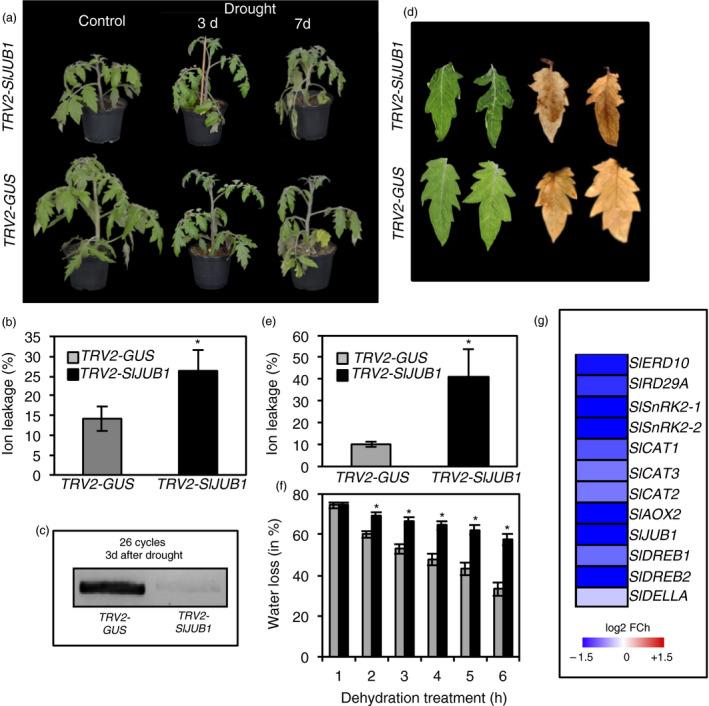
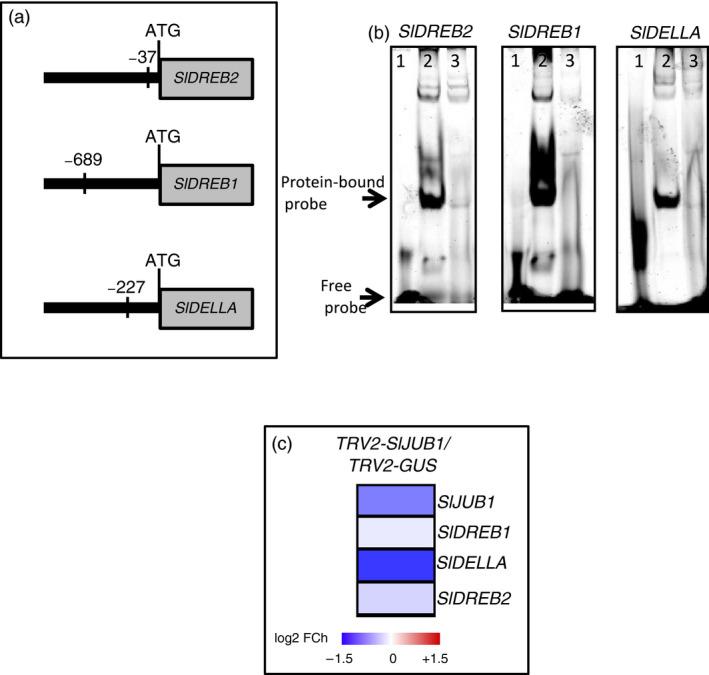
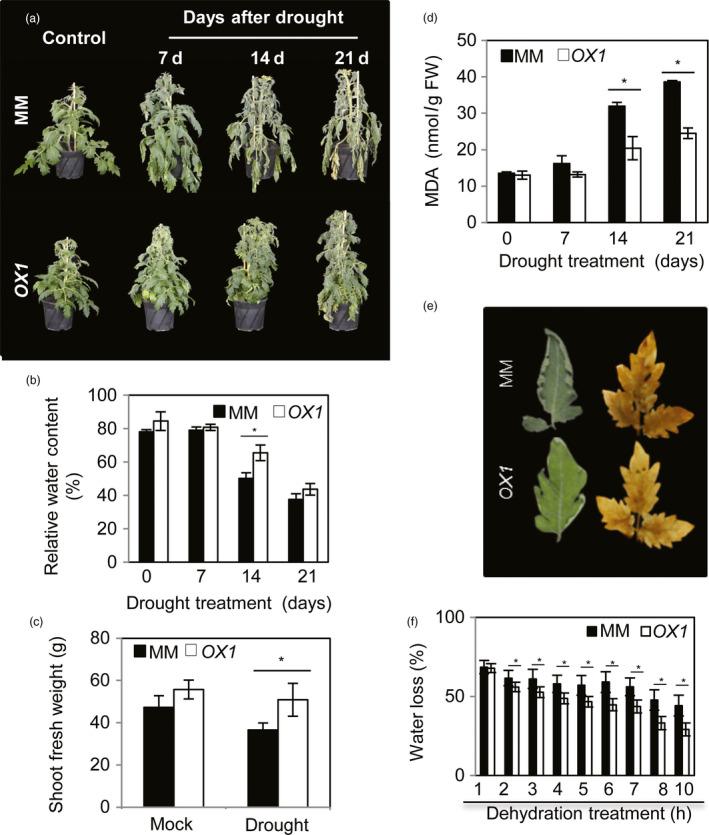
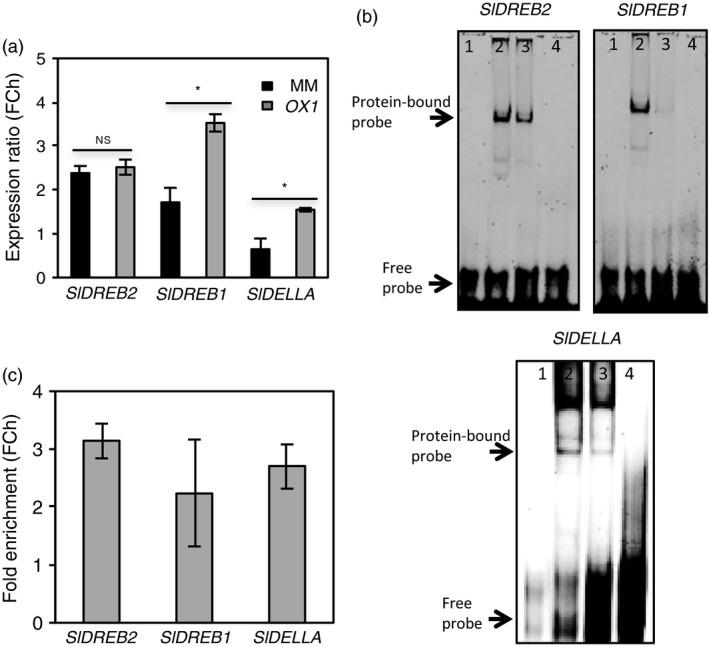
Water deficit (drought stress) massively restricts plant growth and the yield of crops; reducing the deleterious effects of drought is therefore of high agricultural relevance. Drought triggers diverse cellular processes including the inhibition of photosynthesis, the accumulation of cell-damaging reactive oxygen species and gene expression reprogramming, besides others. Transcription factors (TF) are central regulators of transcriptional reprogramming and expression of many TF genes is affected by drought, including members of the NAC family. Here, we identify the NAC factor JUNGBRUNNEN1 (JUB1) as a regulator of drought tolerance in tomato (Solanum lycopersicum). Expression of tomato JUB1 (SlJUB1) is enhanced by various abiotic stresses, including drought. Inhibiting SlJUB1 by virus-induced gene silencing drastically lowers drought tolerance concomitant with an increase in ion leakage, an elevation of hydrogen peroxide (H O ) levels and a decrease in the expression of various drought-responsive genes. In contrast, overexpression of AtJUB1 from Arabidopsis thaliana increases drought tolerance in tomato, alongside with a higher relative leaf water content during drought and reduced H O levels. AtJUB1 was previously shown to stimulate expression of DREB2A, a TF involved in drought responses, and of the DELLA genes GAI and RGL1. We show here that SlJUB1 similarly controls the expression of the tomato orthologs SlDREB1, SlDREB2 and SlDELLA. Furthermore, AtJUB1 directly binds to the promoters of SlDREB1, SlDREB2 and SlDELLA in tomato. Our study highlights JUB1 as a transcriptional regulator of drought tolerance and suggests considerable conservation of the abiotic stress-related gene regulatory networks controlled by this NAC factor between Arabidopsis and tomato.
水分亏缺(干旱胁迫)极大地限制了植物的生长和作物的产量;因此,减少干旱的有害影响具有重要的农业意义。干旱触发了多种细胞过程,包括光合作用的抑制、细胞损伤的活性氧物质的积累和基因表达的重编程等。转录因子(TF)是转录重编程的核心调节剂,许多 TF 基因的表达受到干旱的影响,包括 NAC 家族的成员。在这里,我们将 NAC 因子 JUNGBRUNNEN1(JUB1)鉴定为番茄(Solanum lycopersicum)抗旱性的调节剂。番茄 SlJUB1(SlJUB1)的表达受多种非生物胁迫的增强,包括干旱。通过病毒诱导的基因沉默抑制 SlJUB1 会极大地降低其抗旱性,同时伴随着离子渗漏增加、过氧化氢(H2O2)水平升高和各种干旱响应基因表达降低。相比之下,拟南芥 AtJUB1 的过表达增加了番茄的抗旱性,同时在干旱期间具有更高的相对叶片含水量和降低的 H2O2 水平。AtJUB1 先前被证明能刺激参与干旱响应的 TF DREB2A 以及 DELLA 基因 GAI 和 RGL1 的表达。我们在这里表明,SlJUB1 同样控制着番茄同源物 SlDREB1、SlDREB2 和 SlDELLA 的表达。此外,AtJUB1 还能直接结合番茄 SlDREB1、SlDREB2 和 SlDELLA 的启动子。我们的研究强调了 JUB1 作为抗旱性的转录调节剂,并表明这个 NAC 因子调控的与非生物胁迫相关的基因调控网络在拟南芥和番茄之间具有相当大的保守性。


 Zotero 插件