
家蚊属的马来伊蚊和白纹伊蚊是城市中虫媒病毒的有效传播媒介。
Peridomestic Aedes malayensis and Aedes albopictus are capable vectors of arboviruses in cities.
作者信息
Mendenhall Ian H, Manuel Menchie, Moorthy Mahesh, Lee Theodore T M, Low Dolyce H W, Missé Dorothée, Gubler Duane J, Ellis Brett R, Ooi Eng Eong, Pompon Julien
机构信息
Program in Emerging Infectious Disease, Duke-NUS Medical School, Singapore.
Department of Clinical Virology, Christian Medical College, Vellore, Tamilnadu, India.
出版信息
PLoS Negl Trop Dis. 2017 Jun 26;11(6):e0005667. doi: 10.1371/journal.pntd.0005667. eCollection 2017 Jun.
BACKGROUND
Dengue and chikungunya are global re-emerging mosquito-borne diseases. In Singapore, sustained vector control coupled with household improvements reduced domestic mosquito populations for the past 45 years, particularly the primary vector Aedes aegypti. However, while disease incidence was low for the first 30 years following vector control implementation, outbreaks have re-emerged in the past 15 years. Epidemiological observations point to the importance of peridomestic infection in areas not targeted by control programs. We investigated the role of vectors in peri-domestic areas.
METHODS
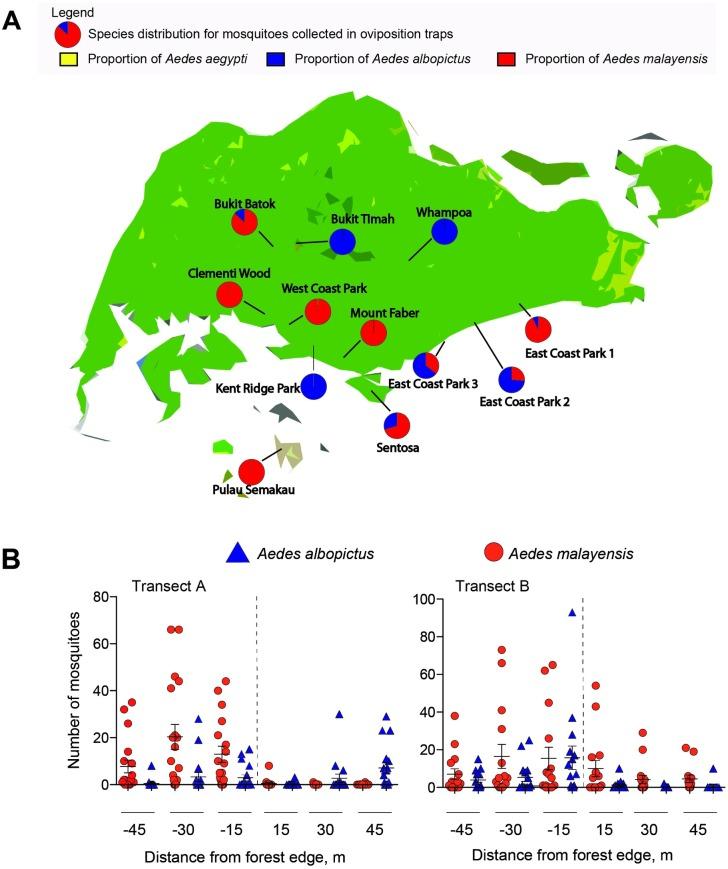
We carried out entomological surveys to identify the Aedes species present in vegetated sites in highly populated areas and determine whether mosquitoes were present in open-air areas frequented by people. We compared vector competence of Aedes albopictus and Aedes malayensis with Ae. aegypti after oral infection with sympatric dengue serotype 2 and chikungunya viruses. Mosquito saliva was tested for the presence of infectious virus particles as a surrogate for transmission following oral infection.
RESULTS
We identified Aedes albopictus and Aedes malayensis throughout Singapore and quantified their presence in forested and opened grassy areas. Both Ae. albopictus and Ae. malayensis can occupy sylvatic niches and were highly susceptible to both arboviruses. A majority of saliva of infected Ae. malayensis contained infectious particles for both viruses.
CONCLUSIONS
Our study reveals the prevalence of competent vectors in peri-domestic areas, including Ae. malayensis for which we established the vector status. Epidemics can be driven by infection foci, which are epidemiologically enhanced in the context of low herd immunity, selective pressure on arbovirus transmission and the presence of infectious asymptomatic persons, all these conditions being present in Singapore. Learning from Singapore's vector control success that reduced domestic vector populations, but has not sustainably reduced arboviral incidence, we suggest including peri-domestic vectors in the scope of vector management.
背景
登革热和基孔肯雅热是全球再度出现的蚊媒疾病。在新加坡,持续的病媒控制措施与家庭环境改善相结合,在过去45年里减少了国内蚊子数量,尤其是主要病媒埃及伊蚊。然而,在实施病媒控制措施后的头30年里疾病发病率较低,但在过去15年里疫情再度出现。流行病学观察表明,在未被控制项目覆盖的周边地区,家庭周边感染非常重要。我们调查了病媒在家庭周边地区的作用。
方法
我们开展了昆虫学调查,以确定人口密集地区植被覆盖区域存在的伊蚊种类,并确定人们经常光顾的露天区域是否有蚊子。在用同域登革2型血清型病毒和基孔肯雅病毒经口感染后,我们比较了白纹伊蚊和马来伊蚊与埃及伊蚊的媒介能力。检测蚊唾液中是否存在传染性病毒颗粒,作为经口感染后传播的替代指标。
结果
我们在新加坡各地发现了白纹伊蚊和马来伊蚊,并对它们在森林和开阔草地的分布情况进行了量化。白纹伊蚊和马来伊蚊都可占据野生生态位,并且对这两种虫媒病毒都高度易感。大多数感染的马来伊蚊的唾液中都含有这两种病毒的传染性颗粒。
结论
我们的研究揭示了家庭周边地区具有传播能力的病媒普遍存在,包括我们确定了其病媒地位的马来伊蚊。疫情可能由感染源引发,在群体免疫力低下、虫媒病毒传播的选择压力以及无症状感染者存在的情况下,从流行病学角度来看疫情会加剧,而新加坡存在所有这些情况。从新加坡病媒控制成功减少了国内病媒数量但未能持续降低虫媒病毒发病率的经验中吸取教训,我们建议将家庭周边病媒纳入病媒管理范围。


 Zotero 插件