
CD8+CD28+/CD8+CD28- T细胞比例降低可敏感预测复杂性克罗恩病患者的不良预后。
Decreased CD8+CD28+/CD8+CD28- T cell ratio can sensitively predict poor outcome for patients with complicated Crohn disease.
作者信息
Dai Shi-Xue, Gu Hong-Xiang, Lin Qian-Yi, Wu Yan-Kun, Wang Xiao-Yan, Huang Shao-Zhuo, Xing Tiao-Si, Chen Min-Hua, Zhang Qing-Fang, Zheng Zhong-Wen, Sha Wei-Hong
机构信息
Department of Gastroenterology, Guangdong General Hospital and Guangdong Academy of Medical Sciences, South China University of Technology Department of Gastroenterology, Nanfang Hospital The First Clinical Medical School (Nanfang Hospital), Southern Medical University, Guangzhou, Guangdong Department of Clinical Medicine, Zhongshan School of Medicine, Sun Yat-sen University Department of Anatomy & Cell Biology, Brody School of Medicine, East Carolina University, Greenville, NC, USA School of Public Health, Southern Medical University, Guangzhou, Guangdong, China.
出版信息
Medicine (Baltimore). 2017 Jun;96(26):e7247. doi: 10.1097/MD.0000000000007247.
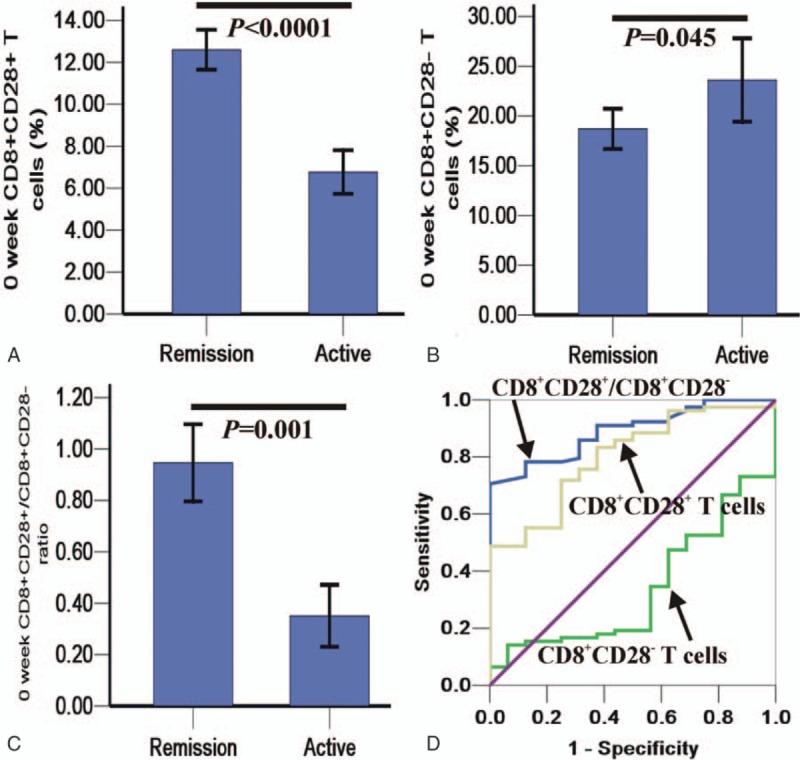
Crohn disease (CD) with complications such as penetrating, stricturing, and perianal disease is called complicated CD. The aim of this study is to test the efficiency with which the CD8CD28/CD8CD28 cell balance can predict a subsequent active stage in patients with newly diagnosed complicated CD.Seventeen patients with complicated CD and 48 CD patients with no complications were enrolled. Blood CD8 T cells were tested from all of the 65 newly diagnosed CD patients upon enrollment. The potential risk factors were compared between the 2 groups. A 30-week follow-up was performed, and the efficiency of the CD8 cell balance at predicting active CD was analyzed using receiver-operating characteristic curves. The cumulative remission lasting rates (CRLRs) were analyzed using the Kaplan-Meier method.Compared with the control CD group, patients with complicated CD were predominantly male and younger in age; they also had lower body mass indices (BMIs), higher Crohn disease activity indices (CDAIs), higher immunosuppressant and steroid prescription rates, and significantly higher surgical rates. The CD8CD28/CD8CD28 balance was associated with BMI, CDAI, steroids, and surgery. The CD8CD28/CD8CD28 ratios were significantly lower at week 0 and on the 6th, 22nd, and 30th week during follow-up with a shorter lasting time of remission for the complicated CD patients. The CD8CD28/CD8CD28 ratio could accurately predict the active stage for the patients with complicated CD, and the highest sensitivity (89.2%) and specificity (85.3%) were found when the ratio was 1.03. Treatment with steroids and surgery, along with a significantly lower CD8CD28/CD8CD28 ratio and lower CRLRs, was closely related to a worse outcome for the patients with complicated CD.Patients requiring steroids and surgery experience more severe disease activity and thus a disequilibrated immunological balance, which could be the main reason for a decreased CD8CD28/CD8CD28 ratio. This ratio can sensitively predict the active stage for patients with complicated CD, and more care should be taken when this ratio is <1.03.
伴有穿透性、狭窄性和肛周疾病等并发症的克罗恩病(CD)被称为复杂性CD。本研究的目的是检验CD8CD28⁺/CD8CD28⁻细胞平衡预测新诊断的复杂性CD患者后续活动期的效能。招募了17例复杂性CD患者和48例无并发症的CD患者。在入组时对所有65例新诊断的CD患者进行血液CD8⁺ T细胞检测。比较两组之间的潜在危险因素。进行了为期30周的随访,并使用受试者操作特征曲线分析CD8⁺细胞平衡预测活动性CD的效能。使用Kaplan-Meier方法分析累积缓解持续率(CRLRs)。与对照CD组相比,复杂性CD患者以男性为主且年龄较小;他们的体重指数(BMI)较低、克罗恩病活动指数(CDAI)较高、免疫抑制剂和类固醇处方率较高,手术率也显著更高。CD8CD28⁺/CD8CD28⁻平衡与BMI、CDAI、类固醇和手术有关。在随访的第0周以及第6、22和30周,CD8CD28⁺/CD8CD28⁻比值显著较低,且复杂性CD患者的缓解持续时间较短。CD8CD28⁺/CD8CD28⁻比值可以准确预测复杂性CD患者的活动期,当该比值为1.03时,敏感性最高(89.2%),特异性最高(85.3%)。类固醇和手术治疗,以及显著较低的CD8CD28⁺/CD8CD28⁻比值和较低的CRLRs,与复杂性CD患者的较差预后密切相关。需要类固醇和手术治疗的患者疾病活动更严重,因此免疫平衡失调,这可能是CD8CD28⁺/CD8CD28⁻比值降低的主要原因。该比值可以敏感地预测复杂性CD患者的活动期,当该比值<1.03时应更加关注。




 Zotero 插件