
牛基因组中的假定增强子位点富含影响复杂性状的变异。
Putative enhancer sites in the bovine genome are enriched with variants affecting complex traits.
作者信息
Wang Min, Hancock Timothy P, MacLeod Iona M, Pryce Jennie E, Cocks Benjamin G, Hayes Benjamin J
机构信息
School of Applied Systems Biology, La Trobe University, Bundoora, VIC, 3083, Australia.
Agriculture Victoria, AgriBio, Centre for AgriBioscience, Bundoora, VIC, 3083, Australia.
出版信息
Genet Sel Evol. 2017 Jul 6;49(1):56. doi: 10.1186/s12711-017-0331-4.
BACKGROUND
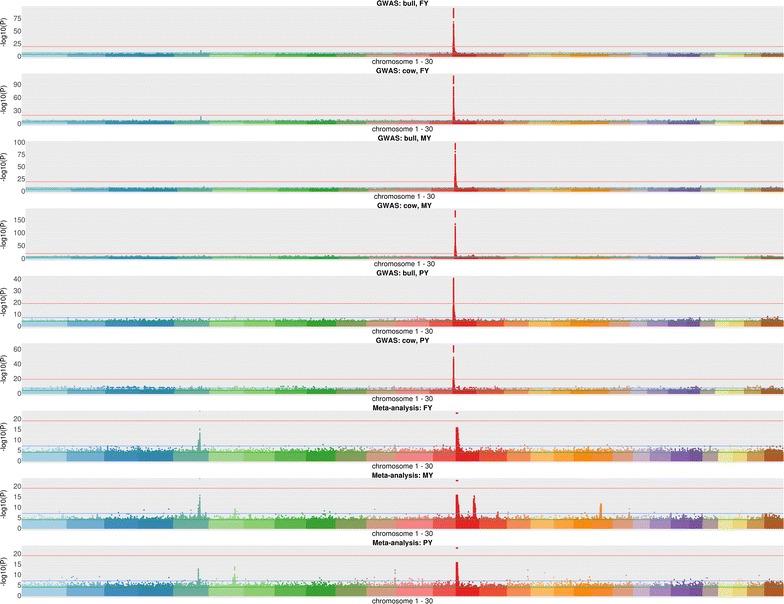
Enhancers are non-coding DNA sequences, which when they are bound by specific proteins increase the level of gene transcription. Enhancers activate unique gene expression patterns within cells of different types or under different conditions. Enhancers are key contributors to gene regulation, and causative variants that affect quantitative traits in humans and mice have been located in enhancer regions. However, in the bovine genome, enhancers as well as other regulatory elements are not yet well defined. In this paper, we sought to improve the annotation of bovine enhancer regions by using publicly available mammalian enhancer information. To test if the identified putative bovine enhancer regions are enriched with functional variants that affect milk production traits, we performed genome-wide association studies using imputed whole-genome sequence data followed by meta-analysis and enrichment analysis.
RESULTS
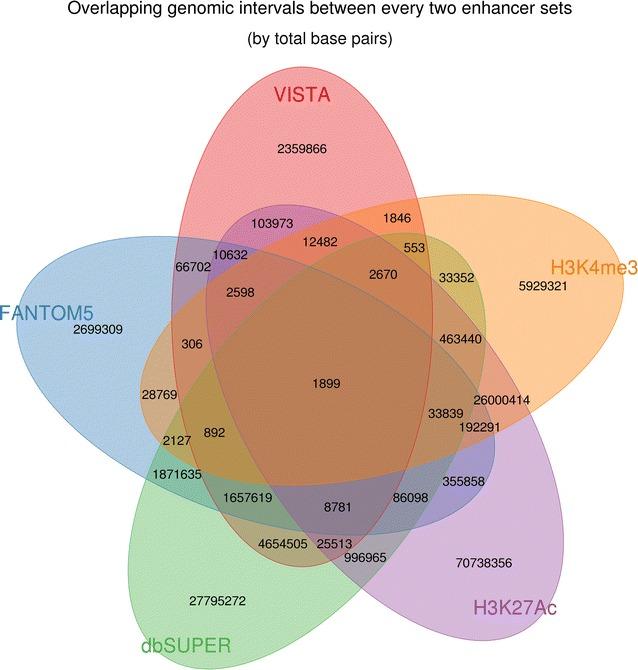
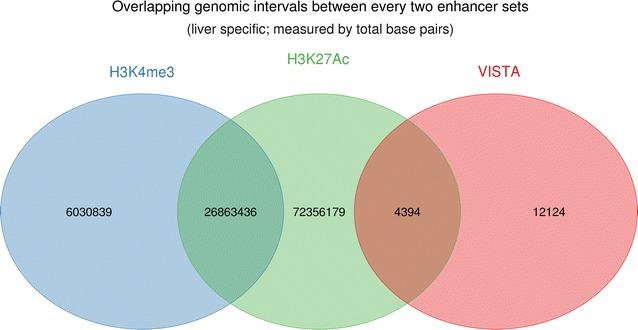
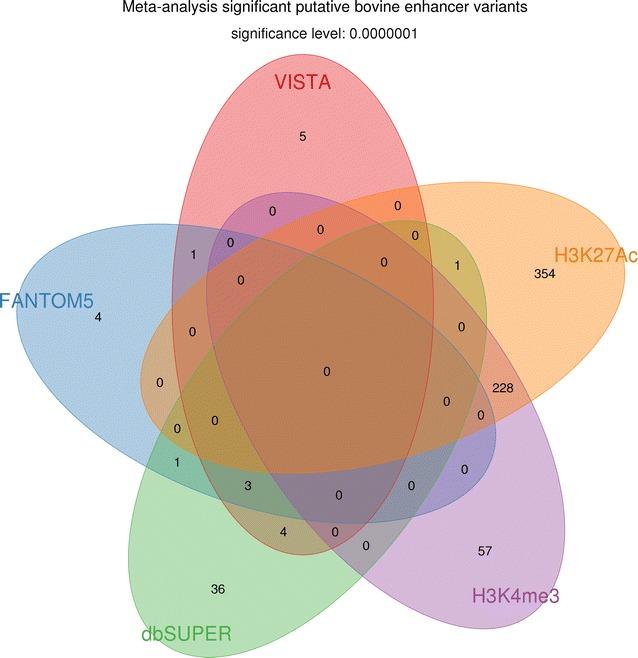
We produced a library of candidate bovine enhancer regions by using publicly available bovine ChIP-Seq enhancer data in combination with enhancer data that were identified based on sequence homology with human and mouse enhancer databases. We found that imputed whole-genome sequence variants associated with milk production traits in 16,581 dairy cattle were enriched with enhancer regions that were marked by bovine-liver H3K4me3 and H3K27ac histone modifications from both permutation tests and gene set enrichment analysis. Enhancer regions that were identified based on sequence homology with human and mouse enhancer regions were not as strongly enriched with trait-associated sequence variants as the bovine ChIP-Seq candidate enhancer regions. The bovine ChIP-Seq enriched enhancer regions were located near genes and quantitative trait loci that are associated with pregnancy, growth, disease resistance, meat quality and quantity, and milk quality and quantity traits in dairy and beef cattle.
CONCLUSIONS
Our results suggest that sequence variants within enhancer regions that are located in bovine non-coding genomic regions contribute to the variation in complex traits. The level of enrichment was higher in bovine-specific enhancer regions that were identified by detecting histone modifications H3K4me3 and H3K27ac in bovine liver tissues than in enhancer regions identified by sequence homology with human and mouse data. These results highlight the need to use bovine-specific experimental data for the identification of enhancer regions.
背景
增强子是非编码DNA序列,当它们与特定蛋白质结合时会增加基因转录水平。增强子在不同类型的细胞或不同条件下激活独特的基因表达模式。增强子是基因调控的关键因素,影响人类和小鼠数量性状的致病变异已定位在增强子区域。然而,在牛基因组中,增强子以及其他调控元件尚未得到很好的定义。在本文中,我们试图通过使用公开可用的哺乳动物增强子信息来改进牛增强子区域的注释。为了测试鉴定出的假定牛增强子区域是否富含影响产奶性状的功能变异体,我们使用推算的全基因组序列数据进行全基因组关联研究,随后进行荟萃分析和富集分析。
结果
我们通过将公开可用的牛ChIP-Seq增强子数据与基于与人及小鼠增强子数据库的序列同源性鉴定出的增强子数据相结合,构建了一个候选牛增强子区域文库。我们发现,在16581头奶牛中,与产奶性状相关的推算全基因组序列变异体在通过置换检验和基因集富集分析确定的、以牛肝脏H3K4me3和H3K27ac组蛋白修饰为标记的增强子区域中富集。基于与人及小鼠增强子区域的序列同源性鉴定出的增强子区域,与性状相关序列变异体的富集程度不如牛ChIP-Seq候选增强子区域。牛ChIP-Seq富集的增强子区域位于与妊娠、生长、抗病性、肉的品质和数量以及奶牛和肉牛的奶品质和数量性状相关的基因和数量性状位点附近。
结论
我们的结果表明,位于牛非编码基因组区域的增强子区域内的序列变异体导致复杂性状的变异。通过检测牛肝脏组织中的组蛋白修饰H3K4me3和H3K27ac鉴定出的牛特异性增强子区域的富集水平,高于通过与人及小鼠数据的序列同源性鉴定出的增强子区域。这些结果凸显了使用牛特异性实验数据来鉴定增强子区域的必要性。


 Zotero 插件