
西班牙人群锌、硒以及维生素A、E和C的报告膳食摄入量及食物来源:ANIBES研究结果
Reported Dietary Intake and Food Sources of Zinc, Selenium, and Vitamins A, E and C in the Spanish Population: Findings from the ANIBES Study.
作者信息
Olza Josune, Aranceta-Bartrina Javier, González-Gross Marcela, Ortega Rosa M, Serra-Majem Lluis, Varela-Moreiras Gregorio, Gil Ángel
机构信息
Department of Biochemistry and Molecular Biology II, Institute of Nutrition and Food Sciences, University of Granada, Campus de la Salud, Avda. del Conocimiento, Armilla, 18016 Granada, Spain.
Instituto de Investigación Biosanitaria ibs.GRANADA, 18012 Granada, Spain.
出版信息
Nutrients. 2017 Jul 6;9(7):697. doi: 10.3390/nu9070697.
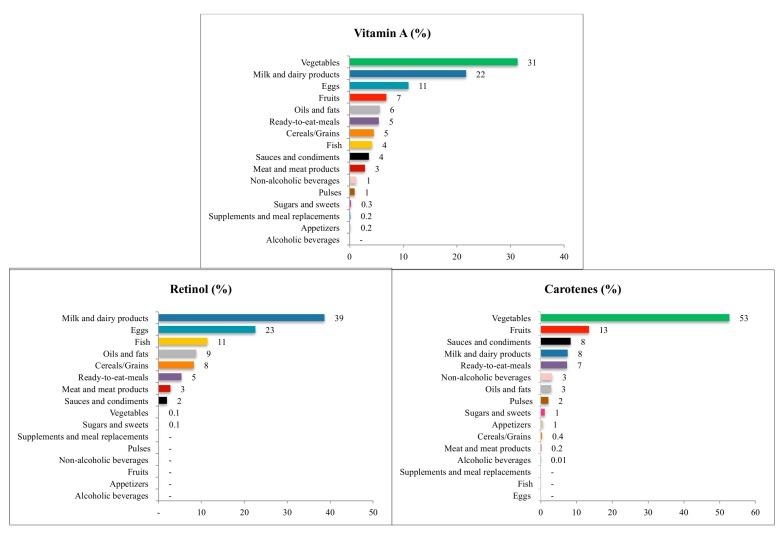
Zinc, selenium, and the vitamins A, E and C, all have specific biological functions that are involved mainly in the antioxidant defence system, which has important implications for the development of chronic diseases. We aimed to assess the reported intake of those six nutrients, as well as the food that contributes to their sources of intakes. Data were obtained from the Spanish ANIBES ("Anthropometry, Intake and Energy Balance in Spain") study, = 2009 (9-75 years old). The analyses were performed in the whole population and in the plausible energy reporters after a misreporting analysis according to the European Food and Safety Authority (EFSA) protocol. A validated, photo-based three-day food record was used to collect the data. Mean (max-min) reported intake for the whole population of zinc was 8.1 ± 0.1 mg/day, (2.3-27.3 mg/day), selenium 75 ± 1 µg/day, (14-265 µg/day), vitamin A 668 µg RE/day (2-11,017 µg RE/day), retinol 364 ± 18 µg/day (0-10,881 µg/day), carotenes 1735 ± 35 µg/day (13-13,962 µg/day), vitamin E 7.0 ± 0.1 mg α-TE/day (0.7-55.2 mg α-TE/day) and vitamin C 84.4 ± 1.4 mg/day (5.0-802.7 mg/day). The main source intakes for zinc were meat and meat products, for selenium cereals and grains, for vitamin E oils and fat, and for vitamin A and C vegetables. There is an elevated percentage of the Spanish ANIBES population not meeting the EFSA recommended intakes for all analysed micronutrients: zinc (83%), vitamin A (60%), vitamin E (80%), vitamin C (36%) and selenium (25%).
锌、硒以及维生素A、E和C均具有特定的生物学功能,主要参与抗氧化防御系统,这对慢性病的发展具有重要意义。我们旨在评估这六种营养素的报告摄入量以及提供这些营养素摄入来源的食物。数据取自西班牙ANIBES(“西班牙人体测量、摄入量与能量平衡”)研究,时间为2009年(9至75岁)。分析在全体人群以及根据欧洲食品安全局(EFSA)方案进行误报分析后的合理能量报告者中进行。使用经过验证的基于照片的三日食物记录来收集数据。全体人群锌的报告平均摄入量为8.1±0.1毫克/天(2.3至27.3毫克/天),硒为75±1微克/天(14至265微克/天),维生素A为668微克视黄醇当量/天(2至11,017微克视黄醇当量/天),视黄醇为364±18微克/天(0至10,881微克/天),类胡萝卜素为1735±35微克/天(13至13,962微克/天),维生素E为7.0±0.1毫克α-生育酚当量/天(0.7至55.2毫克α-生育酚当量/天),维生素C为84.4±1.4毫克/天(5.0至802.7毫克/天)。锌的主要摄入来源是肉类及肉制品,硒是谷物和粮食,维生素E是油类和脂肪,维生素A和C是蔬菜。西班牙ANIBES人群中未达到EFSA推荐摄入量的所有分析微量营养素的比例都很高:锌(83%)、维生素A(60%)、维生素E(80%)、维生素C(36%)和硒(25%)。

 Zotero 插件