
低收入和中等收入国家男男性行为者对艾滋病病毒暴露前预防的知晓率及使用意愿:一项系统评价和荟萃分析
Awareness and willingness to use HIV pre-exposure prophylaxis among men who have sex with men in low- and middle-income countries: a systematic review and meta-analysis.
作者信息
Yi Siyan, Tuot Sovannary, Mwai Grace W, Ngin Chanrith, Chhim Kolab, Pal Khoundyla, Igbinedion Ewemade, Holland Paula, Choub Sok Chamreun, Mburu Gitau
机构信息
KHANA Center for Population Health Research, Phnom Penh, Cambodia.
Center for Global Health Research, Touro University, Vallejo, California, USA.
出版信息
J Int AIDS Soc. 2017 Jun 26;20(1):21580. doi: 10.7448/IAS.20.1.21580.
INTRODUCTION
To facilitate provision of pre-exposure prophylaxis (PrEP) in low- and middle-income countries (LMIC), a better understanding of potential demand and user preferences is required. This review assessed awareness and willingness to use oral PrEP among men who have sex with men (MSM) in LMIC.
METHODS
Electronic literature search of Cochrane library, Embase, PubMed, PsychINFO, CINHAL, Web of Science, and Google Scholar was conducted between July and September 2016. Reference lists of relevant studies were searched, and three authors contacted for additional data. Non-peer reviewed publications were excluded. Studies were screened for inclusion, and relevant data abstracted, assessed for bias, and synthesized.
RESULTS
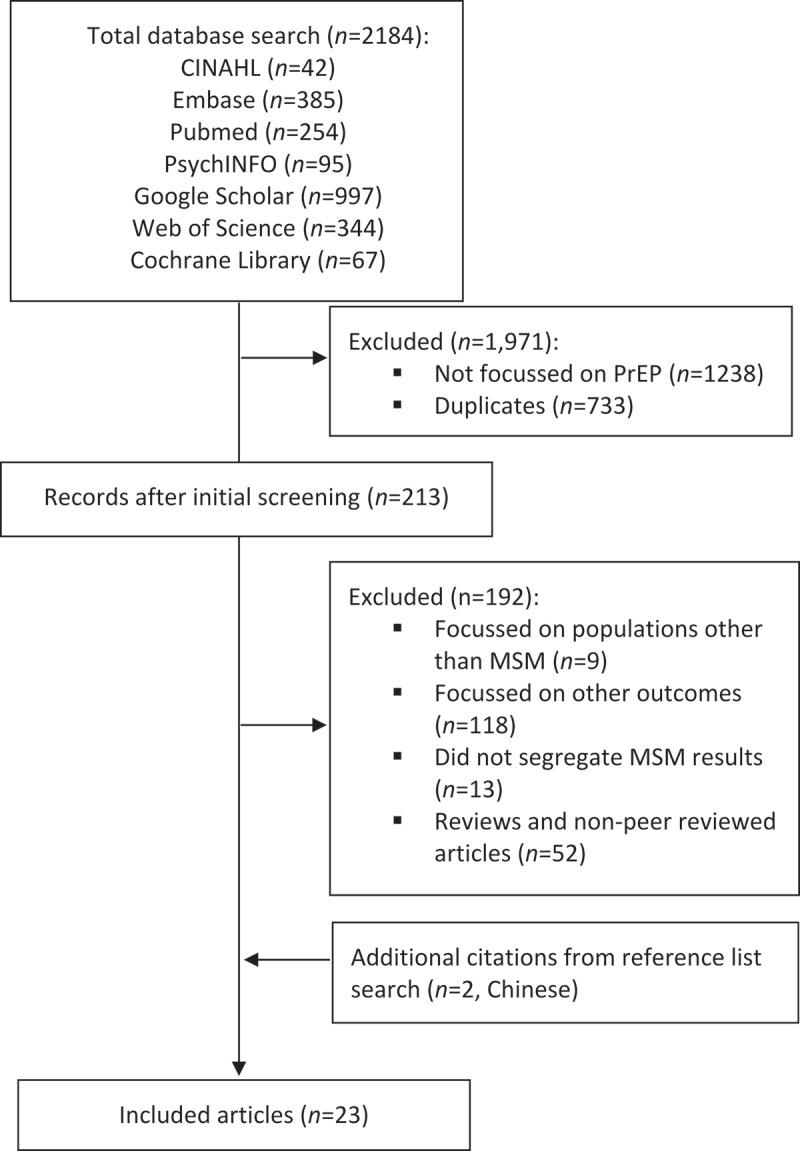
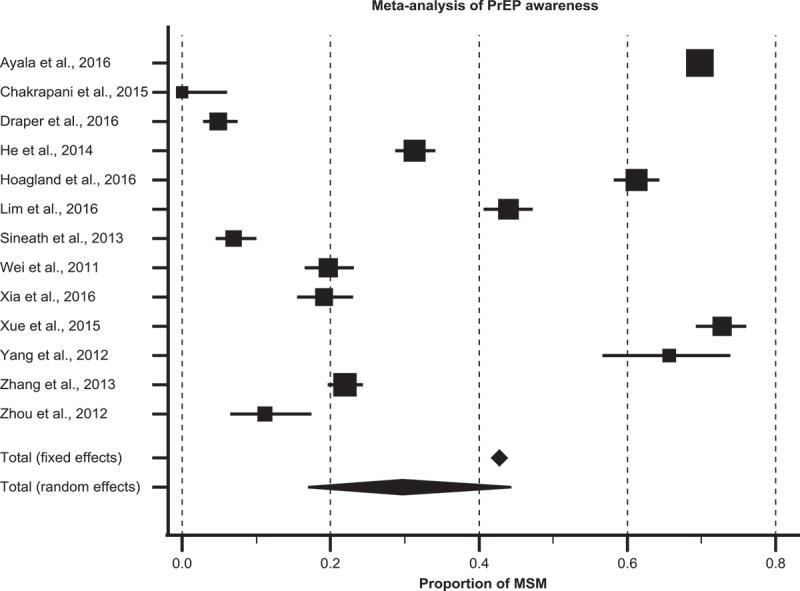
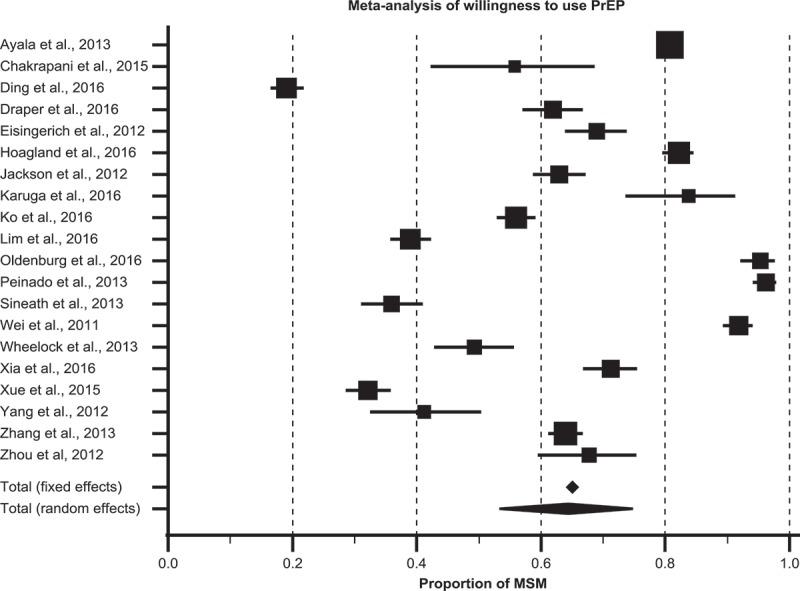
In total, 2186 records were identified, of which 23 studies involving 14,040 MSM from LMIC were included. The proportion of MSM who were aware of PrEP was low at 29.7% (95% CI: 16.9-44.3). However, the proportion willing to use PrEP was higher, at 64.4% (95% CI: 53.3-74.8). Proportions of MSM aware of PrEP was <50% in 11 studies and 50-70% in 3 studies, while willingness to use PrEP was <50% in 6 studies, 50-70% in 9 studies, and over 80% in 5 studies. Several factors affected willingness to use PrEP. At the individual domain, poor knowledge of PrEP, doubts about its effectiveness, fear of side effects, low perception of HIV risk, and the need to adhere or take medicines frequently reduced willingness to use PrEP, while PrEP education and motivation to maintain good health were facilitators of potential use. Demographic factors (education, age, and migration) influenced both awareness and willingness to use PrEP, but their effects were not consistent across studies. At the social domain, anticipated stigma from peers, partners, and family members related to sexual orientation, PrEP, or HIV status were barriers to potential use of PrEP, while partner, peer, and family support were facilitators of potential use. At the structural domain, concerns regarding attitudes of healthcare providers, quality assurance, data protection, and cost were determinants of potential use.
CONCLUSIONS
This review found that despite low levels of awareness of PrEP, MSM in LMIC are willing to use it if they are supported appropriately to deal with a range of individual, social, and structural barriers.
引言
为促进在低收入和中等收入国家(LMIC)提供暴露前预防(PrEP),需要更好地了解潜在需求和用户偏好。本综述评估了LMIC中男男性行为者(MSM)对口服PrEP的知晓情况和使用意愿。
方法
于2016年7月至9月对Cochrane图书馆、Embase、PubMed、PsychINFO、CINHAL、Web of Science和谷歌学术进行电子文献检索。检索了相关研究的参考文献列表,并联系了三位作者获取额外数据。排除未经过同行评审的出版物。筛选纳入研究,提取相关数据,评估偏倚并进行综合分析。
结果
共识别出2186条记录,其中包括23项研究,涉及来自LMIC的14040名MSM。知晓PrEP的MSM比例较低,为29.7%(95%CI:16.9 - 44.3)。然而,愿意使用PrEP的比例较高,为64.4%(95%CI:53.3 - 74.8)。在11项研究中,知晓PrEP的MSM比例<50%,在3项研究中为50 - 70%,而愿意使用PrEP的比例在6项研究中<50%,在9项研究中为50 - 70%,在5项研究中超过80%。有几个因素影响使用PrEP的意愿。在个体层面,对PrEP了解不足、对其有效性存疑、担心副作用、对HIV感染风险认知较低以及需要频繁坚持服药或用药降低了使用PrEP的意愿,而PrEP教育和保持健康的动机是潜在使用的促进因素。人口统计学因素(教育程度、年龄和移民情况)影响了对PrEP的知晓和使用意愿,但不同研究中其影响不一致。在社会层面,来自同伴、伴侣和家庭成员对性取向、PrEP或HIV感染状况的预期污名是PrEP潜在使用的障碍,而伴侣、同伴和家庭支持是潜在使用的促进因素。在结构层面,对医疗服务提供者态度、质量保证、数据保护和成本的担忧是潜在使用的决定因素。
结论
本综述发现,尽管对PrEP的知晓程度较低,但如果得到适当支持以应对一系列个人、社会和结构障碍,LMIC中的MSM愿意使用PrEP。


 Zotero 插件