
患有主动脉瓣狭窄的女性和男性的超声心动图主动脉瓣钙化及预后情况
Echocardiographic aortic valve calcification and outcomes in women and men with aortic stenosis.
作者信息
Thomassen Henrik K, Cioffi Giovanni, Gerdts Eva, Einarsen Eigir, Midtbø Helga Bergljot, Mancusi Costantino, Cramariuc Dana
机构信息
Department of Clinical Science, University of Bergen, Bergen, Norway.
Department of Cardiology, Cura Villa Bianca Hospital, Trento, Italy.
出版信息
Heart. 2017 Oct;103(20):1619-1624. doi: 10.1136/heartjnl-2016-311040. Epub 2017 Jul 11.
OBJECTIVE
Sex differences in risk factors of aortic valve calcification (AVC) by echocardiography have not been reported from a large prospective study in aortic stenosis (AS).
METHODS
AVC was assessed using a prognostically validated visual score and grouped into none/mild or moderate/severe AVC in 1725 men and women with asymptomatic AS in the Simvastatin Ezetimibe in Aortic Stenosis study. The severity of AS was assessed by the energy loss index (ELI) taking pressure recovery in the aortic root into account.
RESULTS
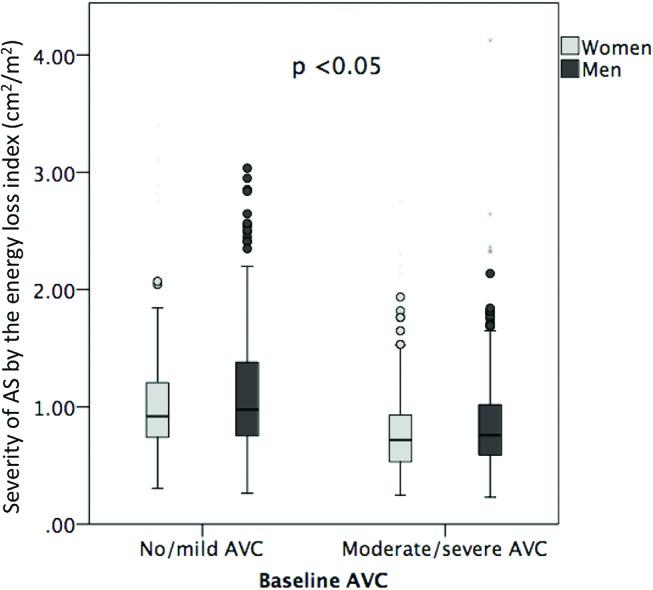
More men than women had moderate/severe AVC at baseline despite less severe AS by ELI (p<0.01). Moderate/severe AVC at baseline was independently associated with lower aortic compliance and more severe AS in both sexes, and with increased high-sensitive C reactive protein (hs-CRP) only in men (all p<0.01). In Cox regression analyses, moderate/severe AVC at baseline was associated with a 2.5-fold (95% CI 1.64 to 3.80) higher hazard rate of major cardiovascular events in women, and a 2.2-fold higher hazard rate in men (95% CI 1.54 to 3.17) (both p<0.001), after adjustment for age, hypertension, study treatment, aortic compliance, left ventricular (LV) mass and systolic function, AS severity and hs-CRP. Moderate/severe AVC at baseline also predicted a 1.8-fold higher hazard rate of all-cause mortality in men (95% CI 1.04 to 3.06, p<0.05) independent of age, AS severity, LV mass and aortic compliance, but not in women.
CONCLUSION
In conclusion, AVC scored by echocardiography has sex-specific characteristics in AS. Moderate/severe AVC is associated with higher cardiovascular morbidity in both sexes, and with higher all-cause mortality in men.
TRIAL REGISTRATION NUMBER
ClinicalTrials.gov identifier: NCT00092677.
目的
在一项关于主动脉瓣狭窄(AS)的大型前瞻性研究中,尚未有通过超声心动图对主动脉瓣钙化(AVC)危险因素的性别差异进行报告。
方法
在辛伐他汀依折麦布治疗主动脉瓣狭窄研究中,对1725例无症状AS的男性和女性使用经预后验证的视觉评分评估AVC,并将其分为无/轻度或中度/重度AVC。通过考虑主动脉根部压力恢复的能量损失指数(ELI)评估AS的严重程度。
结果
尽管ELI显示男性的AS程度较轻,但基线时患有中度/重度AVC的男性多于女性(p<0.01)。基线时中度/重度AVC与两性较低的主动脉顺应性和更严重的AS独立相关,并且仅在男性中与高敏C反应蛋白(hs-CRP)升高相关(所有p<0.01)。在Cox回归分析中,在调整年龄、高血压、研究治疗、主动脉顺应性、左心室(LV)质量和收缩功能、AS严重程度和hs-CRP后,基线时中度/重度AVC与女性主要心血管事件的风险率高2.5倍(95%CI 1.64至3.80)相关,与男性风险率高2.2倍相关(95%CI 1.54至3.17)(均p<0.001)。基线时中度/重度AVC还预测男性全因死亡率的风险率高1.8倍(95%CI 1.04至3.06,p<0.05)——独立于年龄、AS严重程度、LV质量和主动脉顺应性,但在女性中无此关联。
结论
总之,通过超声心动图评分的AVC在AS中具有性别特异性特征。中度/重度AVC与两性较高的心血管发病率相关,与男性较高的全因死亡率相关。
试验注册号
ClinicalTrials.gov标识符:NCT00092677。

 Zotero 插件