
檀香木心材中的抗真菌和鱼毒性倍半萜类化合物。
Antifungal and Ichthyotoxic Sesquiterpenoids from Santalum album Heartwood.
作者信息
Kim Tae Hoon, Hatano Tsutomu, Okamoto Keinosuke, Yoshida Takashi, Kanzaki Hiroshi, Arita Michiko, Ito Hideyuki
机构信息
Department of Food Science and Biotechnology, Daegu University, Gyeongsan 38453, Korea.
Faculty of Pharmaceutical Sciences, Okayama University, Tsushima, Okayama 700-8530, Japan.
出版信息
Molecules. 2017 Jul 8;22(7):1139. doi: 10.3390/molecules22071139.
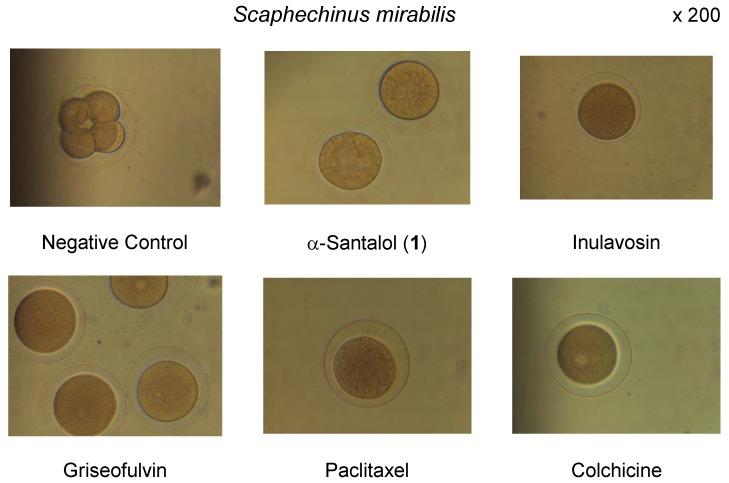
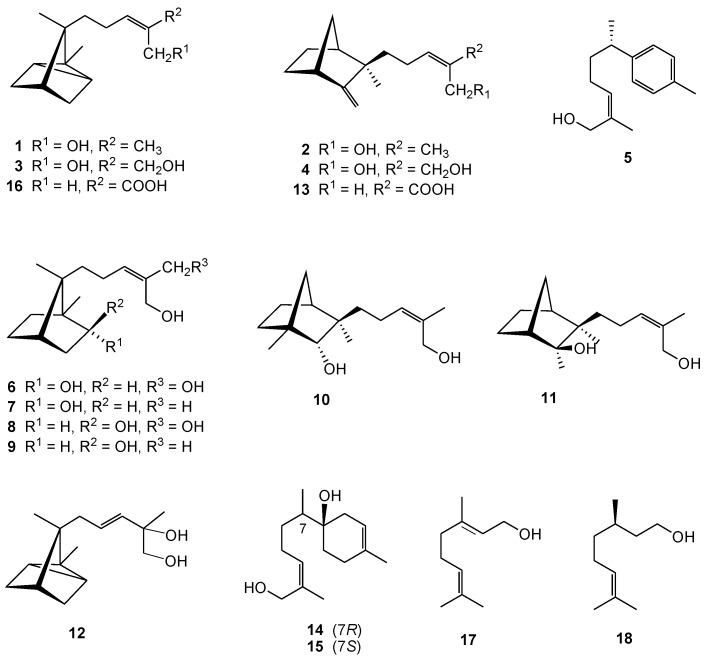
In our continuing study on a survey of biologically active natural products from heartwood of (Southwest Indian origin), we newly found potent fish toxic activity of an -hexane soluble extract upon primary screening using killifish (medaka) and characterized α-santalol and β-santalol as the active components. The toxicity (median tolerance limit (TLm) after 24 h at 1.9 ppm) of α-santalol was comparable with that of a positive control, inulavosin (TLm after 24 h at 1.3 ppm). These fish toxic compounds including inulavosin were also found to show a significant antifungal effect against a dermatophytic fungus, . Based on a similarity of the morphological change of the immobilized hyphae in scanning electron micrographs between treatments with α-santalol and griseofulvin (used as the positive control), inhibitory effect of α-santalol on mitosis (the antifungal mechanism proposed for griseofulvin) was assessed using sea urchin embryos. As a result, α-santalol was revealed to be a potent antimitotic agent induced by interference with microtubule assembly. These data suggested that α-santalol or sandalwood oil would be promising to further practically investigate as therapeutic agent for cancers as well as fungal skin infections.
在我们对(原产于印度西南部)心材中生物活性天然产物的持续研究中,我们在使用青鳉鱼(日本青鳉)进行的初步筛选中,新发现了一种正己烷可溶提取物具有强大的鱼类毒性活性,并鉴定出α-檀香醇和β-檀香醇为活性成分。α-檀香醇的毒性(在1.9 ppm下24小时后的半数耐受限度(TLm))与阳性对照菊糖菌素(在1.3 ppm下24小时后的TLm)相当。还发现这些包括菊糖菌素在内的鱼类毒性化合物对皮肤癣菌 显示出显著的抗真菌作用。基于在扫描电子显微镜图像中,α-檀香醇处理组和用作阳性对照的灰黄霉素处理组中固定化 菌丝形态变化的相似性,使用海胆胚胎评估了α-檀香醇对有丝分裂的抑制作用(这是为灰黄霉素提出的抗真菌机制)。结果表明,α-檀香醇是一种通过干扰微管组装诱导的强效抗有丝分裂剂。这些数据表明,α-檀香醇或檀香油有望作为癌症以及真菌性皮肤感染的治疗剂进一步进行实际研究。

 Zotero 插件