
白藜芦醇对人胶质母细胞瘤中人类端粒酶逆转录酶信使核糖核酸转录本的评估作用
Assessment Effects of Resveratrol on Human Telomerase Reverse Transcriptase Messenger Ribonucleic Acid Transcript in Human Glioblastoma.
作者信息
Mirzazadeh Azin, Kheirollahi Majid, Farashahi Ehsan, Sadeghian-Nodoushan Fatemeh, Sheikhha Mohammad Hasan, Aflatoonian Behrouz
机构信息
Department of Medical Genetics, Shahid Sadoughi University of Medical Sciences, Yazd, Iran.
Department of Medical Genetics, Pediatrics Inherited Diseases Research Center, Research Institute for Primordial Prevention of Noncommunicable Disease School of Medicine, Isfahan University of Medical Sciences, Isfahan, Iran.
出版信息
Adv Biomed Res. 2017 Jun 27;6:73. doi: 10.4103/2277-9175.209047. eCollection 2017.
BACKGROUND
Glioblastoma (GBM) is the most common and aggressive brain tumor, which has a poor prognosis despite the advent of different therapeutic strategies. There are numerous molecular biomarkers to contribute diagnosis, prognosis, and prediction of response to the current therapy in GBM. One of the most important markers that are potentially valuable is immortalization-specific or immortalization-associated marker named "hTERT messenger ribonucleic acid (mRNA)" the key subunit of telomerase enzyme, which is expressed in more than 85% of cancer cells, in spite of the majority of normal somatic cells. In this study, we investigated the effects of resveratrol (RSV) on this mRNA marker level, leading to cancer progression.
MATERIALS AND METHODS
U-87MG cell line was obtained from Pasteur Institute of Iran and treated with various concentrations of 0-160 μg/mL of RSV and at different time points (24, 48, and 72 h). To evaluate viability of U-87MG cells, standard 3-(4,5-dimethylthiazol-2-yl)-2,5-diphenyltetrazolium bromide assay was performed. Real-time polymerase chain reaction (RT-PCR) was used for comparative and quantitative assessment of human telomerase reverse transcriptase (hTERT) mRNA copy number versus control-untreated group.
RESULTS
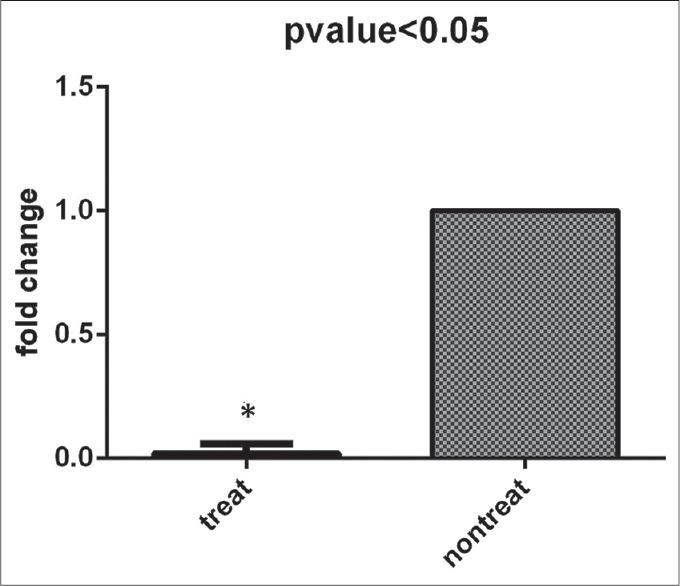
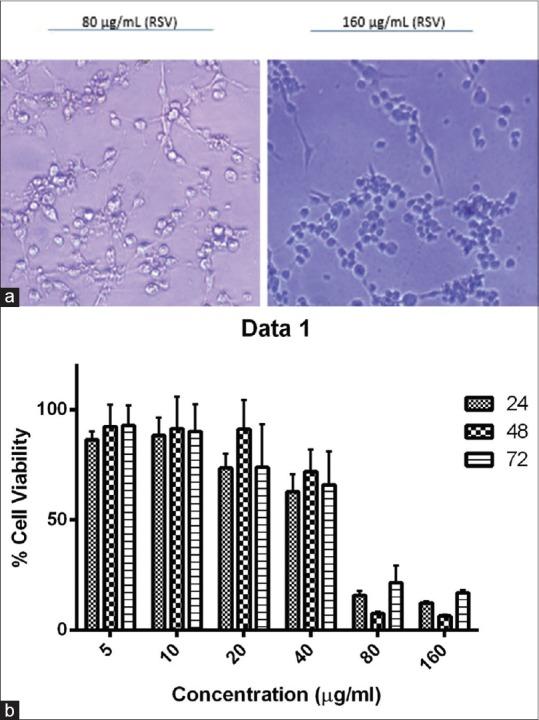
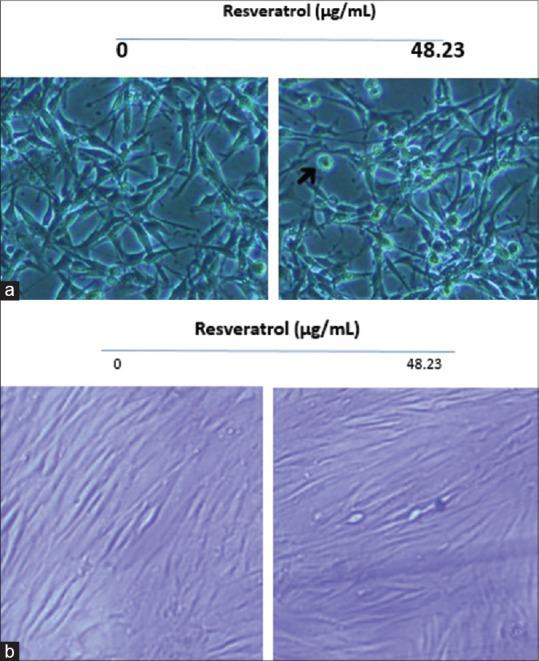
The results of our investigation suggested that RSV effectively inhibited cell growth and caused cell death in dose-dependent ( < 0.05) and not in time-dependent manner ( > 0.05), . Interestingly, quantitative RT-PCR analysis demonstrated that at half inhibition concentration, RSV dramatically decreased mRNA expression of hTERT, the catalytic subunit of telomerase enzyme, which leads to prevention of cell division and tumor progression.
CONCLUSION
With regard to downregulation of this immortalization-associated marker, RSV may potentially be used as a therapeutic agent against GBM.
背景
胶质母细胞瘤(GBM)是最常见且侵袭性最强的脑肿瘤,尽管出现了不同的治疗策略,但其预后仍很差。有许多分子生物标志物可用于GBM的诊断、预后评估以及对当前治疗反应的预测。其中一个具有潜在价值的最重要标志物是名为“hTERT信使核糖核酸(mRNA)”的永生化特异性或永生化相关标志物,它是端粒酶的关键亚基,尽管大多数正常体细胞中不表达,但在超过85%的癌细胞中表达。在本研究中,我们研究了白藜芦醇(RSV)对这种mRNA标志物水平的影响,该标志物会导致癌症进展。
材料与方法
从伊朗巴斯德研究所获得U - 87MG细胞系,并用0 - 160μg/mL的不同浓度RSV在不同时间点(24、48和72小时)进行处理。为评估U - 87MG细胞的活力,进行了标准的3 -(4,5 - 二甲基噻唑 - 2 - 基)- 2,5 - 二苯基四氮唑溴盐试验。实时聚合酶链反应(RT - PCR)用于比较和定量评估人端粒酶逆转录酶(hTERT)mRNA拷贝数与未处理的对照组。
结果
我们的研究结果表明,RSV有效抑制细胞生长并导致细胞死亡,呈剂量依赖性(<0.05)而非时间依赖性(>0.05)。有趣的是,定量RT - PCR分析表明,在半数抑制浓度时,RSV显著降低了端粒酶催化亚基hTERT的mRNA表达,这导致细胞分裂和肿瘤进展受到抑制。
结论
鉴于这种永生化相关标志物的下调,RSV可能有潜力用作抗GBM的治疗药物。

 Zotero 插件