
TFE3通过激活mTOR信号通路调控肾腺癌细胞增殖。
TFE3 regulates renal adenocarcinoma cell proliferation via activation of the mTOR pathway.
作者信息
Fang Yuan, Bao Wei, Rao Qiu, Wang Xuan, Xia Qiuyuan, Shen Qin, Zhou Xiaojun, Yao Bing
机构信息
Reproductive Medical Center, Jinling Hospital, Clinical Medical School of Southern Medical University, Nanjing, Jiangsu 210002, P.R. China.
Department of Pathology, Jinling Hospital, Clinical Medical School of Southern Medical University, Nanjing, Jiangsu 210002, P.R. China.
出版信息
Mol Med Rep. 2017 Sep;16(3):2721-2725. doi: 10.3892/mmr.2017.6930. Epub 2017 Jul 5.
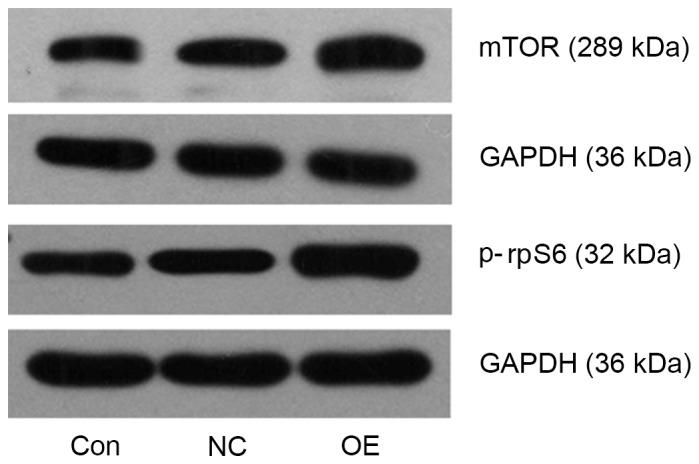
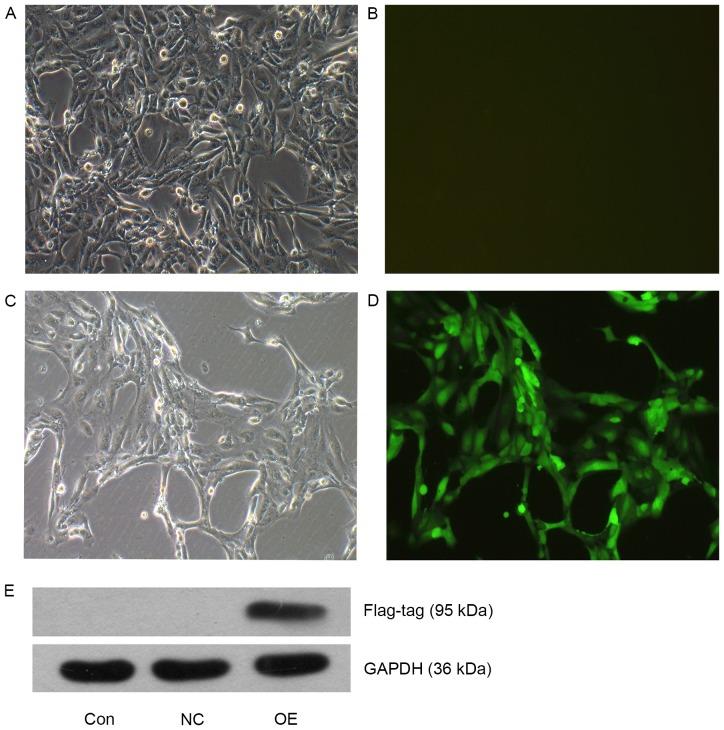
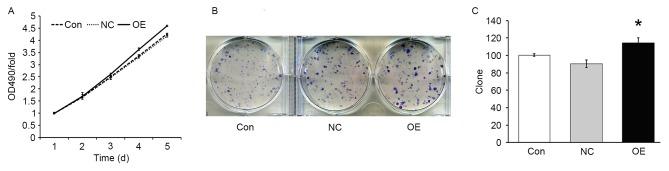
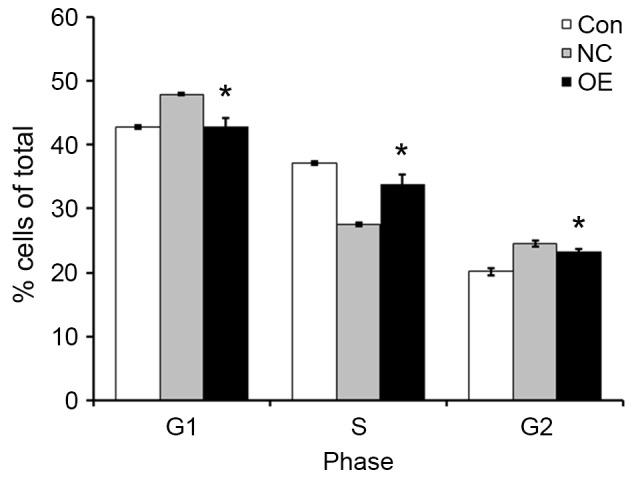
The present study aimed to investigate the role of transcription factor E3 (TFE3) in the regulation of proliferation in renal adenocarcinoma cells. The LV‑TFE3 overexpression (OE) lentivirus and negative control CON195 (NC) lentivirus were transfected into the ACHN cell line. Protein expression of FLAG‑tag TFE3 was determined using western blot analysis. Differences in cell proliferation, plate clone formation and cell cycle distribution between OE and NC groups were compared using MTT, plate colony formation and flow cytometry assays, respectively. The levels of mammalian target of rapamycin (mTOR) and phosphorylated ribosomal protein S6 (p‑rpS6) were analyzed by western blotting. Cell proliferation and colony formation increased significantly in the OE group compared with the NC group. The % of cells in the G1 and G2 phases of the cell cycle decreased, while the % of cells in the S phase of the cell cycle increased in the OE group compared with the NC group. In addition, mTOR and p‑rpS6 levels were increased in the OE group compared with the NC group. The results of the present study demonstrated that TFE3 overexpression resulted in increased ACHN cell proliferation and plate clone formation. TFE3 may promote renal tumor growth by regulating cell cycle progression and activating the phosphatidylinositol 3‑kinase/AKT serine/threonine kinase 1/mTOR signaling pathway.
本研究旨在探讨转录因子E3(TFE3)在肾腺癌细胞增殖调控中的作用。将LV-TFE3过表达(OE)慢病毒和阴性对照CON195(NC)慢病毒转染至ACHN细胞系。采用蛋白质印迹分析测定FLAG标签TFE3的蛋白表达。分别采用MTT、平板克隆形成和流式细胞术检测比较OE组和NC组细胞增殖、平板克隆形成及细胞周期分布的差异。通过蛋白质印迹分析雷帕霉素靶蛋白(mTOR)和磷酸化核糖体蛋白S6(p-rpS6)的水平。与NC组相比,OE组细胞增殖和克隆形成显著增加。与NC组相比,OE组细胞周期G1期和G2期的细胞百分比降低,而S期的细胞百分比增加。此外,与NC组相比,OE组mTOR和p-rpS6水平升高。本研究结果表明,TFE3过表达导致ACHN细胞增殖及平板克隆形成增加。TFE3可能通过调节细胞周期进程和激活磷脂酰肌醇3激酶/AKT丝氨酸/苏氨酸激酶1/mTOR信号通路促进肾肿瘤生长。
 Zotero 插件