
在低收入和中等收入国家采用信息通信技术进行乳腺癌和宫颈癌的早期检测。
Adoption of Information and Communication Technologies for Early Detection of Breast and Cervical Cancers in Low- and Middle-Income Countries.
作者信息
DiCarlo Jessica M, Gopakumar Sricharan, Dhillon Preet K, Krishnan Suneeta
机构信息
, University of California Berkeley, Berkeley, CA; , Rice University, Houston, TX; , Public Health Foundation of India; and , Research Triangle Institute Global India Private Limited, New Delhi; St John's Research Institute, Bangalore, India.
出版信息
J Glob Oncol. 2016 Apr 13;2(4):222-234. doi: 10.1200/JGO.2015.002063. eCollection 2016 Aug.
PURPOSE
In response to the growing burden of breast and cervical cancers, low- and middle-income countries (LMICs) are beginning to implement national cancer prevention programs. We reviewed the literature on information and communication technology (ICT) applications in the prevention of breast and cervical cancers in LMICs to examine their potential to enhance cancer prevention efforts.
METHODS
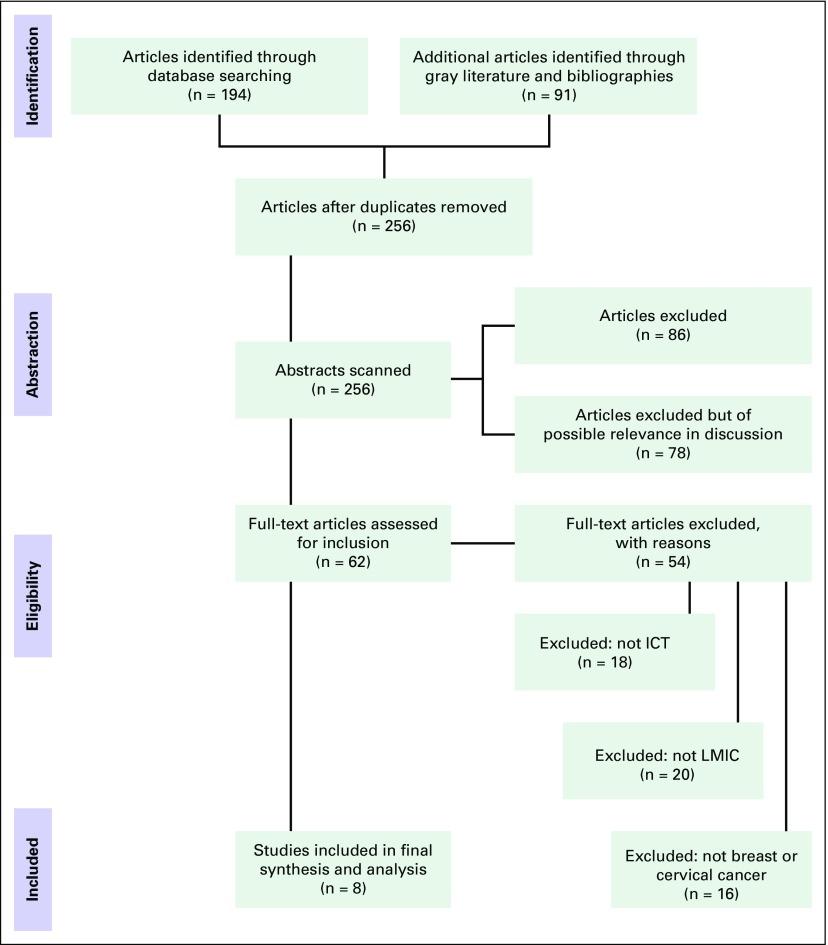
Ten databases of peer-reviewed and gray literature were searched using an automated strategy for English-language articles on the use of mobile health (mHealth) and telemedicine in breast and cervical cancer prevention (screening and early detection) published between 2005 and 2015. Articles that described the rationale for using these ICTs and/or implementation experiences (successes, challenges, and outcomes) were reviewed. Bibliographies of articles that matched the eligibility criteria were reviewed to identify additional relevant references.
RESULTS
Of the initial 285 citations identified, eight met the inclusion criteria. Of these, four used primary data, two were overviews of ICT applications, and two were commentaries. Articles described the potential for mHealth and telemedicine to address both demand- and supply-side challenges to cancer prevention, such as awareness, access, and cost, in LMICs. However, there was a dearth of evidence to support these hypotheses.
CONCLUSION
This review indicates that there are few publications that reflect specifically on the role of mHealth and telemedicine in cancer prevention and even fewer that describe or evaluate interventions. Although articles suggest that mHealth and telemedicine can enhance the implementation and use of cancer prevention interventions, more evidence is needed.
目的
为应对乳腺癌和宫颈癌日益加重的负担,低收入和中等收入国家(LMICs)开始实施国家癌症预防计划。我们回顾了关于信息通信技术(ICT)在LMICs乳腺癌和宫颈癌预防中的应用的文献,以研究其增强癌症预防工作的潜力。
方法
使用自动化策略在10个同行评审和灰色文献数据库中搜索2005年至2015年间发表的关于移动健康(mHealth)和远程医疗在乳腺癌和宫颈癌预防(筛查和早期检测)中应用的英文文章。对描述使用这些ICT的基本原理和/或实施经验(成功、挑战和结果)的文章进行了回顾。对符合纳入标准的文章的参考文献进行了回顾,以识别其他相关参考文献。
结果
在最初识别的285条引文中,有8条符合纳入标准。其中,4条使用了原始数据,2条是ICT应用的概述,2条是评论。文章描述了mHealth和远程医疗在解决LMICs癌症预防的需求侧和供给侧挑战(如意识、可及性和成本)方面的潜力。然而,缺乏支持这些假设的证据。
结论
本综述表明,很少有出版物专门反映mHealth和远程医疗在癌症预防中的作用,描述或评估干预措施的更少。尽管文章表明mHealth和远程医疗可以加强癌症预防干预措施的实施和使用,但仍需要更多证据。
 Zotero 插件