
古欧洲犬基因组揭示了自新石器时代早期以来的连续性。
Ancient European dog genomes reveal continuity since the Early Neolithic.
机构信息
Department of Ecology and Evolution, Stony Brook University, Stony Brook, New York 11794-5245, USA.
Department of Computational Medicine and Bioinformatics, University of Michigan, Ann Arbor, Michigan 48109, USA.
出版信息
Nat Commun. 2017 Jul 18;8:16082. doi: 10.1038/ncomms16082.
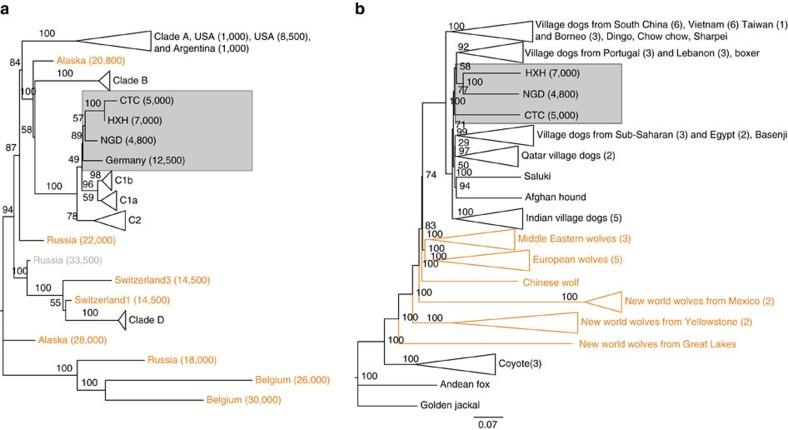
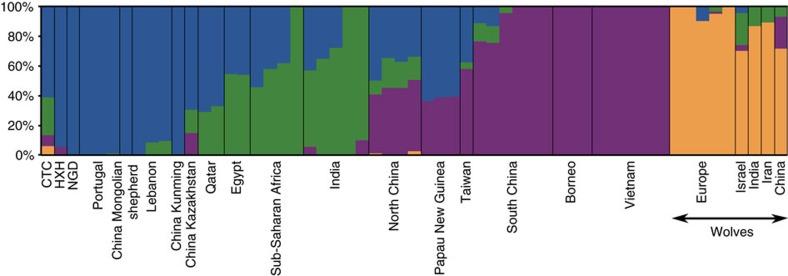
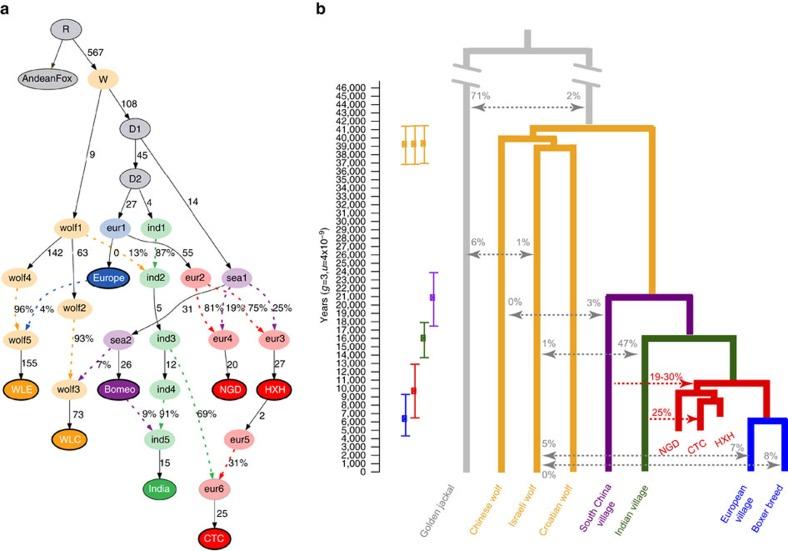
Europe has played a major role in dog evolution, harbouring the oldest uncontested Palaeolithic remains and having been the centre of modern dog breed creation. Here we sequence the genomes of an Early and End Neolithic dog from Germany, including a sample associated with an early European farming community. Both dogs demonstrate continuity with each other and predominantly share ancestry with modern European dogs, contradicting a previously suggested Late Neolithic population replacement. We find no genetic evidence to support the recent hypothesis proposing dual origins of dog domestication. By calibrating the mutation rate using our oldest dog, we narrow the timing of dog domestication to 20,000-40,000 years ago. Interestingly, we do not observe the extreme copy number expansion of the AMY2B gene characteristic of modern dogs that has previously been proposed as an adaptation to a starch-rich diet driven by the widespread adoption of agriculture in the Neolithic.
欧洲在犬类进化中扮演了重要角色,拥有最古老的无可争议的旧石器时代遗迹,并且是现代犬种创造的中心。在这里,我们对德国的一只早期和晚期新石器时代的狗进行了基因组测序,其中包括一个与早期欧洲农耕社区有关的样本。这两只狗彼此之间具有连续性,并且主要与现代欧洲犬共享祖先,这与先前提出的晚新石器时代种群替代理论相矛盾。我们没有发现遗传证据来支持最近提出的关于犬类驯化的双重起源假说。通过使用我们最古老的狗来校准突变率,我们将犬类驯化的时间缩小到 2 万至 4 万年前。有趣的是,我们没有观察到现代犬类中 AMY2B 基因的极端拷贝数扩张,该基因以前被认为是对新石器时代农业广泛采用所驱动的富含淀粉饮食的适应。



 Zotero 插件