
瑞典自由放养的雌性野猪(Sus scrofa)的繁殖模式与繁殖潜力。
The reproductive pattern and potential of free ranging female wild boars (Sus scrofa) in Sweden.
作者信息
Malmsten Anna, Jansson Gunnar, Lundeheim Nils, Dalin Anne-Marie
机构信息
Division of Reproduction, Department of Clinical Sciences, Swedish University of Agricultural Sciences, Box 7054, 750 07, Uppsala, Sweden.
Grimsö Wildlife Research Station, Department of Ecology, Swedish University of Agricultural Sciences, 730 91, Riddarhyttan, Sweden.
出版信息
Acta Vet Scand. 2017 Aug 1;59(1):52. doi: 10.1186/s13028-017-0321-0.
BACKGROUND
The number and spatial distribution of wild boars (Sus scrofa) has increased remarkably in Sweden as well as in other European countries. To understand the population dynamics of the wild boar, knowledge of its reproductive period, oestrus cycle and reproductive success is essential. The aim of this study was therefore to describe the seasonal reproductive pattern and reproductive potential of a wild boar population in Sweden. The study was based on findings from macroscopic examinations of the reproductive organs from 575 hunter-harvested female wild boars (>30 kg body weight). Samples were collected between December 2011 and December 2015 in the southern and middle parts of Sweden. The age of the sampled animals was determined and dressed weight was noted. The stage of the reproductive cycle was defined according to ovarian structures and in relation to the appearance of/and findings in the uterus. The crown-rump length (CRL) of the embryos/foetuses was used to calculate the oestrus/mating month and month for the expected farrowing.
RESULTS
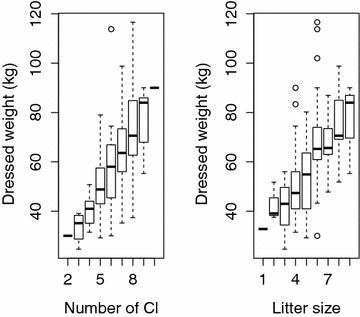
The macroscopic examination revealed a seasonal variation of reproductive stages, although cyclic and pregnant females were found in all seasons. Moreover, the estimated oestrus/mating and farrowing months based on the CRL showed that mating and farrowing may occur 'off-season'. The average litter size (no. of embryos or foetuses) per pregnant female was 5.4. Sow weight and age had significant effect on both the reproductive potential (ovulation rate and litter size) and pregnancy rate, respectively.
CONCLUSIONS
The reproductive potential in the studied wild boar population was high compared to studies from other countries and farrowing may occur 'off-season'. This suggests that the environmental conditions in Sweden, including supplemental feeding, are favourable for wild boar reproduction.
背景
在瑞典以及其他欧洲国家,野猪(Sus scrofa)的数量和空间分布显著增加。为了解野猪的种群动态,掌握其繁殖期、发情周期和繁殖成功率的知识至关重要。因此,本研究的目的是描述瑞典野猪种群的季节性繁殖模式和繁殖潜力。该研究基于对575头体重超过30千克的猎人捕获的雌性野猪生殖器官进行宏观检查的结果。样本于2011年12月至2015年12月在瑞典南部和中部采集。确定了采样动物的年龄并记录了胴体重。根据卵巢结构并结合子宫外观和检查结果确定生殖周期阶段。利用胚胎/胎儿的顶臀长(CRL)计算发情/交配月份和预计产仔月份。
结果
宏观检查显示繁殖阶段存在季节性变化,尽管在所有季节均发现有周期性发情和怀孕的雌性野猪。此外,基于CRL估计的发情/交配和产仔月份表明交配和产仔可能在“非繁殖季节”发生。每头怀孕雌性野猪的平均窝仔数(胚胎或胎儿数量)为5.4。母猪体重和年龄分别对繁殖潜力(排卵率和窝仔数)和怀孕率有显著影响。
结论
与其他国家的研究相比,所研究的野猪种群繁殖潜力较高,且产仔可能在“非繁殖季节”发生。这表明瑞典的环境条件,包括补充喂养,有利于野猪繁殖。


 Zotero 插件