
清道夫受体MARCO在介导腺病毒感染及随后巨噬细胞的天然免疫反应中的关键作用。
Key Role of the Scavenger Receptor MARCO in Mediating Adenovirus Infection and Subsequent Innate Responses of Macrophages.
作者信息
Maler Mareike D, Nielsen Peter J, Stichling Nicole, Cohen Idan, Ruzsics Zsolt, Wood Connor, Engelhard Peggy, Suomalainen Maarit, Gyory Ildiko, Huber Michael, Müller-Quernheim Joachim, Schamel Wolfgang W A, Gordon Siamon, Jakob Thilo, Martin Stefan F, Jahnen-Dechent Willi, Greber Urs F, Freudenberg Marina A, Fejer György
机构信息
Max Planck Institute of Immunobiology and Epigenetics, Freiburg, Germany.
Allergy Research Group, Department of Dermatology, Medical Center-University of Freiburg, Faculty of Medicine, University of Freiburg, Freiburg, Germany.
出版信息
mBio. 2017 Aug 1;8(4):e00670-17. doi: 10.1128/mBio.00670-17.
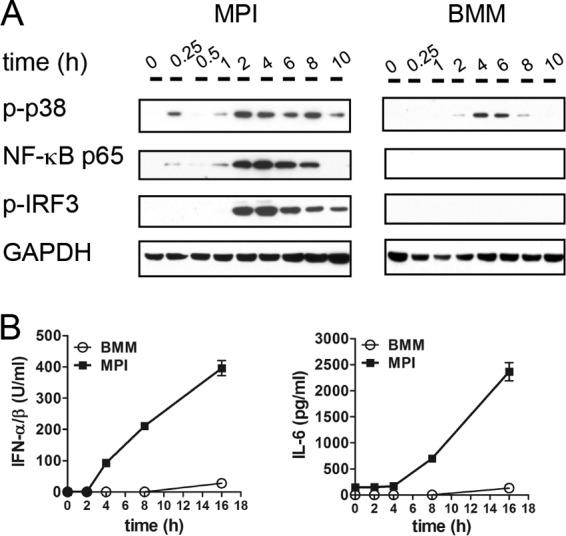
The scavenger receptor MARCO is expressed in several subsets of naive tissue-resident macrophages and has been shown to participate in the recognition of various bacterial pathogens. However, the role of MARCO in antiviral defense is largely unexplored. Here, we investigated whether MARCO might be involved in the innate sensing of infection with adenovirus and recombinant adenoviral vectors by macrophages, which elicit vigorous immune responses Using cells derived from mice, we show that adenovirus infection is significantly more efficient in MARCO-positive alveolar macrophages (AMs) and in AM-like primary macrophage lines (Max Planck Institute cells) than in MARCO-negative bone marrow-derived macrophages. Using antibodies blocking ligand binding to MARCO, as well as gene-deficient and MARCO-transfected cells, we show that MARCO mediates the rapid adenovirus transduction of macrophages. By enhancing adenovirus infection, MARCO contributes to efficient innate virus recognition through the cytoplasmic DNA sensor cGAS. This leads to strong proinflammatory responses, including the production of interleukin-6 (IL-6), alpha/beta interferon, and mature IL-1α. These findings contribute to the understanding of viral pathogenesis in macrophages and may open new possibilities for the development of tools to influence the outcome of infection with adenovirus or adenovirus vectors. Macrophages play crucial roles in inflammation and defense against infection. Several macrophage subtypes have been identified with differing abilities to respond to infection with both natural adenoviruses and recombinant adenoviral vectors. Adenoviruses are important respiratory pathogens that elicit vigorous innate responses and The cell surface receptors mediating macrophage type-specific adenovirus sensing are largely unknown. The scavenger receptor MARCO is expressed on some subsets of naive tissue-resident macrophages, including lung alveolar macrophages. Its role in antiviral macrophage responses is largely unexplored. Here, we studied whether the differential expression of MARCO might contribute to the various susceptibilities of macrophage subtypes to adenovirus. We demonstrate that MARCO significantly enhances adenovirus infection and innate responses in macrophages. These results help to understand adenoviral pathogenesis and may open new possibilities to influence the outcome of infection with adenoviruses or adenovirus vectors.
清道夫受体MARCO在多种幼稚组织驻留巨噬细胞亚群中表达,并且已被证明参与对各种细菌病原体的识别。然而,MARCO在抗病毒防御中的作用在很大程度上尚未得到探索。在此,我们研究了MARCO是否可能参与巨噬细胞对腺病毒和重组腺病毒载体感染的天然感知,巨噬细胞会引发强烈的免疫反应。使用源自小鼠的细胞,我们发现腺病毒感染在MARCO阳性肺泡巨噬细胞(AMs)和类AM原代巨噬细胞系(马克斯·普朗克研究所细胞)中比在MARCO阴性骨髓来源的巨噬细胞中效率显著更高。使用阻断配体与MARCO结合的抗体,以及基因缺陷和MARCO转染的细胞,我们表明MARCO介导巨噬细胞的快速腺病毒转导。通过增强腺病毒感染,MARCO通过细胞质DNA传感器cGAS促进有效的天然病毒识别。这导致强烈的促炎反应,包括白细胞介素-6(IL-6)、α/β干扰素和成熟IL-1α的产生。这些发现有助于理解巨噬细胞中的病毒发病机制,并可能为开发影响腺病毒或腺病毒载体感染结果的工具开辟新的可能性。巨噬细胞在炎症和抗感染防御中发挥着关键作用。已经鉴定出几种巨噬细胞亚型,它们对天然腺病毒和重组腺病毒载体感染的反应能力不同。腺病毒是重要的呼吸道病原体,会引发强烈的天然反应,并且介导巨噬细胞类型特异性腺病毒感知的细胞表面受体在很大程度上是未知的。清道夫受体MARCO在一些幼稚组织驻留巨噬细胞亚群上表达,包括肺泡巨噬细胞。其在抗病毒巨噬细胞反应中的作用在很大程度上尚未得到探索。在此,我们研究了MARCO的差异表达是否可能导致巨噬细胞亚型对腺病毒的不同易感性。我们证明MARCO显著增强巨噬细胞中的腺病毒感染和天然反应。这些结果有助于理解腺病毒发病机制,并可能为影响腺病毒或腺病毒载体感染结果开辟新的可能性。

 Zotero 插件