
麻醉和镇痛对全膝关节置换术后长期结果的影响:一项前瞻性、观察性、多中心研究。
Effects of anaesthesia and analgesia on long-term outcome after total knee replacement: A prospective, observational, multicentre study.
机构信息
From the Department of Anaesthesiology, Intensive Care and Pain Therapy, University Hospital of Parma (DB, MA), Department of Surgical Sciences, University of Parma, Parma (DB, MA), Department of Anaesthesiology, Intensive Care, IRCCS Ospedale San Raffaele, Milano (MG), Department of Anaesthesiology, Intensive Care and Pain Therapy, Ospedale di Circolo, Varese (ALA), Department of Anaesthesiology, Intensive Care, AORN dei Colli Monaldi Cotugno CTO, Napoli (GG, FC), Department of Anaesthesiology and Pain Therapy, Presidio Sanitario Ospedale Cottolengo, Torino (DD), Department of Anaesthesia, IRCCS Istituto Auxologico Italiano, Milano (FN), Department of Anaesthesiology and Intensive Care, Azienda Ospedaliero-Universitaria Policlinico S. Orsola-Malpighi, Bologna (AF), Department of Orthopaedic and Traumatology, ASST-Gaetano Pini-CTO (PF, MB); and Department of Anaesthesiology and Pain Therapy, ASST-Gaetano Pini-CTO, Milano, Italy (GC).
出版信息
Eur J Anaesthesiol. 2017 Oct;34(10):665-672. doi: 10.1097/EJA.0000000000000656.
BACKGROUND
Perioperative regional anaesthesia may protect from persistent postsurgical pain (PPSP) and improve outcome after total knee arthroplasty (TKA).
OBJECTIVES
Aim of this study was to evaluate the impact of regional anaesthesia on PPSP and long-term functional outcome after TKA.
DESIGN
A web-based prospective observational registry.
SETTING
Five Italian Private and University Hospitals from 2012 to 2015.
PATIENTS
Undergoing primary unilateral TKA, aged more than 18 years, informed consent, American Society of Anesthesiologists (ASA) physical status classes 1 to 3, no previous knee surgery.
INTERVENTION(S): Personal data (age, sex, BMI and ASA class), preoperative pain assessed by numerical rating scale (NRS) score, and risk factors for PPSP were registered preoperatively. Data on anaesthetic and analgesic techniques were collected. Postoperative pain (NRS), analgesic consumption, major complications and patient satisfaction were registered up to the time of discharge. PPSP was assessed by a blinded investigator during a phone call after 1, 3 and 6 months, together with patient satisfaction, quality of life (QOL) and walking ability.
MAIN OUTCOME MEASURES
Experience of PPSP according to the type of peri-operative analgesia.
RESULTS
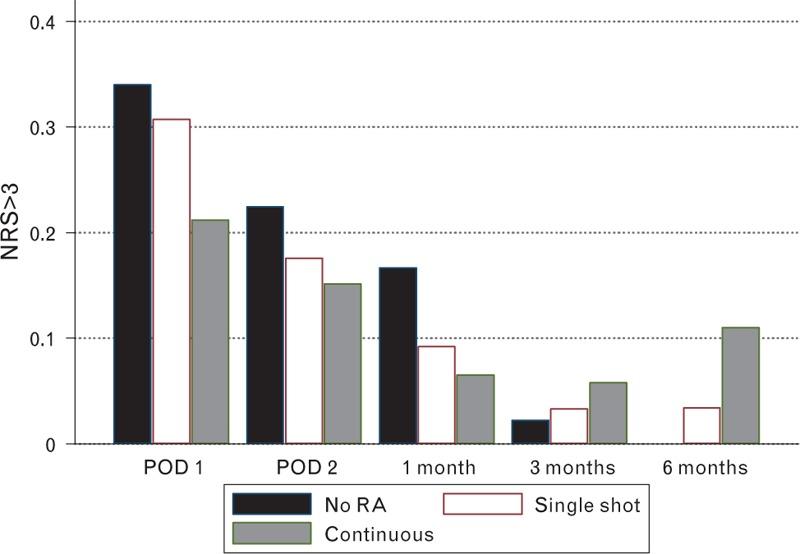
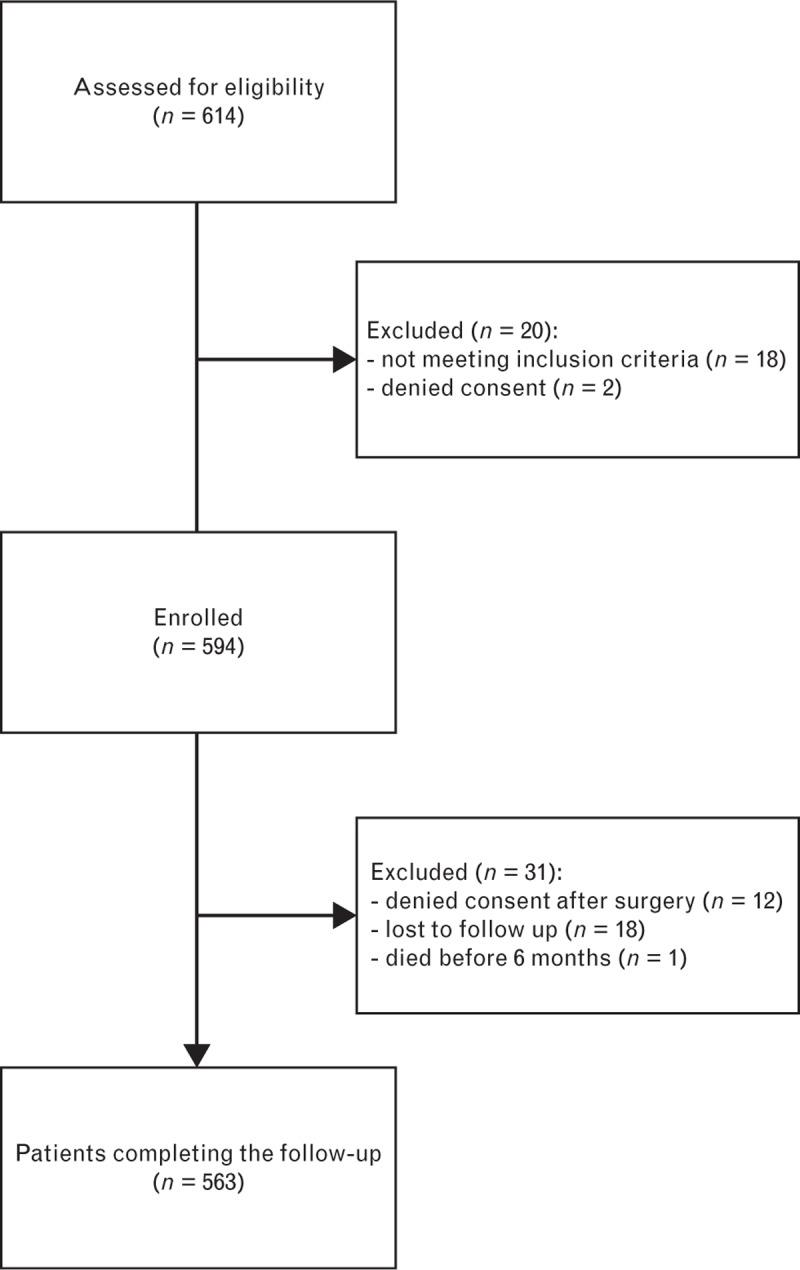
Five hundred sixty-three patients completed the follow-up. At 6 months, 21.6% of patients experienced PPSP, whereas autonomy was improved only in 56.3%; QOL was worsened or unchanged in 30.7% of patients and improved in 69.3%. Patients receiving continuous regional anaesthesia (epidural or peripheral nerve block) showed a lower NRS through the whole peri-operative period up to 1 month compared with both single shot peripheral nerve block and those who did not receive any type of regional anaesthesia. No difference was found between these latter two groups. Differences in PPSP at 3 or 6 months were not significantly affected by the type of anaesthesia or postoperative analgesia. A higher NRS score at 1 month, younger age, history of anxiety or depression, pro-inflammatory status, higher BMI and a lower ASA physical status were associated with a higher incidence of PPSP and worsened QOL at 6 months.
CONCLUSION
Continuous regional anaesthesia provides analgesic benefit for up to 1 month after surgery, but did not influence PPSP at 6 months. Better pain control at 1 month was associated with reduced PPSP. Patients with higher expectations from surgery, enhanced basal inflammation and a pessimistic outlook are more prone to develop PPSP.
TRIAL REGISTRATION
Clinicaltrials.gov identifier: NCT02147730.
背景
围手术期区域麻醉可能预防持续性术后疼痛(PPSP)并改善全膝关节置换术(TKA)后的结果。
目的
本研究旨在评估区域麻醉对 TKA 后 PPSP 和长期功能结果的影响。
设计
基于网络的前瞻性观察性登记。
设置
2012 年至 2015 年,意大利五所私立和大学医院。
患者
接受初次单侧 TKA,年龄大于 18 岁,知情同意,美国麻醉师协会(ASA)身体状况 1 至 3 级,无膝关节手术史。
干预
术前登记个人数据(年龄、性别、BMI 和 ASA 分级)、术前疼痛用数字评分量表(NRS)评分评估以及 PPSP 的风险因素。收集麻醉和镇痛技术的数据。术后疼痛(NRS)、镇痛药物消耗、主要并发症和患者满意度直至出院时登记。术后 1、3 和 6 个月通过电话由盲法研究者评估 PPSP,同时评估患者满意度、生活质量(QOL)和行走能力。
主要观察指标
根据围手术期镇痛类型评估 PPSP 体验。
结果
563 例患者完成了随访。6 个月时,21.6%的患者出现 PPSP,而仅 56.3%的患者自主改善;30.7%的患者 QOL 恶化或无变化,69.3%的患者 QOL 改善。与单次外周神经阻滞和未接受任何类型区域麻醉的患者相比,接受连续区域麻醉(硬膜外或外周神经阻滞)的患者在整个围手术期直至术后 1 个月的 NRS 评分较低。后两组之间没有差异。3 或 6 个月时的 PPSP 差异不受麻醉或术后镇痛类型的显著影响。1 个月时 NRS 评分较高、年龄较小、焦虑或抑郁史、促炎状态、较高的 BMI 和较低的 ASA 身体状况与 6 个月时更高的 PPSP 发生率和更差的 QOL 相关。
结论
连续区域麻醉可提供术后 1 个月的镇痛益处,但对 6 个月时的 PPSP 无影响。1 个月时更好的疼痛控制与减少 PPSP 相关。对手术期望较高、基础炎症增强和悲观前景的患者更容易发生 PPSP。
临床试验注册
Clinicaltrials.gov 标识符:NCT02147730。
 Zotero 插件