
基于机器视觉技术的惯性传感器数据无特征活动分类:方法、开发与评估
Feature-Free Activity Classification of Inertial Sensor Data With Machine Vision Techniques: Method, Development, and Evaluation.
作者信息
Dominguez Veiga Jose Juan, O'Reilly Martin, Whelan Darragh, Caulfield Brian, Ward Tomas E
机构信息
Insight Centre for Data Analytics, Department of Electronic Engineering, Maynooth University, Maynooth, Ireland.
Insight Centre for Data Analytics, University College Dublin, Dublin, Ireland.
出版信息
JMIR Mhealth Uhealth. 2017 Aug 4;5(8):e115. doi: 10.2196/mhealth.7521.
BACKGROUND
Inertial sensors are one of the most commonly used sources of data for human activity recognition (HAR) and exercise detection (ED) tasks. The time series produced by these sensors are generally analyzed through numerical methods. Machine learning techniques such as random forests or support vector machines are popular in this field for classification efforts, but they need to be supported through the isolation of a potentially large number of additionally crafted features derived from the raw data. This feature preprocessing step can involve nontrivial digital signal processing (DSP) techniques. However, in many cases, the researchers interested in this type of activity recognition problems do not possess the necessary technical background for this feature-set development.
OBJECTIVE
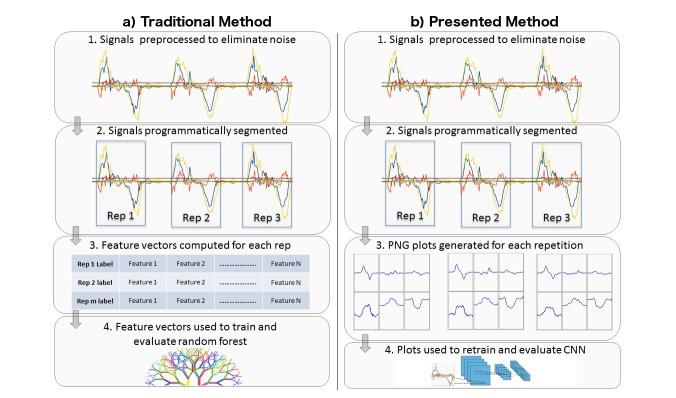
The study aimed to present a novel application of established machine vision methods to provide interested researchers with an easier entry path into the HAR and ED fields. This can be achieved by removing the need for deep DSP skills through the use of transfer learning. This can be done by using a pretrained convolutional neural network (CNN) developed for machine vision purposes for exercise classification effort. The new method should simply require researchers to generate plots of the signals that they would like to build classifiers with, store them as images, and then place them in folders according to their training label before retraining the network.
METHODS
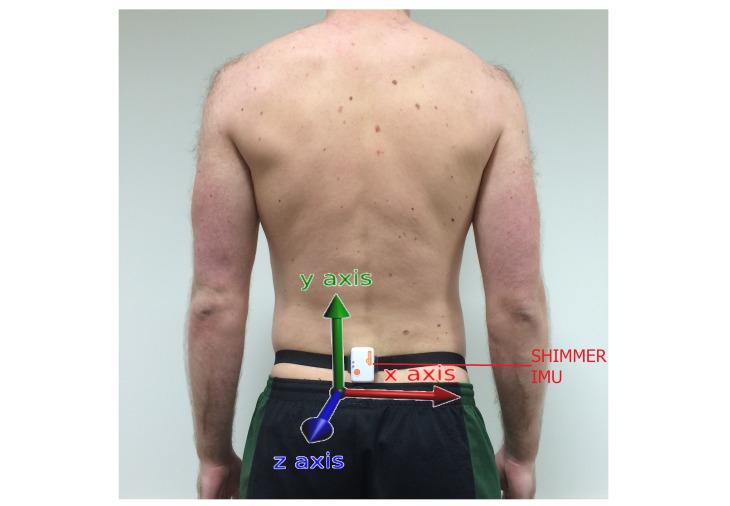
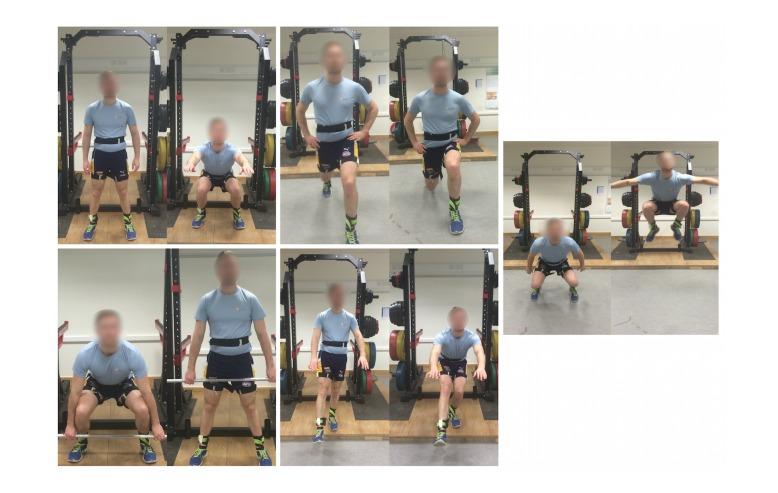
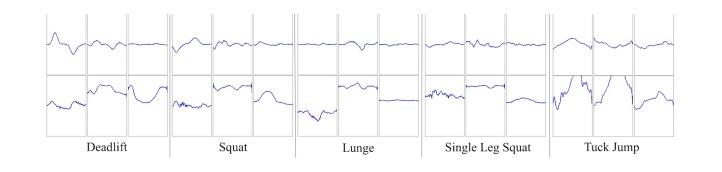
We applied a CNN, an established machine vision technique, to the task of ED. Tensorflow, a high-level framework for machine learning, was used to facilitate infrastructure needs. Simple time series plots generated directly from accelerometer and gyroscope signals are used to retrain an openly available neural network (Inception), originally developed for machine vision tasks. Data from 82 healthy volunteers, performing 5 different exercises while wearing a lumbar-worn inertial measurement unit (IMU), was collected. The ability of the proposed method to automatically classify the exercise being completed was assessed using this dataset. For comparative purposes, classification using the same dataset was also performed using the more conventional approach of feature-extraction and classification using random forest classifiers.
RESULTS
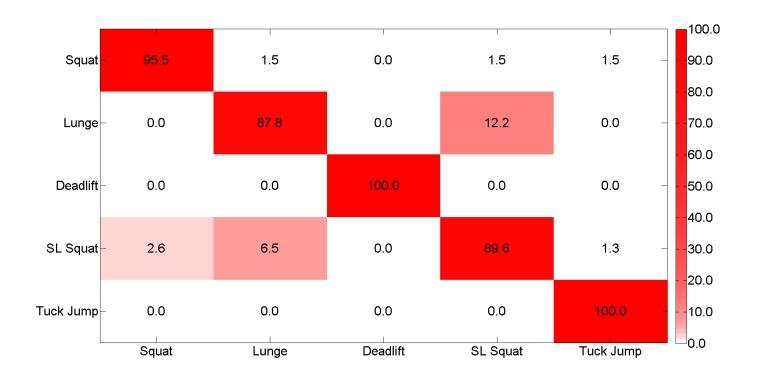
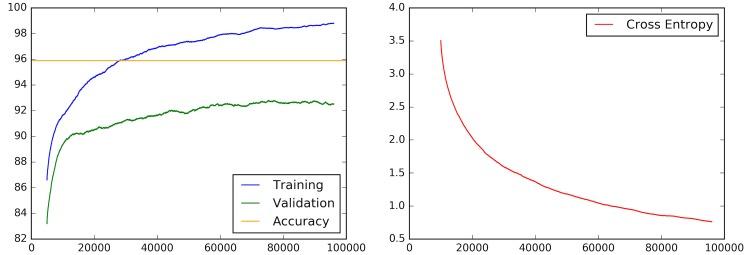
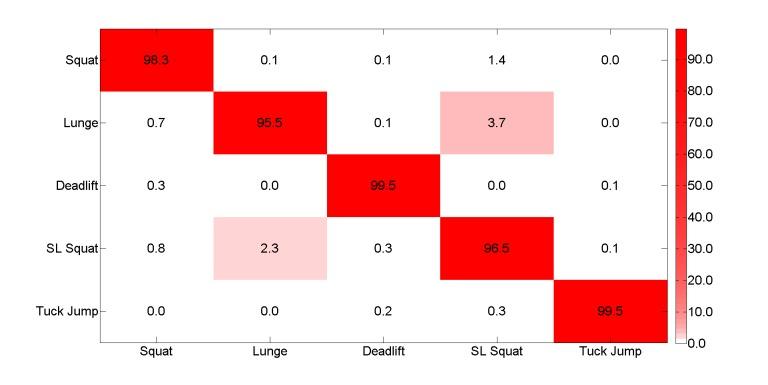
With the collected dataset and the proposed method, the different exercises could be recognized with a 95.89% (3827/3991) accuracy, which is competitive with current state-of-the-art techniques in ED.
CONCLUSIONS
The high level of accuracy attained with the proposed approach indicates that the waveform morphologies in the time-series plots for each of the exercises is sufficiently distinct among the participants to allow the use of machine vision approaches. The use of high-level machine learning frameworks, coupled with the novel use of machine vision techniques instead of complex manually crafted features, may facilitate access to research in the HAR field for individuals without extensive digital signal processing or machine learning backgrounds.
背景
惯性传感器是用于人类活动识别(HAR)和运动检测(ED)任务最常用的数据来源之一。这些传感器产生的时间序列通常通过数值方法进行分析。诸如随机森林或支持向量机等机器学习技术在该领域的分类工作中很受欢迎,但它们需要通过从原始数据中分离出大量潜在的额外精心设计的特征来提供支持。这个特征预处理步骤可能涉及复杂的数字信号处理(DSP)技术。然而,在许多情况下,对这类活动识别问题感兴趣的研究人员并不具备进行这种特征集开发所需的技术背景。
目的
本研究旨在展示一种成熟的机器视觉方法的新颖应用,为感兴趣的研究人员提供一条更容易进入HAR和ED领域的途径。这可以通过使用迁移学习消除对深度DSP技能的需求来实现。具体做法是使用一个为机器视觉目的而开发的预训练卷积神经网络(CNN)来进行运动分类工作。新方法应该只要求研究人员生成他们想要构建分类器的信号图,将其存储为图像,然后根据训练标签将它们放入文件夹中,再对网络进行重新训练。
方法
我们将一种成熟的机器视觉技术——卷积神经网络(CNN)应用于ED任务。使用了一个用于机器学习的高级框架TensorFlow来满足基础设施需求。直接从加速度计和陀螺仪信号生成的简单时间序列图用于重新训练一个最初为机器视觉任务开发的公开可用神经网络(Inception)。收集了82名健康志愿者的数据,他们在佩戴腰部惯性测量单元(IMU)时进行5种不同的运动。使用该数据集评估所提出方法自动分类正在完成的运动的能力。为了进行比较,还使用更传统的特征提取和使用随机森林分类器进行分类的方法对同一数据集进行了分类。
结果
使用所收集的数据集和所提出的方法,可以以95.89%(3827/3991)的准确率识别不同的运动,这与当前ED领域的最先进技术具有竞争力。
结论
所提出的方法获得的高准确率表明,每个运动的时间序列图中的波形形态在参与者之间足够不同,从而可以使用机器视觉方法。使用高级机器学习框架,再加上对机器视觉技术的新颖运用而非复杂的手工制作特征,可能会便于没有广泛数字信号处理或机器学习背景的个人进入HAR领域的研究。


 Zotero 插件