
在小鼠异基因造血干细胞移植中,抗CD4抗体治疗与供体淋巴细胞输注相结合可改善移植物抗宿主病,同时保留移植物抗肿瘤效应。
Combination of anti-CD4 antibody treatment and donor lymphocyte infusion ameliorates graft-versus-host disease while preserving graft-versus-tumor effects in murine allogeneic hematopoietic stem cell transplantation.
作者信息
Ueha Satoshi, Yokochi Shoji, Ishiwata Yoshiro, Kosugi-Kanaya Mizuha, Shono Yusuke, Shibayama Shiro, Ito Satoru, Matsushima Kouji
机构信息
Department of Molecular Preventive Medicine, Graduate School of Medicine, The University of Tokyo, Tokyo, Japan.
IDAC Theranostics Inc., Tokyo, Japan.
出版信息
Cancer Sci. 2017 Oct;108(10):1967-1973. doi: 10.1111/cas.13346. Epub 2017 Aug 29.
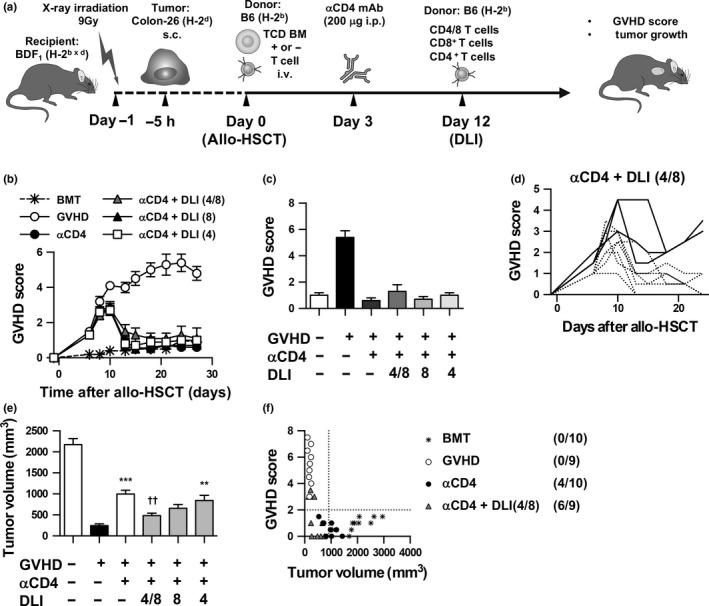
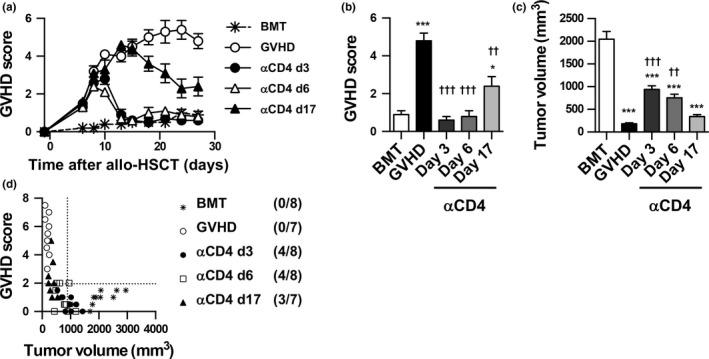
Allogeneic hematopoietic stem cell transplantation (allo-HSCT) is not only a well-established immunotherapy for hematologic malignancies, but is potentially useful for treating solid tumors refractory to available therapies. However, application of allo-HSCT to solid tumors is limited, despite the beneficial antitumor effects, by the risk of graft-versus-host disease (GVHD). CD4 T cells have been implicated in several aspects of GVHD, and suppress antitumor CD8 T-cell responses. In the present study, we investigated clinically applicable allo-HSCT protocols designed to maximize antitumor effects while reducing the risk of GVHD. We used a mouse model of allo-HSCT with s.c. tumors. We found that myeloablative conditioning was associated with better inhibition of tumor growth but with severe acute GVHD. Early treatment with anti-CD4 mAb substantially ameliorated GVHD while preserving antitumor effects, leading to improved survival in myeloablative allo-HSCT. Late treatment with anti-CD4 mAb also ameliorated GVHD to some extent. Donor lymphocyte infusion in GVHD mice treated with anti-CD4 mAb further suppressed tumor growth without exacerbating GVHD. Collectively, our results suggest that myeloablative allo-HSCT followed by anti-CD4 mAb treatment and donor lymphocyte infusion could be a potent and safe immunotherapy for patients with cancers refractory to available therapies.
异基因造血干细胞移植(allo-HSCT)不仅是一种成熟的血液系统恶性肿瘤免疫疗法,而且可能有助于治疗对现有疗法难治的实体瘤。然而,尽管异基因造血干细胞移植对实体瘤具有有益的抗肿瘤作用,但由于存在移植物抗宿主病(GVHD)风险,其在实体瘤中的应用受到限制。CD4 T细胞与移植物抗宿主病的多个方面有关,并抑制抗肿瘤CD8 T细胞反应。在本研究中,我们研究了旨在在降低移植物抗宿主病风险的同时最大化抗肿瘤作用的临床适用的异基因造血干细胞移植方案。我们使用了带有皮下肿瘤的异基因造血干细胞移植小鼠模型。我们发现,清髓性预处理与更好地抑制肿瘤生长相关,但会导致严重的急性移植物抗宿主病。早期用抗CD4单克隆抗体治疗可在保留抗肿瘤作用的同时显著改善移植物抗宿主病,从而提高清髓性异基因造血干细胞移植的生存率。晚期用抗CD4单克隆抗体治疗也在一定程度上改善了移植物抗宿主病。在用抗CD4单克隆抗体治疗的移植物抗宿主病小鼠中输注供体淋巴细胞可进一步抑制肿瘤生长而不会加剧移植物抗宿主病。总体而言,我们的结果表明,清髓性异基因造血干细胞移植后进行抗CD4单克隆抗体治疗和供体淋巴细胞输注可能是一种对现有疗法难治的癌症患者有效且安全的免疫疗法。

 Zotero 插件