
埃塞俄比亚南部哈瓦萨大学综合专科医院高血压患者代谢综合征的危险因素
Risk factors of metabolic syndrome among hypertensive patients at Hawassa University Comprehensive Specialized Hospital, Southern Ethiopia.
作者信息
Tadewos Agete, Egeno Tariku, Amsalu Antenah
机构信息
Department of Medical Laboratory Sciences, Hawassa University College of Medicine and Health Science, P.O. Box 1560, Hawassa, Ethiopia.
Hawassa University College of Medicine and Health Science, School of Medicine, Hawasa, Ethiopia.
出版信息
BMC Cardiovasc Disord. 2017 Aug 8;17(1):218. doi: 10.1186/s12872-017-0648-5.
BACKGROUND
Data regarding the prevalence of metabolic syndrome (MetS) among hypertensive patients in Ethiopia is very scarce, and the nature and the burden of MetS among these patients has not been well investigated. Therefore, the aim of this study was to assess the pattern and risk factors of MetS in hypertensive patients.
METHODS
A cross-sectional study was conducted at Hawassa University comprehensive specialized hospital from September 2015 to June 2016. Data on socio-demographic, clinical and anthropometric characteristics were collected from 238 hypertensive participants using WHO stepwise technique. Blood glucose and lipid profiles were determined after overnight fasting. Finally, MetS was defined according to National Cholesterol Education Program Adult Treatment Panel III Criteria.
RESULTS
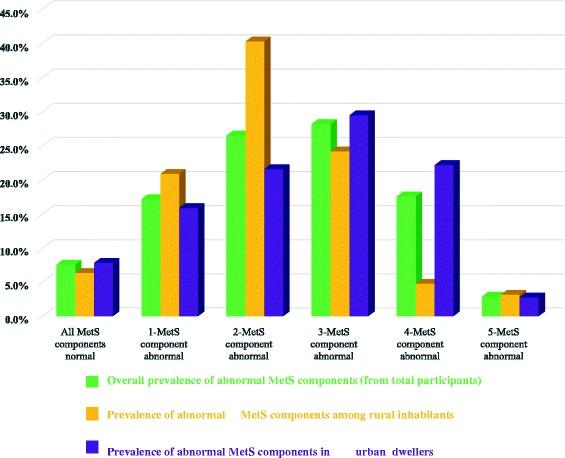
The overall prevalence of MetS was 48.7% and urban dwellers had significantly higher prevalence of MetS (82.8%) compared to rural inhabitants (17.2%), p = 0.003. About 37.8%, 62.2%, 60.9% and 35.7% of the participants had abdominal obesity, elevated triglycerides, low HDL-c, and increased fasting blood glucose, respectively. In addition the mean HDL-c was significantly lower in MetS group compared to non-MetS group (39.4 vs.47.6), P < 0.0001. Age over 60 years, overweight, and obesity were associated risk factors of MetS. The adjusted odds ratio (95% CI) was 8.2 (1.1-62.4) for age over 60 years, 2.8 (1.4-5.9) for overweight and 10.7 (3.8-29.8) for obesity. Moreover monthly income of 1001-2000 Ethiopian birr, income ≥2001birr, a retirement pension, being married, divorced/widowed were also significantly associated risk factors of MetS, the adjusted odds ratio (95% CI) was 3.6 (1.1-12.5), 5.8 (1.5-22.3),5.3 (1.1-25.9),7.2 (1.4-35.9) and 16.4 (1.1-244.2), respectively.
CONCLUSION
Metabolic syndrome is highly prevalent among hypertensive patients and this may potentiate the risk of cardiovascular problems. Therefore, regular screening of patients for individual components of MetS is vital in order to avert/limit the risks before developing cardiovascular related morbidity and mortality.
背景
关于埃塞俄比亚高血压患者代谢综合征(MetS)患病率的数据非常稀少,且这些患者中代谢综合征的性质和负担尚未得到充分研究。因此,本研究的目的是评估高血压患者中代谢综合征的模式和危险因素。
方法
2015年9月至2016年6月在哈瓦萨大学综合专科医院进行了一项横断面研究。使用世界卫生组织逐步技术从238名高血压参与者中收集社会人口统计学、临床和人体测量学特征数据。过夜禁食后测定血糖和血脂谱。最后,根据美国国家胆固醇教育计划成人治疗小组第三次报告标准定义代谢综合征。
结果
代谢综合征的总体患病率为48.7%,城市居民的代谢综合征患病率(82.8%)显著高于农村居民(17.2%),p = 0.003。分别约有37.8%、62.2%、60.9%和35.7%的参与者有腹型肥胖、甘油三酯升高、高密度脂蛋白胆固醇降低和空腹血糖升高。此外,代谢综合征组的平均高密度脂蛋白胆固醇显著低于非代谢综合征组(39.4对47.6),P < 0.0001。60岁以上、超重和肥胖是代谢综合征的相关危险因素。60岁以上的调整优势比(95%CI)为8.2(1.1 - 62.4),超重为2.8(1.4 - 5.9),肥胖为10.7(3.8 - 29.8)。此外,月收入1001 - 2000埃塞俄比亚比尔、收入≥2001比尔、退休金、已婚、离婚/丧偶也是代谢综合征的显著相关危险因素,调整优势比(95%CI)分别为3.6(1.1 - 12.5)、5.8(1.5 - 22.3)、5.3(1.1 - 25.9)、7.2(1.4 - 35.9)和16.4(1.1 - 244.2)。
结论
代谢综合征在高血压患者中高度流行,这可能会增加心血管问题的风险。因此,定期筛查患者的代谢综合征个体成分对于在发生心血管相关发病率和死亡率之前避免/限制风险至关重要。
 Zotero 插件