
高等教育能提升认知功能和学习效能吗?来自一个大规模多样化样本的研究结果。
Does higher education hone cognitive functioning and learning efficacy? Findings from a large and diverse sample.
作者信息
Guerra-Carrillo Belén, Katovich Kiefer, Bunge Silvia A
机构信息
Department of Psychology, University of California at Berkeley, Berkeley, CA, United States of America.
General Assembly Space, Inc., San Francisco, CA, United States of America.
出版信息
PLoS One. 2017 Aug 23;12(8):e0182276. doi: 10.1371/journal.pone.0182276. eCollection 2017.
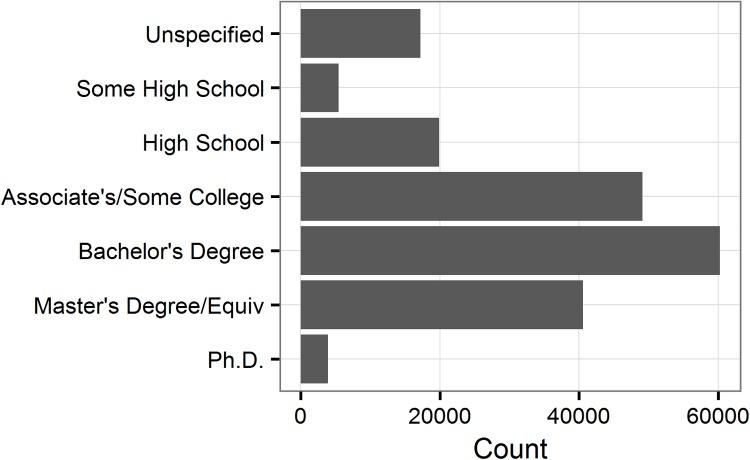
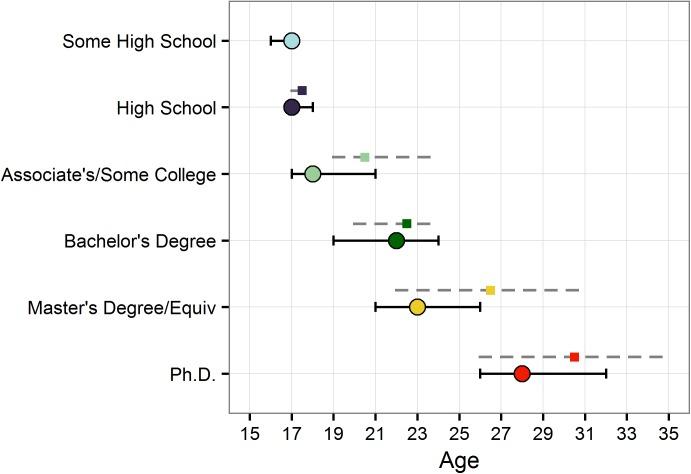
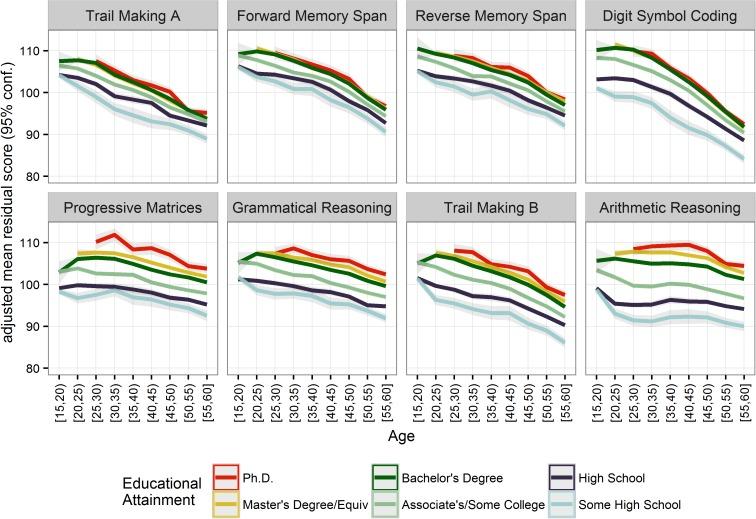
Attending school is a multifaceted experience. Students are not only exposed to new knowledge but are also immersed in a structured environment in which they need to respond flexibly in accordance with changing task goals, keep relevant information in mind, and constantly tackle novel problems. To quantify the cumulative effect of this experience, we examined retrospectively and prospectively, the relationships between educational attainment and both cognitive performance and learning. We analyzed data from 196,388 subscribers to an online cognitive training program. These subscribers, ages 15-60, had completed eight behavioral assessments of executive functioning and reasoning at least once. Controlling for multiple demographic and engagement variables, we found that higher levels of education predicted better performance across the full age range, and modulated performance in some cognitive domains more than others (e.g., reasoning vs. processing speed). Differences were moderate for Bachelor's degree vs. High School (d = 0.51), and large between Ph.D. vs. Some High School (d = 0.80). Further, the ages of peak cognitive performance for each educational category closely followed the typical range of ages at graduation. This result is consistent with a cumulative effect of recent educational experiences, as well as a decrement in performance as completion of schooling becomes more distant. To begin to characterize the directionality of the relationship between educational attainment and cognitive performance, we conducted a prospective longitudinal analysis. For a subset of 69,202 subscribers who had completed 100 days of cognitive training, we tested whether the degree of novel learning was associated with their level of education. Higher educational attainment predicted bigger gains, but the differences were small (d = 0.04-0.37). Altogether, these results point to the long-lasting trace of an effect of prior cognitive challenges but suggest that new learning opportunities can reduce performance gaps related to one's educational history.
上学是一种多方面的体验。学生不仅接触新知识,还沉浸在一个结构化的环境中,在这个环境里他们需要根据不断变化的任务目标灵活做出反应,记住相关信息,并不断解决新问题。为了量化这种体验的累积效应,我们进行了回顾性和前瞻性研究,考察了教育程度与认知表现及学习之间的关系。我们分析了来自一个在线认知训练项目的196,388名订阅者的数据。这些订阅者年龄在15至60岁之间,至少完成过八次执行功能和推理的行为评估。在控制了多个人口统计学和参与度变量后,我们发现,在整个年龄范围内,较高的教育程度预示着更好的表现,并且在某些认知领域对表现的调节作用大于其他领域(例如,推理与处理速度)。学士学位与高中学历之间的差异适中(d = 0.51),而博士学位与部分高中学历之间的差异较大(d = 0.80)。此外,每个教育类别的认知表现峰值年龄紧密遵循毕业的典型年龄范围。这一结果与近期教育经历的累积效应一致,也与随着学业完成时间越来越久表现下降的情况相符。为了开始刻画教育程度与认知表现之间关系的方向性,我们进行了一项前瞻性纵向分析。对于完成了100天认知训练的69,202名订阅者的子集,我们测试了新学习程度是否与他们的教育水平相关。较高的教育程度预示着更大的进步,但差异较小(d = 0.04 - 0.37)。总之,这些结果表明了先前认知挑战的长期影响,但也表明新的学习机会可以缩小与个人教育经历相关的表现差距。


 Zotero 插件