
基于单手想象不同力负荷驱动的脑机接口:一项在线可行性研究。
A brain-computer interface driven by imagining different force loads on a single hand: an online feasibility study.
作者信息
Wang Kun, Wang Zhongpeng, Guo Yi, He Feng, Qi Hongzhi, Xu Minpeng, Ming Dong
机构信息
Lab of Neural Engineering & Rehabilitation, Department of Biomedical Engineering, College of Precision Instruments and Optoelectronics Engineering, Tianjin University, Tianjin, China.
Tianjin International Joint Research Center for Neural Engineering, Academy of Medical Engineering and Translational Medicine, Tianjin University, Tianjin, China.
出版信息
J Neuroeng Rehabil. 2017 Sep 11;14(1):93. doi: 10.1186/s12984-017-0307-1.
BACKGROUND
Motor imagery (MI) induced EEG patterns are widely used as control signals for brain-computer interfaces (BCIs). Kinetic and kinematic factors have been proved to be able to change EEG patterns during motor execution and motor imagery. However, to our knowledge, there is still no literature reporting an effective online MI-BCI using kinetic factor regulated EEG oscillations. This study proposed a novel MI-BCI paradigm in which users can online output multiple commands by imagining clenching their right hand with different force loads.
METHODS
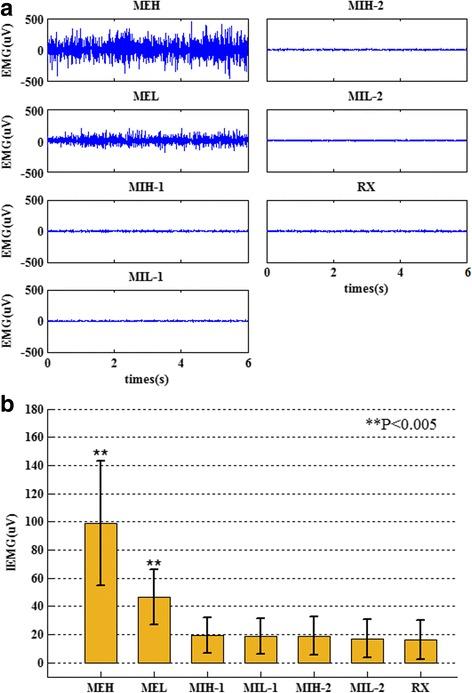
Eleven subjects participated in this study. During the experiment, they were asked to imagine clenching their right hands with two different force loads (30% maximum voluntary contraction (MVC) and 10% MVC). Multi-Common spatial patterns (Multi-CSPs) and support vector machines (SVMs) were used to build the classifier for recognizing three commands corresponding to high load MI, low load MI and relaxed status respectively. EMG were monitored to avoid voluntary muscle activities during the BCI operation. The event-related spectral perturbation (ERSP) method was used to analyse EEG variation during multiple load MI tasks.
RESULTS
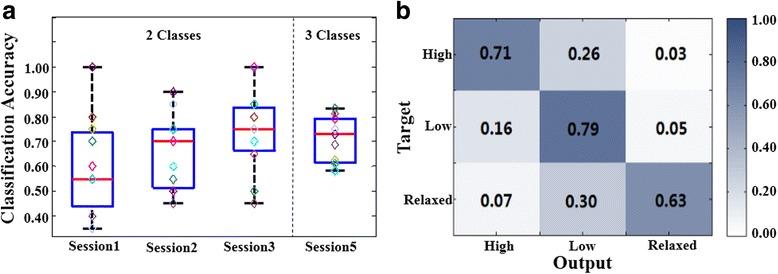
All subjects were able to drive BCI systems using motor imagery of different force loads in online experiments. We achieved an average online accuracy of 70.9%, with the highest accuracy of 83.3%, which was much higher than the chance level (33%). The event-related desynchronization (ERD) phenomenon during high load tasks was significantly higher than it was during low load tasks both in terms of intensity at electrode positions C3 (p < 0.05) and spatial distribution.
CONCLUSIONS
This paper demonstrated the feasibility of the proposed MI-BCI paradigm based on multi-force loads on the same limb through online studies. This paradigm could not only enlarge the command set of MI-BCI, but also provide a promising approach to rehabilitate patients with motor disabilities.
背景
运动想象(MI)诱发的脑电图模式被广泛用作脑机接口(BCI)的控制信号。动力学和运动学因素已被证明能够在运动执行和运动想象过程中改变脑电图模式。然而,据我们所知,尚无文献报道使用动力学因素调节脑电振荡的有效的在线MI-BCI。本研究提出了一种新颖的MI-BCI范式,用户可以通过想象以不同的力负荷握紧右手来在线输出多个命令。
方法
11名受试者参与了本研究。在实验过程中,要求他们想象以两种不同的力负荷(最大自主收缩(MVC)的30%和MVC的10%)握紧右手。使用多公共空间模式(Multi-CSPs)和支持向量机(SVMs)构建分类器,以分别识别对应于高负荷MI、低负荷MI和放松状态的三个命令。监测肌电图以避免BCI操作期间的自主肌肉活动。使用事件相关频谱扰动(ERSP)方法分析多负荷MI任务期间的脑电图变化。
结果
在在线实验中,所有受试者都能够使用不同力负荷的运动想象来驱动BCI系统。我们实现了70.9%的平均在线准确率,最高准确率为83.3%,远高于随机水平(33%)。在电极位置C3处,高负荷任务期间的事件相关去同步化(ERD)现象在强度(p < 0.05)和空间分布方面均显著高于低负荷任务期间。
结论
本文通过在线研究证明了基于同一肢体多力负荷的MI-BCI范式的可行性。这种范式不仅可以扩大MI-BCI的命令集,还为运动障碍患者的康复提供了一种有前景的方法。


 Zotero 插件