
胆碱能系统在免疫细胞中的表达与功能
Expression and Function of the Cholinergic System in Immune Cells.
作者信息
Fujii Takeshi, Mashimo Masato, Moriwaki Yasuhiro, Misawa Hidemi, Ono Shiro, Horiguchi Kazuhide, Kawashima Koichiro
机构信息
Faculty of Pharmaceutical Sciences, Department of Pharmacology, Doshisha Women's College of Liberal Arts, Kyoto, Japan.
Faculty of Pharmacy, Department of Pharmacology, Keio University, Tokyo, Japan.
出版信息
Front Immunol. 2017 Sep 6;8:1085. doi: 10.3389/fimmu.2017.01085. eCollection 2017.
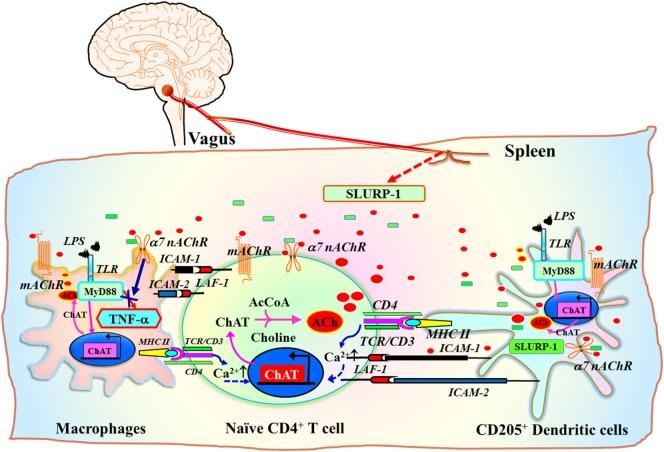
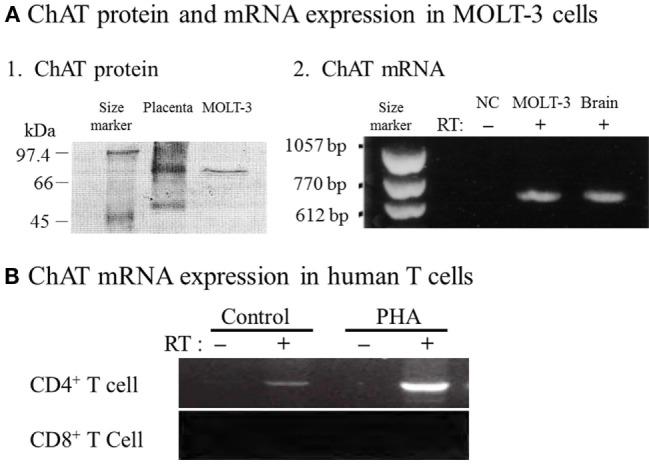
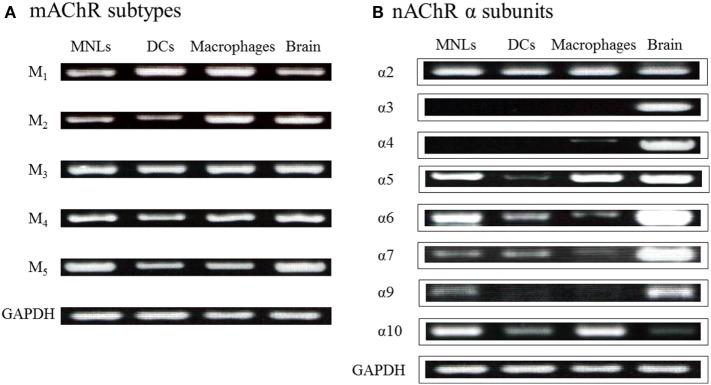
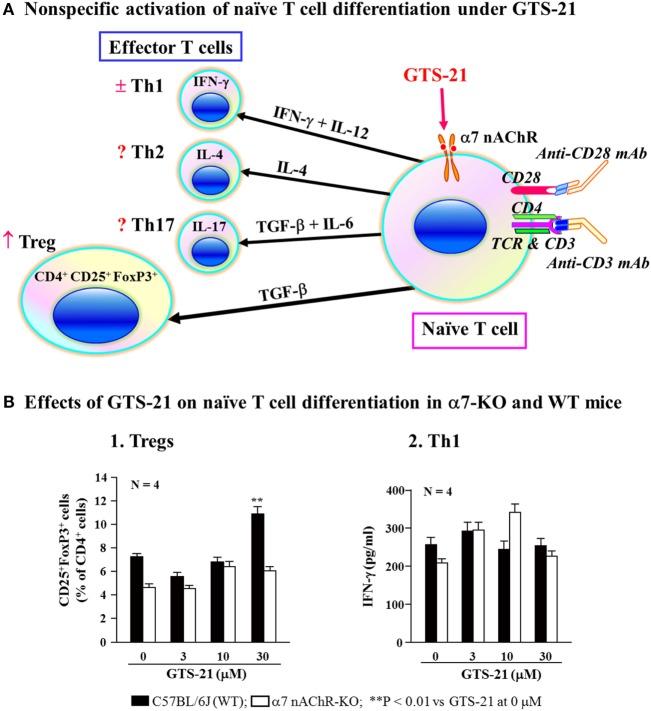
T and B cells express most cholinergic system components-e.g., acetylcholine (ACh), choline acetyltransferase (ChAT), acetylcholinesterase, and both muscarinic and nicotinic ACh receptors (mAChRs and nAChRs, respectively). Using ChAT-eGFP transgenic mice, ChAT expression has been confirmed in T and B cells, dendritic cells, and macrophages. Moreover, T cell activation T-cell receptor/CD3-mediated pathways upregulates ChAT mRNA expression and ACh synthesis, suggesting that this lymphocytic cholinergic system contributes to the regulation of immune function. Immune cells express all five mAChRs (M-M). Combined M/M mAChR-deficient (M/MKO) mice produce less antigen-specific antibody than wild-type (WT) mice. Furthermore, spleen cells in M/M-KO mice produce less tumor necrosis factor (TNF)-α and interleukin (IL)-6, suggesting M/M mAChRs are involved in regulating pro-inflammatory cytokine and antibody production. Immune cells also frequently express the α2, α5, α6, α7, α9, and α10 nAChR subunits. α7 nAChR-deficient (α7-KO) mice produce more antigen-specific antibody than WT mice, and spleen cells from α7-KO mice produce more TNF-α and IL-6 than WT cells. This suggests that α7 nAChRs are involved in regulating cytokine production and thus modulate antibody production. Evidence also indicates that nicotine modulates immune responses by altering cytokine production and that α7 nAChR signaling contributes to immunomodulation through modification of T cell differentiation. Together, these findings suggest the involvement of both mAChRs and nAChRs in the regulation of immune function. The observation that vagus nerve stimulation protects mice from lethal endotoxin shock led to the notion of a cholinergic anti-inflammatory reflex pathway, and the spleen is an essential component of this anti-inflammatory reflex. Because the spleen lacks direct vagus innervation, it has been postulated that ACh synthesized by a subset of CD4 T cells relays vagal nerve signals to α7 nAChRs on splenic macrophages, which downregulates TNF-α synthesis and release, thereby modulating inflammatory responses. However, because the spleen is innervated solely by the noradrenergic splenic nerve, confirmation of an anti-inflammatory reflex pathway involving the spleen requires several more hypotheses to be addressed. We will review and discuss these issues in the context of the cholinergic system in immune cells.
T细胞和B细胞表达大多数胆碱能系统成分,例如乙酰胆碱(ACh)、胆碱乙酰转移酶(ChAT)、乙酰胆碱酯酶,以及毒蕈碱型和烟碱型ACh受体(分别为m AChRs和n AChRs)。利用ChAT-eGFP转基因小鼠,已证实T细胞、B细胞、树突状细胞和巨噬细胞中存在ChAT表达。此外,T细胞活化——T细胞受体/CD3介导的信号通路可上调ChAT mRNA表达和ACh合成,提示这种淋巴细胞胆碱能系统有助于免疫功能的调节。免疫细胞表达所有五种m AChRs(M1-M5)。M1/M3 m AChR双缺陷(M1/M3KO)小鼠产生的抗原特异性抗体比野生型(WT)小鼠少。此外,M1/M3-KO小鼠的脾细胞产生的肿瘤坏死因子(TNF)-α和白细胞介素(IL)-6较少,提示M1/M3 m AChRs参与调节促炎细胞因子和抗体的产生。免疫细胞也经常表达α2、α5、α6、α7、α9和α10 n AChR亚基。α7 n AChR缺陷(α7-KO)小鼠产生的抗原特异性抗体比WT小鼠多,且α7-KO小鼠的脾细胞产生的TNF-α和IL-6比WT细胞多。这表明α7 n AChRs参与调节细胞因子的产生,从而调节抗体的产生。证据还表明,尼古丁通过改变细胞因子的产生来调节免疫反应,并且α7 n AChR信号传导通过改变T细胞分化而有助于免疫调节。总之,这些发现提示m AChRs和n AChRs均参与免疫功能的调节。迷走神经刺激可保护小鼠免受致死性内毒素休克的观察结果,引出了胆碱能抗炎反射通路的概念,而脾脏是这种抗炎反射的重要组成部分。由于脾脏缺乏迷走神经的直接支配,因此推测由一部分CD4 T细胞合成的ACh将迷走神经信号传递给脾巨噬细胞上的α7 n AChRs,从而下调TNF-α的合成和释放,进而调节炎症反应。然而,由于脾脏仅由去甲肾上腺素能脾神经支配,因此要证实涉及脾脏的抗炎反射通路,还需要解决更多的假说。我们将在免疫细胞胆碱能系统的背景下回顾和讨论这些问题。
 Zotero 插件