
用于去除整合型前病毒DNA的工程化HIV特异性重组酶的晶体结构。
Crystal structure of an engineered, HIV-specific recombinase for removal of integrated proviral DNA.
作者信息
Meinke Gretchen, Karpinski Janet, Buchholz Frank, Bohm Andrew
机构信息
Department of Developmental, Molecular and Chemical Biology, Tufts University School of Medicine, Boston, MA 02111, USA.
Medical Systems Biology, UCC, Medical Faculty Carl Gustav Carus, TU Dresden, 01307 Dresden, Germany.
出版信息
Nucleic Acids Res. 2017 Sep 19;45(16):9726-9740. doi: 10.1093/nar/gkx603.
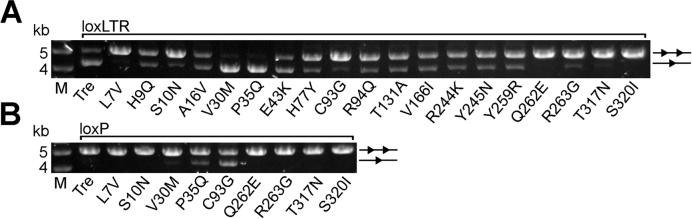
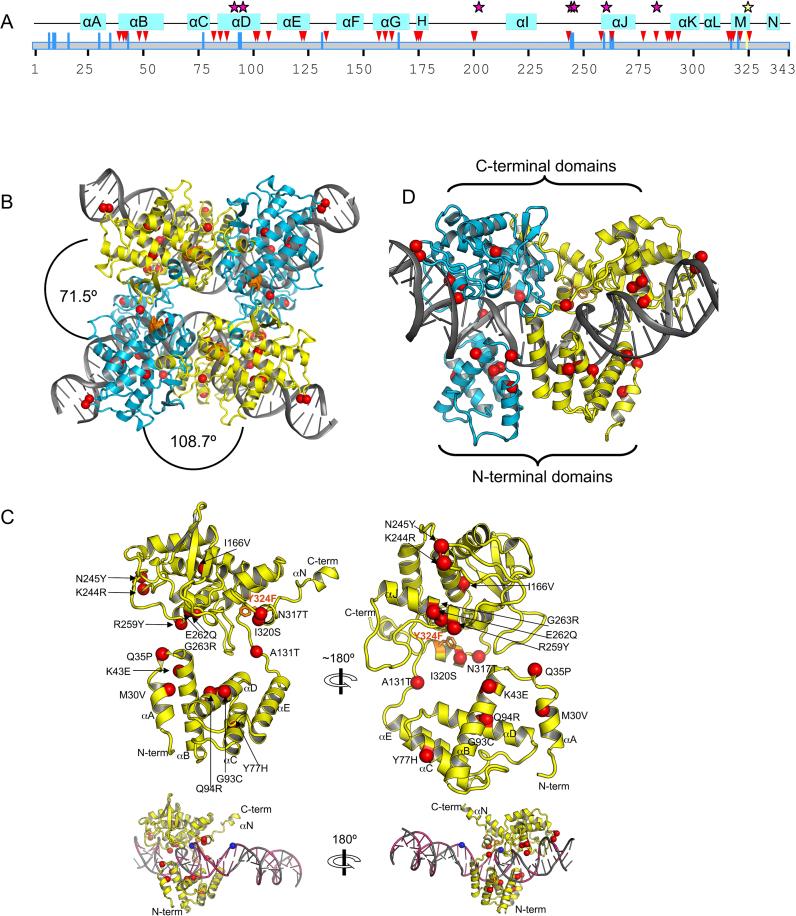
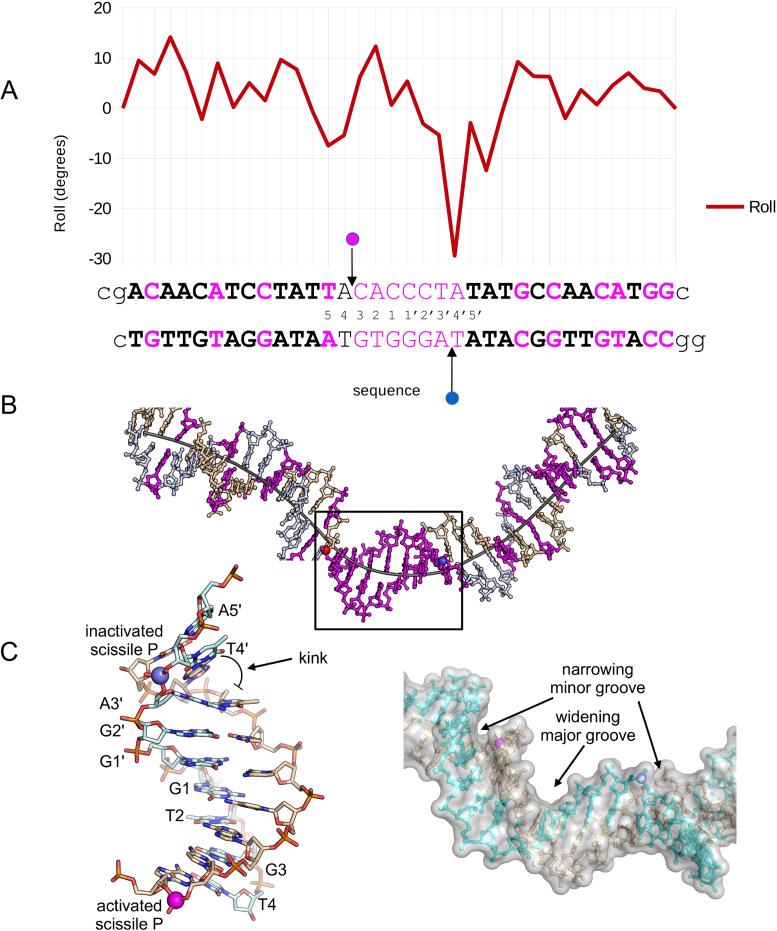
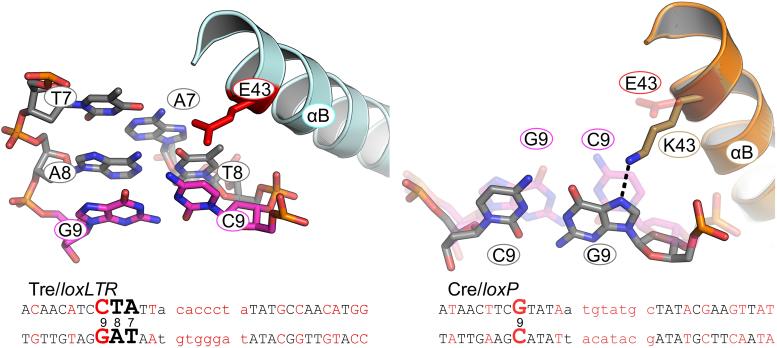
As part of the HIV infection cycle, viral DNA inserts into the genome of host cells such that the integrated DNA encoding the viral proteins is flanked by long terminal repeat (LTR) regions from the retrovirus. In an effort to develop novel genome editing techniques that safely excise HIV provirus from cells, Tre, an engineered version of Cre recombinase, was designed to target a 34-bp sequence within the HIV-1 LTR (loxLTR). The sequence targeted by Tre lacks the symmetry present in loxP, the natural DNA substrate for Cre. We report here the crystal structure of a catalytically inactive (Y324F) mutant of this engineered Tre recombinase in complex with the loxLTR DNA substrate. We also report that 17 of the 19 amino acid changes relative to Cre contribute to the altered specificity, even though many of these residues do not contact the DNA directly. We hypothesize that some mutations increase the flexibility of the Cre tetramer and that this, along with flexibility in the DNA, enable the engineered enzyme and DNA substrate to adopt complementary conformations.
作为HIV感染周期的一部分,病毒DNA插入宿主细胞基因组,使得编码病毒蛋白的整合DNA两侧是来自逆转录病毒的长末端重复序列(LTR)区域。为了开发能够安全地从细胞中切除HIV前病毒的新型基因组编辑技术,设计了一种经过工程改造的Cre重组酶Tre,使其靶向HIV-1 LTR(loxLTR)内的一个34碱基对序列。Tre靶向的序列缺乏Cre的天然DNA底物loxP中存在的对称性。我们在此报告这种经过工程改造的Tre重组酶的催化失活(Y324F)突变体与loxLTR DNA底物复合物的晶体结构。我们还报告称,相对于Cre的19个氨基酸变化中有17个导致了特异性改变,尽管其中许多残基并不直接与DNA接触。我们推测,一些突变增加了Cre四聚体的灵活性,并且这与DNA的灵活性一起,使工程酶和DNA底物能够采用互补构象。




 Zotero 插件