
B 群链球菌的酸应激反应机制。
Acid Stress Response Mechanisms of Group B Streptococci.
机构信息
Institute of Medical Microbiology and Hygiene, University of UlmUlm, Germany.
Department of Microbiology and Immunology, Faculty of Pharmacy, Suez Canal UniversityIsmailia, Egypt.
出版信息
Front Cell Infect Microbiol. 2017 Sep 7;7:395. doi: 10.3389/fcimb.2017.00395. eCollection 2017.
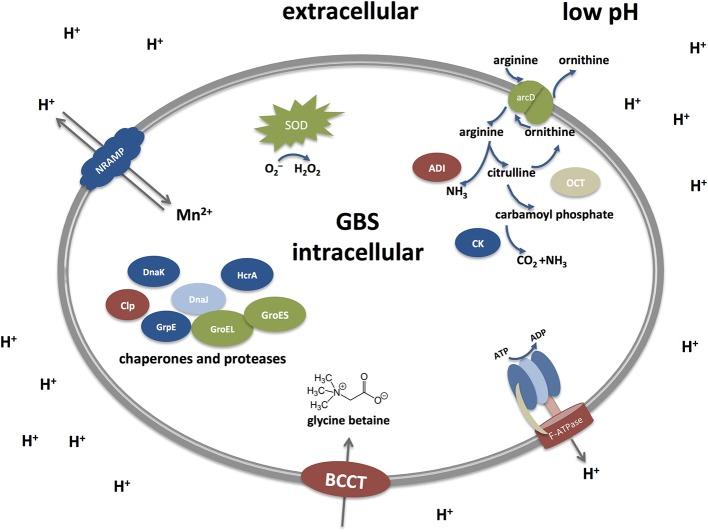
Group B streptococcus (GBS) is a leading cause of neonatal mortality and morbidity in the United States and Europe. It is part of the vaginal microbiota in up to 30% of pregnant women and can be passed on to the newborn through perinatal transmission. GBS has the ability to survive in multiple different host niches. The pathophysiology of this bacterium reveals an outstanding ability to withstand varying pH fluctuations of the surrounding environments inside the human host. GBS host pathogen interations include colonization of the acidic vaginal mucosa, invasion of the neutral human blood or amniotic fluid, breaching of the blood brain barrier as well as survival within the acidic phagolysosomal compartment of macrophages. However, investigations on GBS responses to acid stress are limited. Technologies, such as whole genome sequencing, genome-wide transcription and proteome mapping facilitate large scale identification of genes and proteins. Mechanisms enabling GBS to cope with acid stress have mainly been studied through these techniques and are summarized in the current review.
B 群链球菌(GBS)是美国和欧洲导致新生儿死亡和发病的主要原因。它是多达 30%孕妇阴道微生物群的一部分,并且可以通过围产期传播传递给新生儿。GBS 有能力在多种不同的宿主小生境中存活。这种细菌的病理生理学揭示了其出色的能力,可以承受人体宿主内周围环境不断变化的 pH 值波动。GBS 宿主病原体相互作用包括酸性阴道黏膜的定植、中性人血液或羊水的侵袭、血脑屏障的突破以及巨噬细胞酸性吞噬溶酶体腔内的存活。然而,对 GBS 对酸应激反应的研究有限。全基因组测序、全基因组转录和蛋白质组图谱等技术促进了大规模的基因和蛋白质鉴定。使 GBS 能够应对酸应激的机制主要通过这些技术进行研究,并在本综述中进行了总结。

 Zotero 插件