
通过益生菌干预使短双歧杆菌减少可减轻成年人的肠胃胀气:一项非随机配对设计的疗效临床试验
Methanobrevibacter attenuation via probiotic intervention reduces flatulence in adult human: A non-randomised paired-design clinical trial of efficacy.
作者信息
Seo Minseok, Heo Jaeyoung, Yoon Joon, Kim Se-Young, Kang Yoon-Mo, Yu Jihyun, Cho Seoae, Kim Heebal
机构信息
C&K Genomics, Seoul National University Research Park, Seoul, Republic of Korea.
Department of Animal Biotechnology, Chonbuk National University, Jeonju, Republic of Korea.
出版信息
PLoS One. 2017 Sep 22;12(9):e0184547. doi: 10.1371/journal.pone.0184547. eCollection 2017.
TRIAL DESIGN
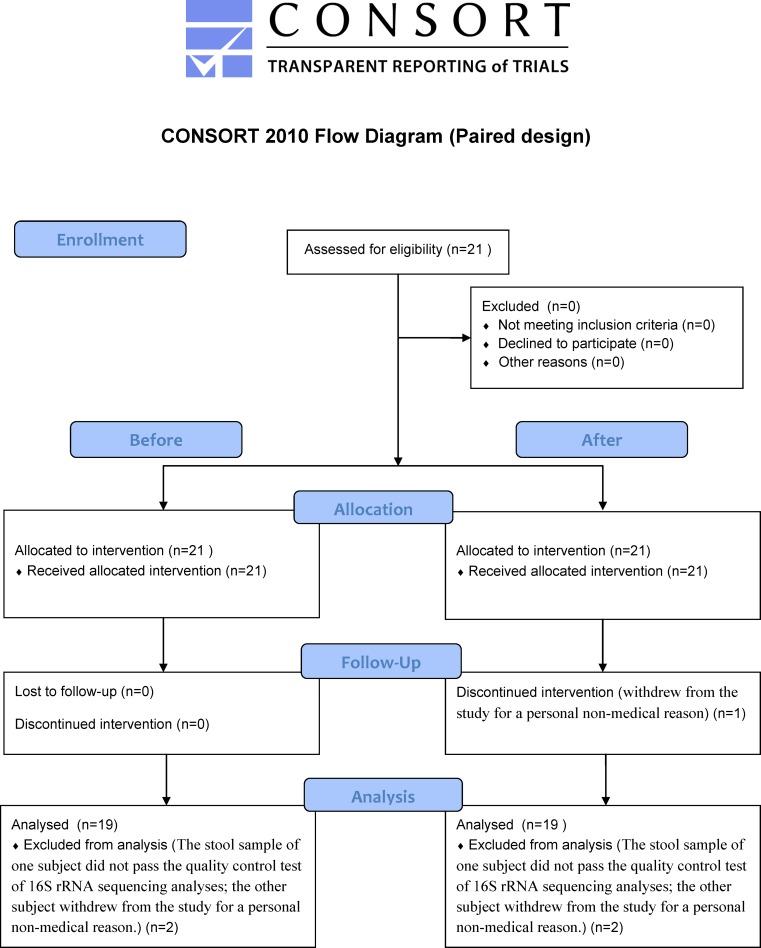
The aim of this study was to investigate which of the gut microbes respond to probiotic intervention, as well as study whether they are associated with gastrointestinal symptoms in a healthy adult human. For the experimental purpose, twenty-one healthy adults were recruited and received probiotic mixture, which is composed of five Lactobacilli strains and two Bifidobacteria strains, once a day for 60 days. Defecation survey and Bioelectrical Impedance Analysis were conducted pre- and post-administration to measure phenotypic differences. Stool samples of the subjects were collected twice.
METHODS
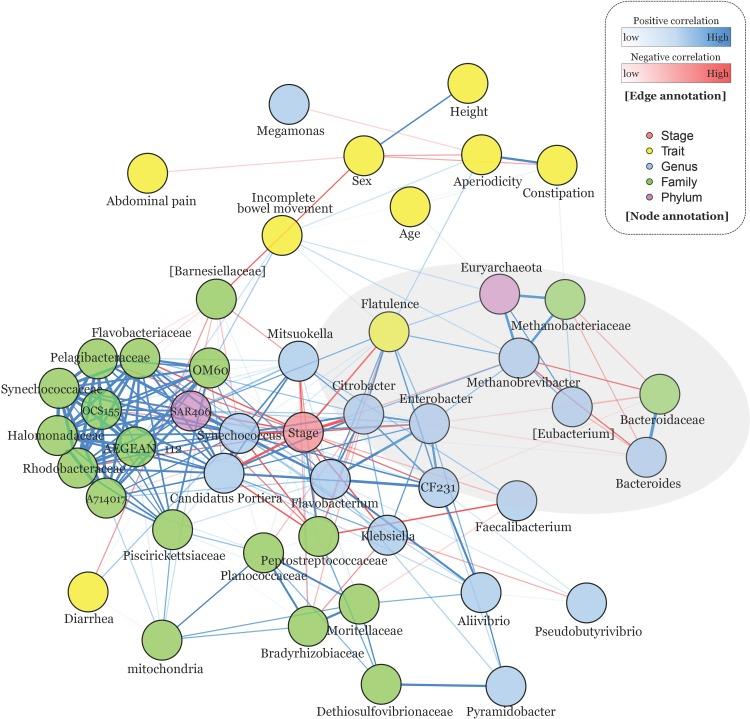
The statistical analysis was performed for pair designed metagenome data with 11 phenotypic records of the bioelectrical impedance body composition analyzer and 6 responses of the questionnaires about gastrointestinal symptom. Furthemore, correlation-based network analysis was conducted for exploring complex relationships among microbiome communities.
RESULTS
The abundances of Citrobacter, Klebsiella, and Methanobrevibacter were significantly reduced, which are strong candidates to be highly affected by the probiotic administration. In addition, interaction effects were observed between flatulence symptom attenuation and decreasing patterns of the Methanobrevibacter abundance.
CONCLUSIONS
These results reveal that probiotic intervention modulated the composition of gut microbiota and reduced the abundance of potential pathogens (i.e. Citrobacter and Klebsiella). In addition, methanogens (i.e. Methanobrevibacter) associated with the gastrointestinal symptom in an adult human.
试验设计
本研究的目的是调查哪些肠道微生物对益生菌干预有反应,并研究它们是否与健康成年人的胃肠道症状相关。出于实验目的,招募了21名健康成年人,让他们每天服用一次由五种乳酸杆菌菌株和两种双歧杆菌菌株组成的益生菌混合物,持续60天。在给药前后进行排便调查和生物电阻抗分析,以测量表型差异。收集受试者的粪便样本两次。
方法
对配对设计的宏基因组数据进行统计分析,这些数据包括生物电阻抗身体成分分析仪的11个表型记录和关于胃肠道症状的问卷的6个反应。此外,进行基于相关性的网络分析以探索微生物群落之间的复杂关系。
结果
柠檬酸杆菌、克雷伯菌和短柄甲烷杆菌的丰度显著降低,它们很可能是受益生菌给药影响较大的菌株。此外,在肠胃胀气症状减轻与短柄甲烷杆菌丰度降低模式之间观察到相互作用效应。
结论
这些结果表明,益生菌干预调节了肠道微生物群的组成,并降低了潜在病原体(即柠檬酸杆菌和克雷伯菌)的丰度。此外,产甲烷菌(即短柄甲烷杆菌)与成年人的胃肠道症状有关。


 Zotero 插件