
利用 24 小时膳食回顾和生物标志物评估多种族亚洲人群膳食摄入量的食物频率问卷的相对有效性和可重复性。
Relative Validity and Reproducibility of a Food Frequency Questionnaire for Assessing Dietary Intakes in a Multi-Ethnic Asian Population Using 24-h Dietary Recalls and Biomarkers.
机构信息
Saw Swee Hock School of Public Health, National University of Singapore and National University Health System, Singapore 117549, Singapore.
Department of Medicine, Yong Loo Lin School of Medicine, National University of Singapore and National University Health System, Singapore 119228, Singapore.
出版信息
Nutrients. 2017 Sep 25;9(10):1059. doi: 10.3390/nu9101059.
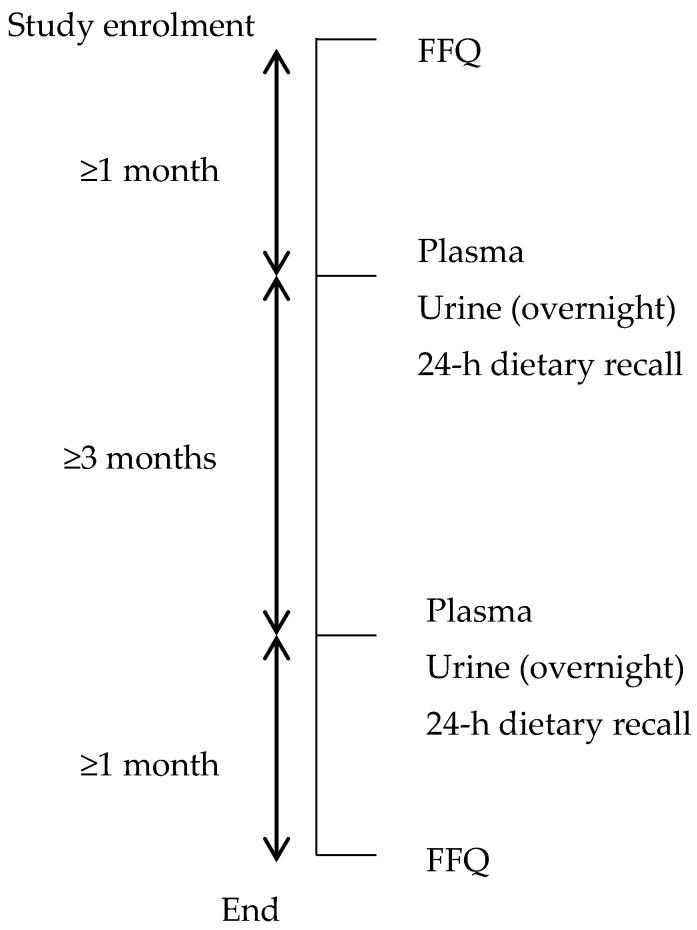
The assessment of diets in multi-ethnic cosmopolitan settings is challenging. A semi-quantitative 163-item food frequency questionnaire (FFQ) was developed for the adult Singapore population, and this study aimed to assess its reproducibility and relative validity against 24-h dietary recalls (24 h DR) and biomarkers. The FFQ was administered twice within a six-month interval in 161 adults (59 Chinese, 46 Malay, and 56 Indian). Fasting plasma, overnight urine, and 24 h DR were collected after one month and five months. Intra-class correlation coefficients between the two FFQ were above 0.70 for most foods and nutrients. The median correlation coefficient between energy-adjusted deattenuated FFQ and 24 h DR nutrient intakes was 0.40 for FFQ1 and 0.39 for FFQ2, highest for calcium and iron, and lowest for energy and carbohydrates. Significant associations were observed between urinary isoflavones and soy protein intake ( = 0.46), serum carotenoids and fruit and vegetable intake ( = 0.34), plasma eicosapentaenoic acid and docosahexaenoic acid (EPA + DHA) and fish/seafood intake ( = 0.36), and plasma odd chain saturated fatty acids (SFA) and dairy fat intake ( = 0.25). Associations between plasma EPA + DHA and fish/seafood intake were consistent across ethnic groups ( = 0.28-0.49), while differences were observed for other associations. FFQ assessment of dietary intakes in modern cosmopolitan populations remains feasible for the purpose of ranking individuals' dietary exposures in epidemiological studies.
在多民族的国际化大都市环境中评估饮食是具有挑战性的。我们为新加坡成年人开发了一个包含 163 种食物的半定量食物频率问卷(FFQ),本研究旨在评估其在六个月内两次重复评估的重现性和相对有效性,并与 24 小时膳食回顾(24 h DR)和生物标志物进行比较。在一个月和五个月后收集空腹血浆、过夜尿液和 24 h DR。在两次 FFQ 之间,大多数食物和营养素的 ICC 均大于 0.70。经能量校正的去衰减 FFQ 与 24 h DR 营养素摄入量之间的中位数相关系数为 0.40(FFQ1)和 0.39(FFQ2),最高的是钙和铁,最低的是能量和碳水化合物。尿异黄酮和大豆蛋白摄入量之间存在显著相关性( = 0.46),血清类胡萝卜素和水果及蔬菜摄入量之间存在显著相关性( = 0.34),血浆二十碳五烯酸和二十二碳六烯酸(EPA+DHA)和鱼/海鲜摄入量之间存在显著相关性( = 0.36),血浆奇数链饱和脂肪酸(SFA)和乳脂摄入量之间存在显著相关性( = 0.25)。血浆 EPA+DHA 和鱼/海鲜摄入量之间的相关性在不同种族群体中是一致的( = 0.28-0.49),而其他相关性则存在差异。对于在流行病学研究中对人群饮食暴露进行排序的目的而言,FFQ 评估现代国际化大都市人群的饮食摄入仍然是可行的。
 Zotero 插件