
大鼠中银纳米颗粒的急性毒性和遗传毒性
Acute toxicity and genotoxicity of silver nanoparticle in rats.
作者信息
Wen Hairuo, Dan Mo, Yang Ying, Lyu Jianjun, Shao Anliang, Cheng Xiang, Chen Liang, Xu Liming
机构信息
National Center for Safety Evaluation of Drugs, National Institutes for Food and Drug Control, Key Laboratory of Beijing for Nonclinical Safety Evaluation Research of Drugs, Beijing, P.R., China.
Institute for Medical Device Control, National Institutes for Food and Drug Control, Beijing, P. R., China.
出版信息
PLoS One. 2017 Sep 27;12(9):e0185554. doi: 10.1371/journal.pone.0185554. eCollection 2017.
OBJECTIVE
The potential risk of a nanoparticle as a medical application has raised wide concerns, and this study aims to investigate silver nanoparticle (AgNP)-induced acute toxicities, genotoxicities, target organs and the underlying mechanisms.
METHODS
Sprague-Dawley rats were randomly divided into 4 groups (n = 4 each group), and AgNP (containing Ag nanoparticles and released Ag+, 5 mg/kg), Ag+ (released from the same dose of AgNP, 0.0003 mg/kg), 5% sucrose solution (vechicle control) and cyclophophamide (positive control, 40 mg/kg) were administrated intravenously for 24 h respectively. Clinical signs and body weight of rats were recorded, and the tissues were subsequently collected for biochemical examination, Ag+ distribution detection, histopathological examination and genotoxicity assays.
RESULTS
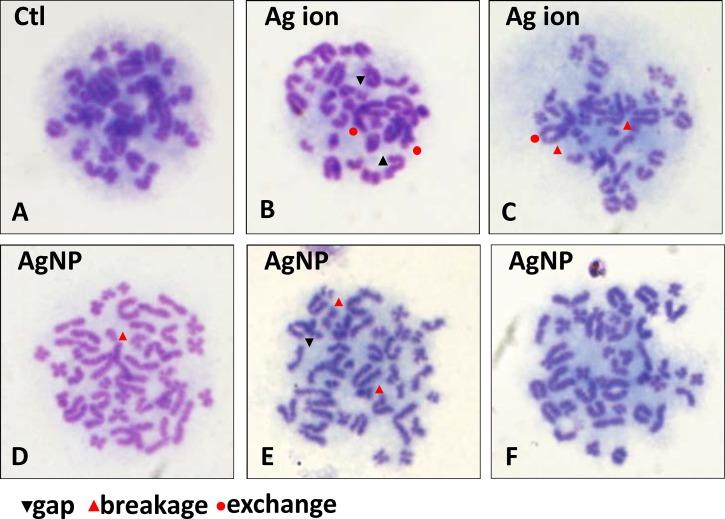
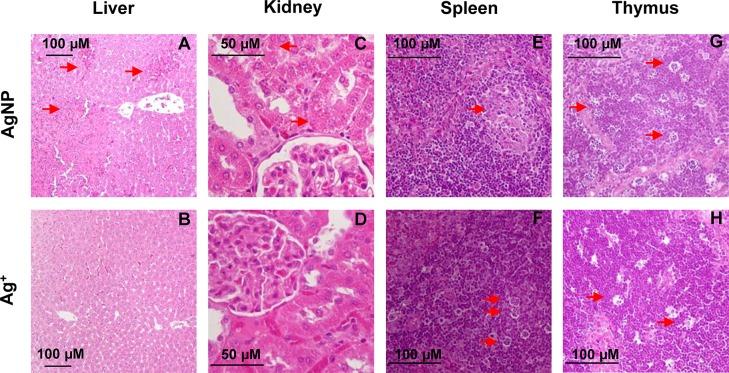
The rank of Ag detected in organs from highest to lowest is lung>spleen>liver>kidney>thymus>heart. Administration of AgNP induced a marked increase of ALT, BUN, TBil and Cre. Histopathological examination results showed that AgNP induced more extensive organ damages in liver, kidneys, thymus, and spleen. Bone marrow micronucleus assay found no statistical significance among groups (p > 0.05), but the number of aberration cells and multiple aberration cells were predominately increased from rats dosed with Ag+ and AgNP (p < 0.01), and more polyploidy cells were generated in the AgNP group (4.3%) compared with control.
CONCLUSION
Our results indicated that the AgNP accumulated in the immune system organs, and mild irritation was observed in the thymus and spleen of animals treated with AgNP, but not with Ag+. The liver and kidneys could be the most affected organs by an acute i.v. dose of AgNP, and significantly increased chromosome breakage and polyploidy cell rates also implied the potential genotoxicity of AgNP. However, particle-specific toxicities and potential carcinogenic effect remain to be further confirmed in a chronic toxicity study.
目的
纳米颗粒在医学应用中的潜在风险引发了广泛关注,本研究旨在探讨银纳米颗粒(AgNP)诱导的急性毒性、遗传毒性、靶器官及潜在机制。
方法
将Sprague-Dawley大鼠随机分为4组(每组n = 4),分别静脉注射AgNP(含银纳米颗粒及释放的Ag⁺,5 mg/kg)、Ag⁺(同剂量AgNP释放的,0.0003 mg/kg)、5%蔗糖溶液(载体对照)和环磷酰胺(阳性对照,40 mg/kg),持续24小时。记录大鼠的临床症状和体重,随后收集组织进行生化检查、Ag⁺分布检测、组织病理学检查和遗传毒性检测。
结果
在各器官中检测到的银含量从高到低依次为肺>脾>肝>肾>胸腺>心脏。注射AgNP后,谷丙转氨酶(ALT)、血尿素氮(BUN)、总胆红素(TBil)和肌酐(Cre)显著升高。组织病理学检查结果显示,AgNP对肝脏、肾脏、胸腺和脾脏造成了更广泛的器官损伤。骨髓微核试验各组间无统计学意义(p > 0.05),但Ag⁺和AgNP给药组的畸变细胞和多重畸变细胞数量主要增加(p < 0.01),与对照组相比,AgNP组产生了更多的多倍体细胞(4.3%)。
结论
我们的结果表明,AgNP在免疫系统器官中蓄积,在接受AgNP处理的动物的胸腺和脾脏中观察到轻度刺激,但Ag⁺处理组未观察到。肝脏和肾脏可能是静脉注射急性剂量AgNP影响最严重的器官,染色体断裂和多倍体细胞率的显著增加也暗示了AgNP的潜在遗传毒性。然而,颗粒特异性毒性和潜在致癌作用仍有待在慢性毒性研究中进一步证实。



 Zotero 插件