
塔卡里贝病毒感染的牙买加果蝠的转录组特征
Transcriptomic Signatures of Tacaribe Virus-Infected Jamaican Fruit Bats.
作者信息
Gerrard Diana L, Hawkinson Ann, Sherman Tyler, Modahl Cassandra M, Hume Gretchen, Campbell Corey L, Schountz Tony, Frietze Seth
机构信息
Department of Medical Laboratory and Radiation Sciences and Cell, Molecular, and Biomedical Sciences Program, University of Vermont, Burlington, Vermont, USA.
School of Biological Sciences, University of Northern Colorado, Greeley, Colorado, USA.
出版信息
mSphere. 2017 Sep 27;2(5). doi: 10.1128/mSphere.00245-17. eCollection 2017 Sep-Oct.
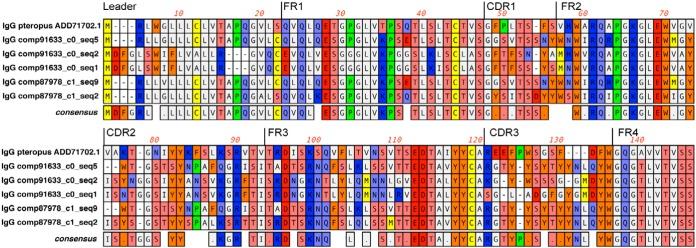
Tacaribe virus (TCRV) is a mammalian arenavirus that was first isolated from artibeus bats in the 1950s. Subsequent experimental infection of Jamaican fruit bats () caused a disease similar to that of naturally infected bats. Although substantial attention has focused on bats as reservoir hosts of viruses that cause human disease, little is known about the interactions between bats and their pathogens. We performed a transcriptome-wide study to illuminate the response of Jamaican fruit bats experimentally infected with TCRV. Differential gene expression analysis of multiple tissues revealed global and organ-specific responses associated with innate antiviral responses, including interferon alpha/beta and Toll-like receptor signaling, activation of complement cascades, and cytokine signaling, among others. Genes encoding proteins involved in adaptive immune responses, such as gamma interferon signaling and costimulation of T cells by the CD28 family, were also altered in response to TCRV infection. Immunoglobulin gene expression was also elevated in the spleens of infected bats, including IgG, IgA, and IgE isotypes. These results indicate an active innate and adaptive immune response to TCRV infection occurred but did not prevent fatal disease. This assembly provides a high-throughput data set of the Jamaican fruit bat and its host response to TCRV infection, which remains a valuable tool to understand the molecular signatures involved in antiviral responses in bats. As reservoir hosts of viruses associated with human disease, little is known about the interactions between bats and viruses. Using Jamaican fruit bats infected with Tacaribe virus (TCRV) as a model, we characterized the gene expression responses to infection in different tissues and identified pathways involved with the response to infection. This report is the most detailed gene discovery work in the species to date and the first to describe immune gene expression responses in bats during a pathogenic viral infection.
塔卡里贝病毒(TCRV)是一种哺乳动物沙粒病毒,于20世纪50年代首次从食果蝠中分离出来。随后对牙买加果蝠进行的实验性感染引发了一种与自然感染蝙蝠相似的疾病。尽管大量关注集中在蝙蝠作为导致人类疾病的病毒储存宿主上,但对于蝙蝠与其病原体之间的相互作用却知之甚少。我们进行了一项全转录组研究,以阐明实验感染TCRV的牙买加果蝠的反应。对多个组织的差异基因表达分析揭示了与先天性抗病毒反应相关的整体和器官特异性反应,包括α/β干扰素和Toll样受体信号传导、补体级联反应的激活以及细胞因子信号传导等。参与适应性免疫反应的蛋白质编码基因,如γ干扰素信号传导和CD28家族对T细胞的共刺激,也因TCRV感染而发生改变。感染蝙蝠脾脏中的免疫球蛋白基因表达也有所升高,包括IgG、IgA和IgE亚型。这些结果表明,对TCRV感染发生了积极的先天性和适应性免疫反应,但并未预防致命疾病。这个组装提供了牙买加果蝠及其对TCRV感染的宿主反应的高通量数据集,这仍然是了解蝙蝠抗病毒反应中涉及的分子特征的宝贵工具。作为与人类疾病相关病毒的储存宿主,对于蝙蝠与病毒之间的相互作用知之甚少。以感染塔卡里贝病毒(TCRV)的牙买加果蝠为模型,我们表征了不同组织中对感染的基因表达反应,并确定了与感染反应相关的途径。本报告是迄今为止该物种中最详细的基因发现工作,也是首次描述致病性病毒感染期间蝙蝠的免疫基因表达反应。


 Zotero 插件