
在EMBARK试验中,依那西普对骶髂关节MRI结构损伤的改善:一项针对非放射学中轴型脊柱关节炎患者的12周随机安慰剂对照试验。
Modification of structural lesions on MRI of the sacroiliac joints by etanercept in the EMBARK trial: a 12-week randomised placebo-controlled trial in patients with non-radiographic axial spondyloarthritis.
作者信息
Maksymowych Walter P, Wichuk Stephanie, Dougados Maxime, Jones Heather E, Pedersen Ron, Szumski Annette, Marshall Lisa, Bukowski Jack F, Lambert Robert G
机构信息
Department of Medicine, University of Alberta, Edmonton, Alberta, Canada.
Paris Descartes University, Rheumatology Department, Cochin Hospital, Assistance Publique-Hôpitaux de Paris, INSERM (U1153): Clinical Epidemiology and Biostatistics, PRES Sorbonne Paris-Cité, France.
出版信息
Ann Rheum Dis. 2018 Jan;77(1):78-84. doi: 10.1136/annrheumdis-2017-211605. Epub 2017 Sep 29.
OBJECTIVE
To evaluate the impact on structural lesions observed on MRI in the sacroiliac joints (SIJ) at 12 weeks in patients with non-radiographic axial spondyloarthritis (nr-axSpA) receiving etanercept or placebo in EMBARK (Effect of Etanercept on Symptoms and Objective Inflammation in nr-axSpA, a 104 week study).
METHODS
Patients were randomised to double-blind etanercept 50 mg/week or placebo for 12 weeks. Structural lesions at baseline and 12 weeks were scored by two independent readers using the Spondyloarthritis Research Consortium of Canada (SPARCC) SIJ structural score (SSS) on T1-weighted MRI. Change in SPARCC SSS and correlation with improvement in clinical outcomes was evaluated.
RESULTS
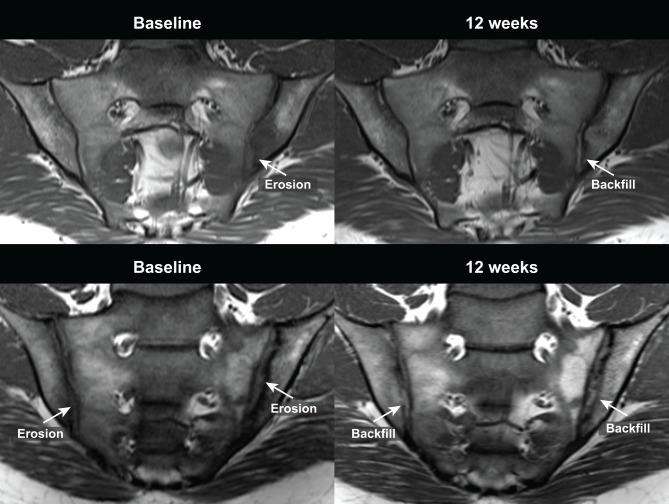
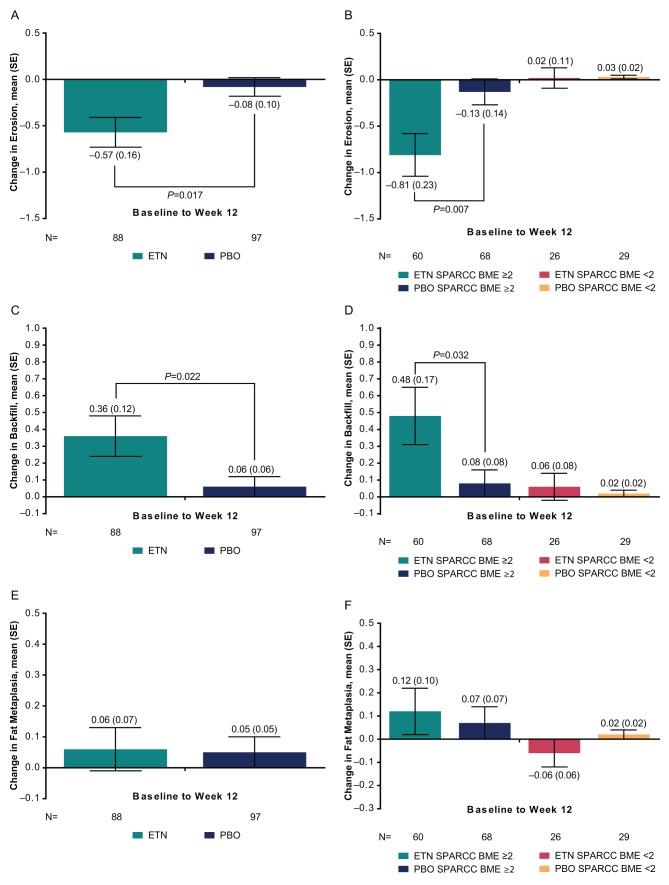
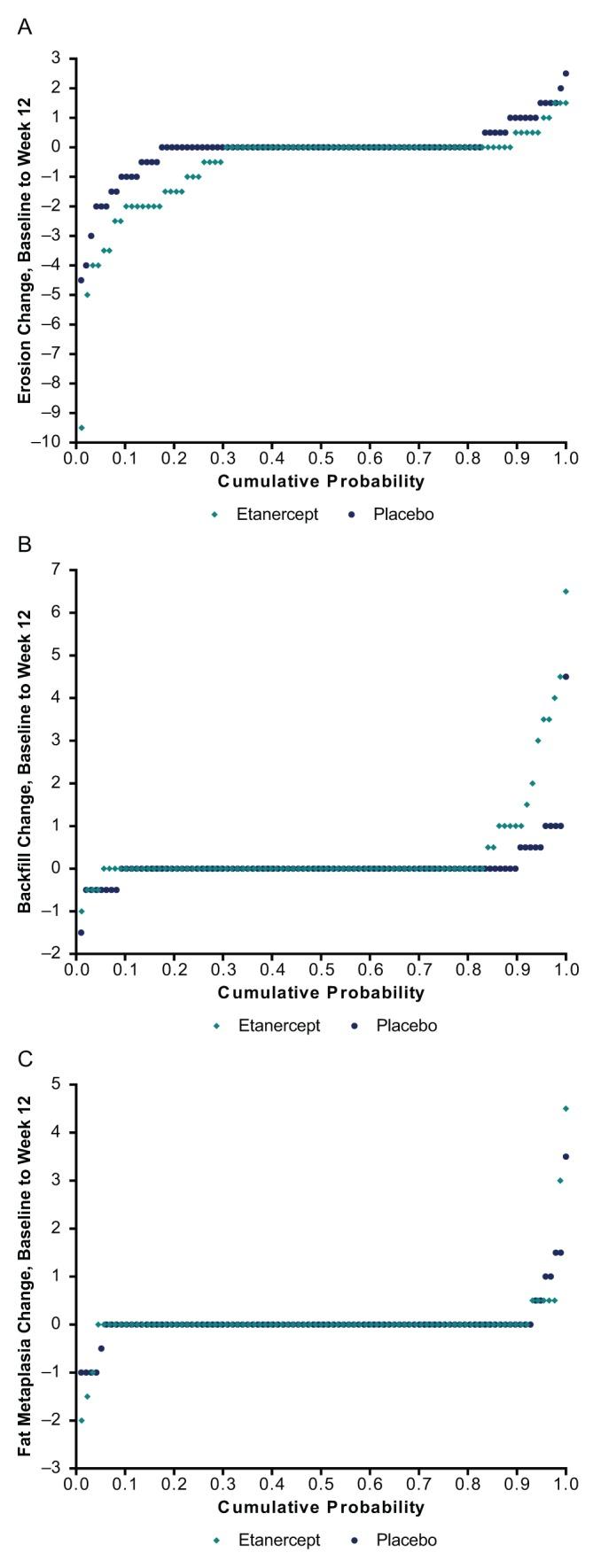
MRI scans from 185 patients (etanercept, n=88; placebo, n=97) were reviewed. At baseline, there were no significant differences in mean SPARCC SSS between etanercept and placebo. From baseline to 12 weeks, change in mean SPARCC SSS was significantly greater for etanercept than placebo for erosion (-0.57 vs -0.08, respectively, adjusted p value=0.017) and backfill (0.36 vs 0.06, adjusted p value=0.022). A treatment difference was also present for the subgroup of patients with SIJ inflammation on MRI (SPARCC bone marrow oedema ≥2): erosion: -0.81 versus -0.13 for etanercept versus placebo, respectively, p=0.007; backfill: 0.48 versus 0.08, respectively, p=0.032. Decrease in erosion and increase in backfill correlated with improvement in more clinical outcomes for etanercept than placebo.
CONCLUSION
Treatment with etanercept was associated with significantly greater reduction in erosions and increase in backfill at 12 weeks compared with placebo, consistent with a very early reparative response to antitumour necrosis factor therapy. The impact on disease progression in spondyloarthritis should be studied further.
TRIAL REGISTRATION NUMBER
NCT01258738; Post-results.
目的
在EMBARK(依那西普对非放射学轴向脊柱关节炎(nr-axSpA)症状和客观炎症的影响,一项为期104周的研究)中,评估接受依那西普或安慰剂治疗12周的非放射学轴向脊柱关节炎(nr-axSpA)患者骶髂关节(SIJ)MRI上观察到的结构损伤的影响。
方法
患者被随机分为双盲组,分别接受每周50mg依那西普或安慰剂治疗12周。由两名独立阅片者使用加拿大脊柱关节炎研究联盟(SPARCC)骶髂关节结构评分(SSS)在T1加权MRI上对基线和12周时的结构损伤进行评分。评估SPARCC SSS的变化及其与临床结局改善的相关性。
结果
对185例患者(依那西普组,n = 88;安慰剂组,n = 97)的MRI扫描进行了回顾。基线时,依那西普组和安慰剂组的平均SPARCC SSS无显著差异。从基线到12周,依那西普组在侵蚀(分别为-0.57对-0.08,校正p值 = 0.017)和填充(0.36对0.06,校正p值 = 0.022)方面的平均SPARCC SSS变化显著大于安慰剂组。对于MRI上有骶髂关节炎症的患者亚组(SPARCC骨髓水肿≥2)也存在治疗差异:侵蚀:依那西普组为-0.81,安慰剂组为-0.13,p = 0.007;填充:分别为0.48对0.08,p = 0.032。与安慰剂相比,依那西普组侵蚀的减少和填充的增加与更多临床结局的改善相关。
结论
与安慰剂相比,依那西普治疗在12周时侵蚀的显著减少和填充的增加相关,这与对抗肿瘤坏死因子治疗的非常早期的修复反应一致。对脊柱关节炎疾病进展的影响应进一步研究。
试验注册号
NCT01258738;结果后。
 Zotero 插件