
BRAF非V600E突变对经治转移性结直肠癌患者抗表皮生长因子受体(EGFR)单克隆抗体治疗疗效的临床意义:综合癌症基因组学抗EGFR单克隆抗体生物标志物研究(BREAC研究)
Clinical significance of BRAF non-V600E mutations on the therapeutic effects of anti-EGFR monoclonal antibody treatment in patients with pretreated metastatic colorectal cancer: the Biomarker Research for anti-EGFR monoclonal Antibodies by Comprehensive Cancer genomics (BREAC) study.
作者信息
Shinozaki Eiji, Yoshino Takayuki, Yamazaki Kentaro, Muro Kei, Yamaguchi Kensei, Nishina Tomohiro, Yuki Satoshi, Shitara Kohei, Bando Hideaki, Mimaki Sachiyo, Nakai Chikako, Matsushima Koutatsu, Suzuki Yutaka, Akagi Kiwamu, Yamanaka Takeharu, Nomura Shogo, Fujii Satoshi, Esumi Hiroyasu, Sugiyama Masaya, Nishida Nao, Mizokami Masashi, Koh Yasuhiro, Abe Yukiko, Ohtsu Atsushi, Tsuchihara Katsuya
机构信息
Department of Gastrointestinal Oncology, Cancer Institute Hospital of Japanese Foundation for Cancer Research, Tokyo 135-0063, Japan.
Department of Gastroenterology and Gastrointestinal Oncology, National Cancer Center Hospital East, Kashiwa 277-8577, Japan.
出版信息
Br J Cancer. 2017 Nov 7;117(10):1450-1458. doi: 10.1038/bjc.2017.308. Epub 2017 Oct 3.
BACKGROUND
Patients with BRAF-mutated metastatic colorectal cancer (mCRC) have a poorer prognosis as well as resistance to anti-EGFR antibodies. However, it is unclear whether BRAF mutations other than BRAF (BRAF mutations) contribute to anti-EGFR antibody resistance.
METHODS
This study was composed of exploratory and inference cohorts. Candidate biomarkers identified by whole exome sequencing from super-responders and nonresponders in the exploratory cohort were validated by targeted resequencing for patients who received anti-EGFR antibody in the inference cohort.
RESULTS
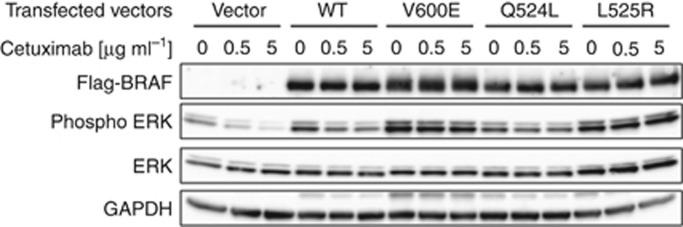
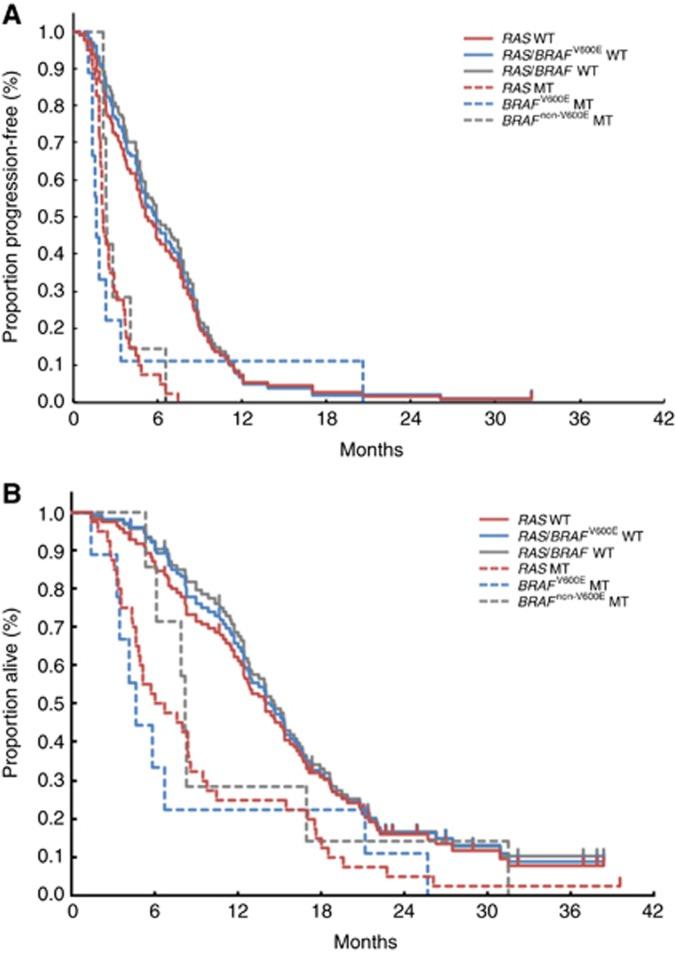
In the exploratory cohort, 31 candidate biomarkers, including KRAS/NRAS/BRAF mutations, were identified. Targeted resequencing of 150 patients in the inference cohort revealed 40 patients with RAS (26.7%), 9 patients with BRAF (6.0%), and 7 patients with BRAF mutations (4.7%), respectively. The response rates in RAS, BRAF, and BRAF were lower than those in RAS/BRAF wild-type (2.5%, 0%, and 0% vs 31.9%). The median PFS in BRAF mutations was 2.4 months, similar to that in RAS or BRAF mutations (2.1 and 1.6 months) but significantly worse than that in wild-type RAS/BRAF (5.9 months).
CONCLUSIONS
Although BRAF mutations identified were a rare and unestablished molecular subtype, certain BRAF mutations might contribute to a lesser benefit of anti-EGFR monoclonal antibody treatment.
背景
BRAF 突变的转移性结直肠癌(mCRC)患者预后较差,且对抗表皮生长因子受体(EGFR)抗体耐药。然而,除 BRAF(BRAF 突变)外的其他 BRAF 突变是否导致抗 EGFR 抗体耐药尚不清楚。
方法
本研究由探索性队列和推断性队列组成。在探索性队列中,通过全外显子测序从超级应答者和无应答者中鉴定出的候选生物标志物,在推断性队列中对接受抗 EGFR 抗体治疗的患者进行靶向重测序验证。
结果
在探索性队列中,鉴定出 31 种候选生物标志物,包括 KRAS/NRAS/BRAF 突变。推断性队列中 150 例患者的靶向重测序显示,分别有 40 例 RAS 突变患者(26.7%)、9 例 BRAF 突变患者(6.0%)和 7 例 BRAF 突变患者(4.7%)。RAS、BRAF 和 BRAF 突变患者的缓解率低于 RAS/BRAF 野生型患者(分别为 2.5%、0%和 0%,而野生型为 31.9%)。BRAF 突变患者的中位无进展生存期(PFS)为 2.4 个月,与 RAS 或 BRAF 突变患者相似(分别为 2.1 个月和 1.6 个月),但显著低于野生型 RAS/BRAF 患者(5.9 个月)。
结论
尽管鉴定出的 BRAF 突变是一种罕见且未确定的分子亚型,但某些 BRAF 突变可能导致抗 EGFR 单克隆抗体治疗获益较少。
 Zotero 插件