
十个欧洲国家克罗恩病生物制剂的可及性。
Access to biologicals in Crohn's disease in ten European countries.
机构信息
Department of Health Economics, Corvinus University of Budapest, H-1093 Budapest, Hungary.
McGill University, MUHC, Montreal General Hospital, H3G 1A4 Montreal, Canada.
出版信息
World J Gastroenterol. 2017 Sep 14;23(34):6294-6305. doi: 10.3748/wjg.v23.i34.6294.
AIM
To analyze access (availability, affordability and acceptability) to biologicals for Crohn's disease (CD) in ten European countries and to explore the associations between these dimensions, the uptake of biologicals and economic development.
METHODS
A questionnaire-based survey combined with desk research was carried out in May 2016. Gastroenterologists from the Czech Republic, France, Germany, Hungary, Latvia, Poland, Romania, Slovakia, Spain and Sweden were invited to participate and provide data on the availability of biologicals/biosimilars, reimbursement criteria, clinical practice and prices, and use of biologicals. An availability score was developed to evaluate the restrictiveness of eligibility and administrative criteria applied in the countries. Affordability was defined as the annual cost of treatment as a share of gross domestic product (GDP) per capita. Correlations with the uptake of biologicals, dimensions of access and GDP per capita were calculated.
RESULTS
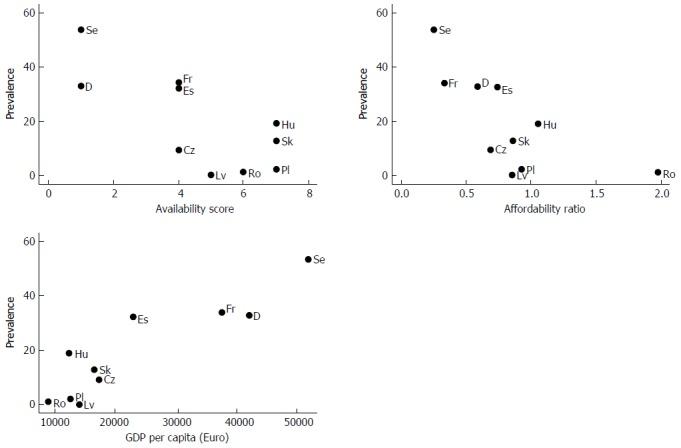
At the time of the survey, infliximab and adalimumab were reimbursed in all ten countries, and vedolizumab was reimbursed in five countries (France, Germany, Latvia, Slovakia, Sweden). Reimbursement criteria were the least strict in Sweden and Germany, and the strictest in Hungary, Poland and Slovakia. Between countries, the annual cost of different biological treatments differed 1.6-3.3-fold. Treatments were the most affordable in Sweden (13%-37% of the GDP per capita) and the least affordable in the Central and Eastern European countries, especially in Hungary (87%-124%) and Romania (141%-277%). Biosimilars made treatments more affordable by driving down the annual costs. The number of patients with CD on biologicals per 100000 population was strongly correlated with GDP per capita (0.91), although substantial differences were found in the uptake among countries with similar economic development. Correlation between the number of patients with CD on biologicals per 100000 population and the availability and affordability was also strong (-0.75, -0.69 respectively).
CONCLUSION
Substantial inequalities in access to biologicals were largely associated with GDP. To explain differences in access among countries with similar development needs further research on acceptance.
目的
分析 10 个欧洲国家中用于治疗克罗恩病(CD)的生物制剂的可及性(供应、可负担性和可接受性),并探讨这些维度与生物制剂的应用以及经济发展之间的关系。
方法
本项研究于 2016 年 5 月采用问卷调查与文献研究相结合的方式进行。邀请捷克共和国、法国、德国、匈牙利、拉脱维亚、波兰、罗马尼亚、斯洛伐克、西班牙和瑞典的胃肠病专家参与并提供生物制剂/生物类似药的供应情况、报销标准、临床实践和价格以及生物制剂使用情况方面的数据。同时开发了一个供应评分系统,以评估各国的资格和行政标准的限制程度。可负担性定义为治疗的年度费用占人均国内生产总值(GDP)的比例。计算了与生物制剂的应用、可及性维度和人均 GDP 之间的相关性。
结果
在调查时,所有 10 个国家均报销英夫利昔单抗和阿达木单抗,5 个国家(法国、德国、拉脱维亚、斯洛伐克、瑞典)报销维得利珠单抗。瑞典和德国的报销标准最宽松,匈牙利、波兰和斯洛伐克最严格。各国之间,不同生物制剂治疗的年度费用相差 1.6-3.3 倍。瑞典的治疗最具可负担性(占人均 GDP 的 13%-37%),而中欧和东欧国家的治疗最不可负担,尤其是匈牙利(87%-124%)和罗马尼亚(141%-277%)。生物类似药通过降低年度费用使治疗更具可负担性。每 10 万人口中接受 CD 生物制剂治疗的患者数量与人均 GDP 呈强相关(0.91),尽管在经济发展水平相似的国家中发现了生物制剂应用的显著差异。每 10 万人口中接受 CD 生物制剂治疗的患者数量与供应和可负担性之间也存在很强的相关性(-0.75、-0.69)。
结论
生物制剂可及性的巨大差异在很大程度上与 GDP 相关。要解释具有相似发展需求的国家之间的可及性差异,需要进一步研究接受度。
 Zotero 插件