
与自身免疫性疾病相关的基因变异的特定背景效应。
Context-specific effects of genetic variants associated with autoimmune disease.
作者信息
Jonkers Iris H, Wijmenga Cisca
机构信息
Department of Genetics, University Medical Centre Groningen, University of Groningen, 9700 RB Groningen, The Netherlands.
Department of Immunology, K.G. Jebsen Coeliac Disease Research Centre, University of Oslo, 0424 Oslo, Norway.
出版信息
Hum Mol Genet. 2017 Oct 1;26(R2):R185-R192. doi: 10.1093/hmg/ddx254.
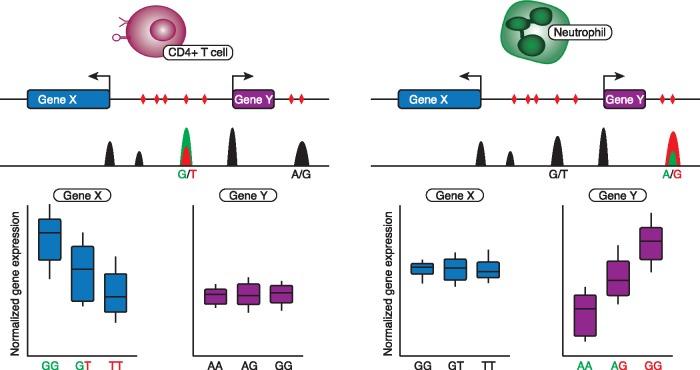
Autoimmune diseases such as rheumatoid arthritis and coeliac disease are typical examples of complex genetic diseases caused by a combination of genetic and non-genetic risk factors. Insight into the genetic risk factors (single nucleotide polymorphisms (SNPs)) has increased since genome-wide association studies (GWAS) became possible in 2007 and, for individual diseases, SNPs can now explain some 15-50% of genetic risk. GWAS have also shown that some 50% of the genetic risk factors for individual autoimmune diseases overlap between different diseases. Thus, shared risk factors may converge to pathways that, when perturbed by genetic variation, predispose to autoimmunity in general. This raises the question of what determines disease specificity, and suggests that identical risk factors may have different effects in various autoimmune diseases. Addressing this question requires translation of genetic risk factors to causal genes and then to molecular and cellular pathways. Since >90% of the genetic risk factors are found in the non-coding part of the genome (i.e. outside the exons of protein-coding genes) and can have an impact on gene regulation, there is an urgent need to better understand the non-coding part of the genome. Here, we will outline the methods being used to unravel the gene regulatory networks perturbed in autoimmune diseases and the importance of doing this in the relevant cell types. We will highlight findings in coeliac disease, which manifests in the small intestine, to demonstrate how cell type and disease context can impact on the consequences of genetic risk factors.
类风湿性关节炎和乳糜泻等自身免疫性疾病是由遗传和非遗传风险因素共同导致的复杂遗传疾病的典型例子。自2007年全基因组关联研究(GWAS)成为可能以来,对遗传风险因素(单核苷酸多态性,即SNPs)的认识有所增加,对于个别疾病而言,SNPs现在可以解释约15%-50%的遗传风险。GWAS还表明,个别自身免疫性疾病约50%的遗传风险因素在不同疾病之间存在重叠。因此,共同的风险因素可能汇聚到一些通路,当这些通路因遗传变异而受到干扰时,通常会使人易患自身免疫性疾病。这就提出了一个问题,即是什么决定了疾病的特异性,并表明相同的风险因素在各种自身免疫性疾病中可能产生不同的影响。要解决这个问题,需要将遗传风险因素转化为致病基因,然后再转化为分子和细胞通路。由于超过90%的遗传风险因素存在于基因组的非编码部分(即蛋白质编码基因外显子之外),并且可能对基因调控产生影响,因此迫切需要更好地了解基因组的非编码部分。在这里,我们将概述用于揭示在自身免疫性疾病中受到干扰的基因调控网络的方法,以及在相关细胞类型中进行此项工作的重要性。我们将重点介绍在小肠中表现出症状的乳糜泻的研究结果,以说明细胞类型和疾病背景如何影响遗传风险因素的后果。


 Zotero 插件