
恶性疟原虫EPCR结合型PfEMP1的表达随疟疾疾病严重程度增加而升高,且在无视网膜病变的脑型疟疾中升高。
Plasmodium falciparum EPCR-binding PfEMP1 expression increases with malaria disease severity and is elevated in retinopathy negative cerebral malaria.
作者信息
Shabani Estela, Hanisch Benjamin, Opoka Robert O, Lavstsen Thomas, John Chandy C
机构信息
Ryan White Center for Pediatric Infectious Diseases and Global Health, Indiana University, 1044 W Walnut St R4 402D, Indianapolis, Indiana, USA.
Department of Pediatrics, Division of Global Pediatrics, University of Minnesota, Minneapolis, Minnesota, USA.
出版信息
BMC Med. 2017 Oct 13;15(1):183. doi: 10.1186/s12916-017-0945-y.
BACKGROUND
Expression of group A and the A-like subset of group B Plasmodium falciparum erythrocyte membrane protein 1 (PfEMP1) is associated with severe malaria (SM). The diversity of var sequences combined with the challenges of distinct classification of patient pathologies has made studying the role of distinct PfEMP1 variants on malaria disease severity challenging. The application of retinopathy in the recent years has provided a further method to clinically evaluate children with cerebral malaria (CM). The question of whether children with clinical CM but no retinopathy represent a completely different disease process or a subgroup within the spectrum of CM remains an important question in malaria. In the current study, we use newly designed primer sets with the best coverage to date in a large cohort of children with SM to determine the role of var genes in malaria disease severity and especially CM as discriminated by retinopathy.
METHODS
We performed qRT-PCR targeting the different subsets of these var genes on samples from Ugandan children with CM (n = 98, of whom 50 had malarial retinopathy [RP] and 47 did not [RN]), severe malarial anemia (SMA, n = 47), and asymptomatic parasitemia (AP, n = 14). The primers used in this study were designed based on var sequences from 226 Illumina whole genome sequenced P. falciparum field isolates.
RESULTS
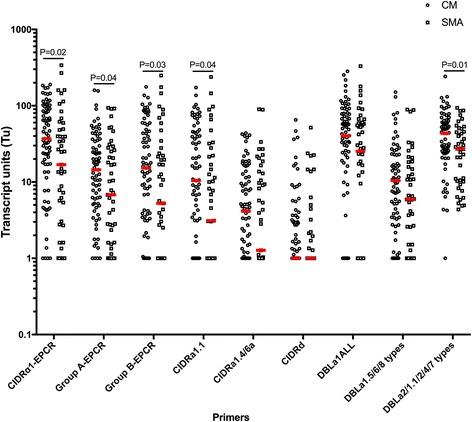
Increasing severity of illness was associated with increasing levels of endothelial protein C receptor (EPCR)-binding PfEMP1. EPCR-binding PfEMP1 transcript levels were highest in children with combined CM and SMA and then decreased by level of disease severity: RP CM > RN CM > SMA > AP.
CONCLUSIONS
The study findings indicate that PfEMP1 binding to EPCR is important in the pathogenesis of SM, including RN CM, and suggest that increased expression of EPCR-binding PfEMP1 is associated with progressively more severe disease. Agents that block EPCR-binding of PfEMP1 could provide novel interventions to prevent or decrease disease severity in malaria.
背景
A组以及B组恶性疟原虫红细胞膜蛋白1(PfEMP1)中的A样亚群的表达与重症疟疾(SM)相关。var基因序列的多样性,再加上对患者病理进行明确分类存在挑战,使得研究不同PfEMP1变体对疟疾疾病严重程度的作用具有挑战性。近年来视网膜病变的应用为临床评估脑型疟疾(CM)患儿提供了另一种方法。临床诊断为CM但无视网膜病变的儿童代表着一种完全不同的疾病过程,还是CM范围内的一个亚组,这一问题在疟疾研究中仍然很重要。在本研究中,我们使用了新设计的引物组,该引物组在迄今为止覆盖范围最佳,我们对一大群患SM的儿童进行研究,以确定var基因在疟疾疾病严重程度,尤其是通过视网膜病变区分的CM中的作用。
方法
我们对乌干达CM患儿(n = 98,其中50例有疟疾视网膜病变[RP],47例没有[RN])、严重疟疾贫血(SMA,n = 47)和无症状寄生虫血症(AP,n = 14)的样本,针对这些var基因的不同亚组进行了定量逆转录聚合酶链反应(qRT-PCR)。本研究中使用的引物是根据226株经Illumina全基因组测序恶性疟原虫野外分离株的var序列设计的。
结果
疾病严重程度增加与内皮蛋白C受体(EPCR)结合型PfEMP1水平升高相关。EPCR结合型PfEMP1转录水平在合并CM和SMA的儿童中最高,然后随疾病严重程度降低:RP CM>RN CM>SMA>AP。
结论
研究结果表明,PfEMP1与EPCR的结合在包括RN CM在内的SM发病机制中很重要,并表明EPCR结合型PfEMP1表达增加与疾病逐渐加重有关。阻断PfEMP1与EPCR结合的药物可为预防或降低疟疾疾病严重程度提供新的干预措施。



 Zotero 插件