
大流行性流感出现风险的季节性。
Seasonality in risk of pandemic influenza emergence.
作者信息
Fox Spencer J, Miller Joel C, Meyers Lauren Ancel
机构信息
Integrative Biology, The University of Texas at Austin, Austin, Texas, United States of America.
Mathematical Sciences, Monash University, Frankston, Victoria, Australia.
出版信息
PLoS Comput Biol. 2017 Oct 19;13(10):e1005749. doi: 10.1371/journal.pcbi.1005749. eCollection 2017 Oct.
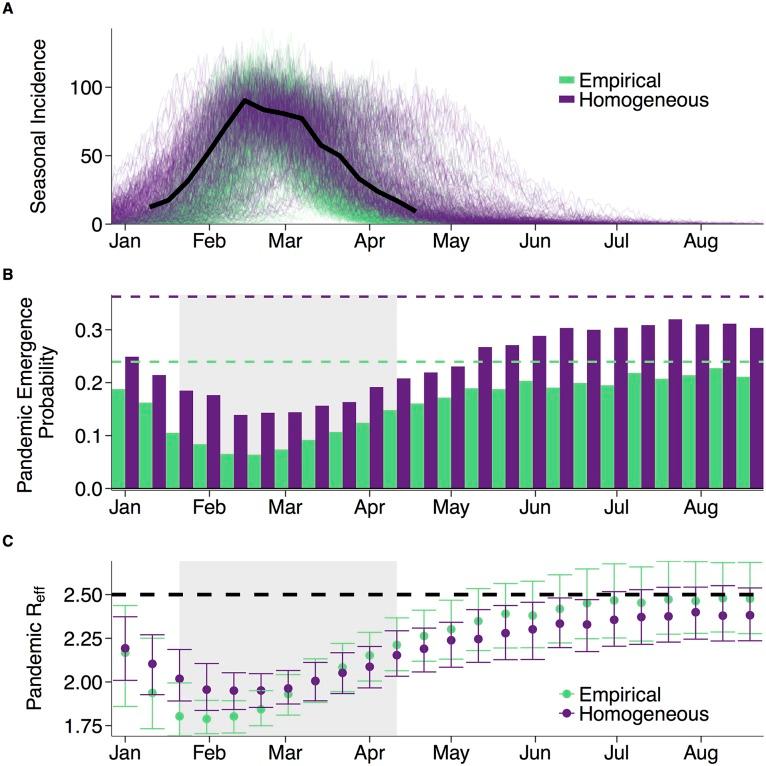
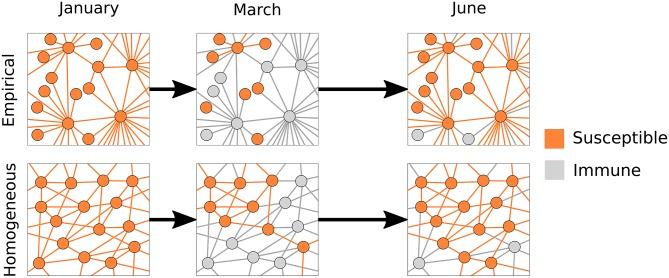
Influenza pandemics can emerge unexpectedly and wreak global devastation. However, each of the six pandemics since 1889 emerged in the Northern Hemisphere just after the flu season, suggesting that pandemic timing may be predictable. Using a stochastic model fit to seasonal flu surveillance data from the United States, we find that seasonal flu leaves a transient wake of heterosubtypic immunity that impedes the emergence of novel flu viruses. This refractory period provides a simple explanation for not only the spring-summer timing of historical pandemics, but also early increases in pandemic severity and multiple waves of transmission. Thus, pandemic risk may be seasonal and predictable, with the accuracy of pre-pandemic and real-time risk assessments hinging on reliable seasonal influenza surveillance and precise estimates of the breadth and duration of heterosubtypic immunity.
流感大流行可能会意外出现并造成全球破坏。然而,自1889年以来的六次大流行均在北半球流感季节刚结束后出现,这表明大流行的时间可能是可预测的。通过一个拟合美国季节性流感监测数据的随机模型,我们发现季节性流感会留下异亚型免疫的短暂痕迹,从而阻碍新型流感病毒的出现。这一不应期不仅为历史上大流行发生在春夏季的时间规律提供了一个简单解释,也解释了大流行严重程度早期上升以及多波传播的现象。因此,大流行风险可能具有季节性且可预测,大流行前和实时风险评估的准确性取决于可靠的季节性流感监测以及对异亚型免疫广度和持续时间的精确估计。



 Zotero 插件